Fiji’s mentally ill
p. 32 · Read in the full issue
Reports by Bernadette Hussein
These people roam Fiji’s streets.
They talk to themselves and some times beg. These are people with psychiatric disorders who have either run away from home or have been abandoned by their families. Those who manage it to the country’s only psychiatric hospital stand some chance of receiving medica tion and treatment. But while St Giles Hospital in Suva officially has facilities to care for 190 patients, the hospital is rarely full. To have patients committed and taken off the streets is a lengthy process involv ing much red tape.
“There is a long legal process which we have to go through if we want to help these people,” says Dr Isaac Karim of St Giles. Two doctors have to examine the person and certify that he/she is suffering from a mental illness, then we have to have the authority from the next of kin, the person has to be taken before the court and the magistrate has to give the authori ty to put them in.”
The other problem, however, is that although the hospital’s capacity is 190 patients, St Giles lacks the resources to run it effectively, says Dr Karim.
“Government does give us some money but it is just not enough,” he says.
“When you talk about people living on the streets, these are mainly patients who
suffer from schizophrenia [personality
disorder],” he said. “Schizophrenia itself is a type of illness which causes major dis abilities and studies have shown that an average of one per cent of any country’s population suffers from it.
"They became chronic sufferers and after a period of time they become perma nent residents of the mental hospital.”
People on the streets were victims of schizophrenia, drug abuse or were mental ly retarded. Dr Karim said most of the people on streets were there because they often viewed people wanting to help them as a threat to their freedom - so they run away from home and the only other place for them to go is the streets.
“We know through studies that if a per son abuses marijuana over a long period of time, they develop a disorder like what
Where do they go?
one sees in the ‘negative’ type of schizophrenia. It is called the amotivation al syndrome.
“We are recognising more and more the positive and negative effects'of this ill ness. The negative effects are no motiva tion so they just start drifting and very often they end up on the streets.
“The patients showing more positive symptoms sometimes become violent and aggressive. These are the people who often come into conflict with the law and they are picked up and brought to us.
“Those with the negative symptoms don’t create problems and they don’t harm anybody.” Such patients need lifetime medication, Dr Karim said.
“But there are some patients who do not respond to medication and it is very hard to control them.”
On the other hand, there were some patients who improved without medica tion. Dr Karim said it was still not known what caused schizophrenia. “It maybe genetic, [a result of] early experiences, later-on stresses of life or disappointments all grouped together.” Dr Karim believes mental patients should be placed in hos tels. "They should be given the freedom to move around and mingle and mix with patients and staff alike.” ■
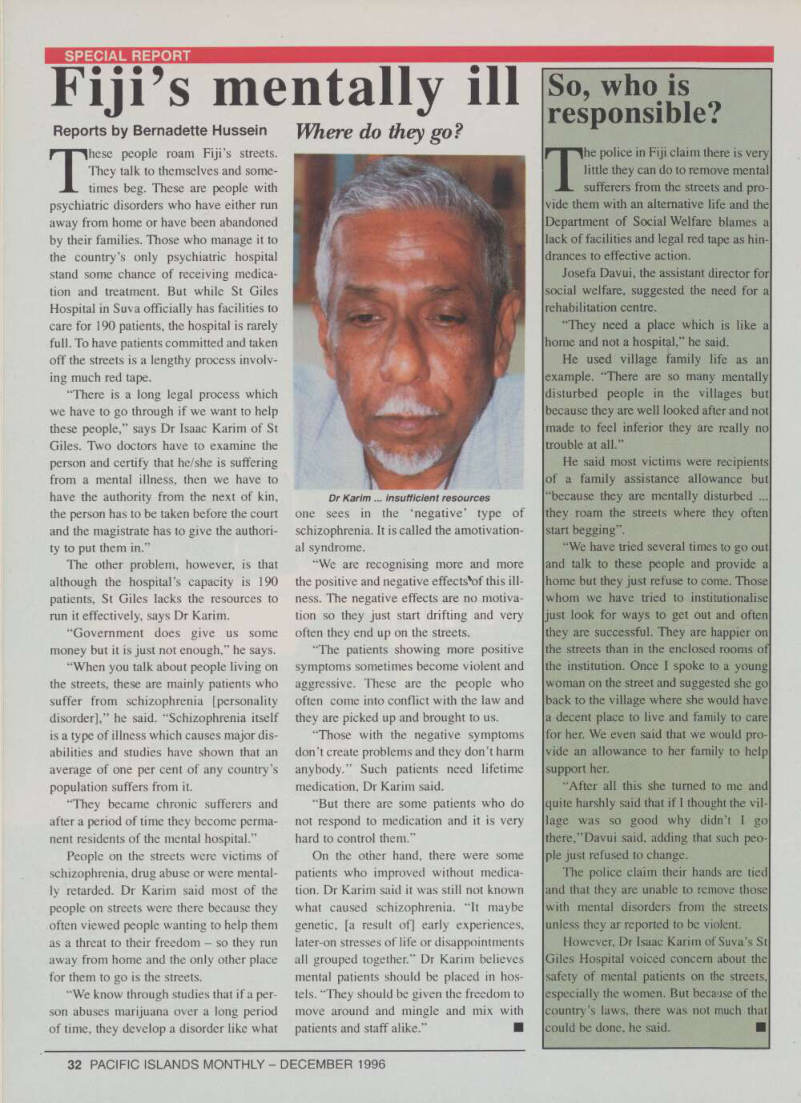
Dr Karim ... insufficient resources