With mad abandon
pp. 27-29 · Read in the full issue
Special Report
In Western Samoa, apart from a few people, everyone seems to content to either ignore the country’s 600 registered psychiatric patients or have them removed from public view
By Chris Peteru
They dress in rags, smell bad and beg in public. Many God-fearing Western Samoans see them as little more than a nuisance.
Aside from the few people fighting for better care and treatment for the country’s 600 registered psychiatric patients, every one from the government down seems content to ignore them.
“It’s (care of the mentally ill) not a very high priority at the moment in terms of budget and allocation of resources,” admits Health Minister Misa Telefoni Retzlaff.
Even within their own families they are treated as outcasts, often left to fend for themselves, say health workers.
The growing number of mentally ill walking the streets of the capital, Apia, is
no accident, despite complaints by the
Western Samoa Visitors Bureau to have them removed from public view. Rather, it follows a Health Department policy from 1986 that adopts the Home Care system of rehabilitation practised in New Zealand and Australia.
The idea is that following hospital treatment for the acute phase of their ill ness, which normally lasts about a week, patients not considered a danger to the public return to their families for contin ued care.
They are allowed to move within the community as part of the ongoing rehabil itation process.
Staff from the National Hospital’s Mental Health Unit provide a backup ser vice, administering medication and pro viding counselling for patients and their families during visits.
Following the implentation of the HC policy during the 1980 s, the psychiatric ward was pulled down. Plans to build a
security unit for violent cases have often been discussed but little has been done about it.
“When we had the ward running, there was a lot of copycat behaviour between those that were mentally ill and those with mental problems,” says nurse consultant with the Mental Health Unit lokapeta Enoka. The entire unit consists of Enoka and two assistants who are on call 24 hours. The hospital has no psychiatric doctor.
“The end result was patients went a bit crazy and began to threaten and intimidate staff. There had to be another way which is why the psychiatric ward was taken down and the HC system introduced.”
Police Commissioner Galuvao Tanielu says since the hospital has no security
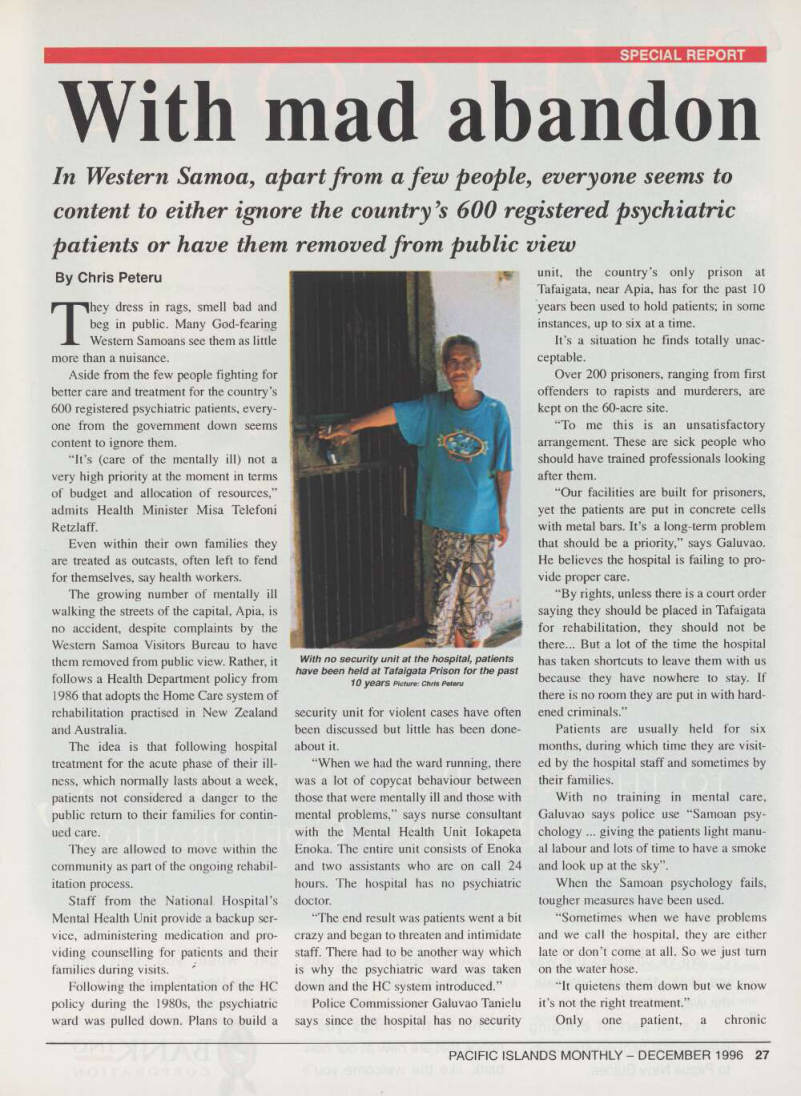
unit, the country’s only prison at Tafaigata, near Apia, has for the past 10 years been used to hold patients; in some instances, up to six at a time.
It’s a situation he finds totally unac
ceptable.
Over 200 prisoners, ranging from first offenders to rapists and murderers, are kept on the 60-acre site.
“To me this is an unsatisfactory arrangement. These are sick people who should have trained professionals looking after them.
“Our facilities are built for prisoners, yet the patients are put in concrete cells with metal bars. It’s a long-term problem that should be a priority,” says Galuvao.
He believes the hospital is failing to pro vide proper care.
“By rights, unless there is a court order saying they should be placed in Tafaigata for rehabilitation, they should not be there... But a lot of the time the hospital has taken shortcuts to leave them with us because they have nowhere to stay. If there is no room they are put in with hard ened criminals.”
Patients are usually held for six months, during which time they are visit ed by the hospital staff and sometimes by their families.
With no training in mental care, Galuvao says police use “Samoan psy chology ... giving the patients light manu al labour and lots of time to have a smoke and look up at the sky”.
When the Samoan psychology fails, tougher measures have been used.
“Sometimes when we have problems and we call the hospital, they are either late or don’t come at all. So we just turn on the water hose.
“It quietens them down but we know it’s not the right treatment.”
Only one patient, a chronic
With no security unit at the hospital, patients have been held at Tafaigata Prison for the past 10 years Picture: Chris Peteru
schizophrenic, is currently being held at
the prison. His family is keen for him to remain there indefinitely, say the police.
The commissioner agrees it is not unusual now for a Samoan family to imprison one of their own, and could be an indication that the Homecare system has shortcomings.
Usually those brought to Tafaigata are
given a six-month spell. Upon release they often find their families have reject ed them.
“Some families are too proud ... some denounce their own kin and chase them out. So they end up around town. Even though they are loving people there is a limit because they are ashamed.
“I think the remedy is for the govern ment to build a proper institute for these
patients.
“There is a lot of mental and physical abuse going on because people don’t want them around.”
Nurse consultant Enoka says patients who end up on the street fall into two main categories, substance abusers and stress psychosis cases.
“You don’t see many schizophrenics or manic depressives anymore. But the substance abusers, those on marijuana and magic mushrooms, are very dopey in the head.
“Still, they are only a threat if people perceive them as such.”
An earlier incident where a nun was stabbed to death by a manic depressive has stigmatised the mentally ill in the
public eye.
But MHU workers say that, aside from their unkept appearance, they pose little threat to anyone.
“If you talked to them you would find they are sane.
“People think that because they smash bottles on the pavement or yell in the street they are idiots,” says trainee nurse Aliilelei Matautia.
However, a facility for violent offend ers should have been built last year, says Enoka.
The medical superintendent of the National Hospital, Dr Frank Smith, con curs.
He described how in 1994 a building was constructed for violent cases but when hospital staff checked the building,
there was no padded cell.
“It was okay, but the security room was not okay.
“There was a mix up somewhere along the line (with the design). A manic depressive could have torn the place down in no time.”
Although Dr Smith supports the con cept of Home Care, he says the govern ment should be prepared to support those patients whose families are unwilling or unable to take on the responsibility.
“The controversy of allowing mental ly ill people on the street arose when we decided to follow what New Zealand is
doing.
But you know how people react to psychiatric illness - no one knows the answer, even people in New Zealand are
complaining about releasing psychiatric
patients into the community.
“We believe the family must take care of their own, but there is evidence that people are not caring for their own. What must we do?”
He saw the bigger picture as a move away from the role of the hospital as an institution for the mentally ill to putting the emphasis on community-based care.
A hostel where nursing staff could admin ister medication and provide assistance was one alternative combining profes sional care while providing patients with the environment to become self-depen dent again.
This kind of facility takes on more importance, given there are families with out the means to look after relatives with mental disorders.
In Malta, an island of similar size but twice Western Samoa’s 160,000 popula tion, patients are taken into family care for a month or so and then taken back to the institution, which functions along the lines of a hostel.
Patients are rarely seen in public but there is participation by both the commu nity and the government.
“We can take care of the medical side.
It’s the social side we have no control over. And this is a community problem.”
But why in a country that prides itself on the strength of the family unit and Christian love is there neglect for those of their own clan?
“The teaching of the Old Testament
doesn’t help - teaching that if you are bad something will happen to you. I think the church should be more compassionate and change their stance.
“ I think the teaching of Jesus is more important. You can’t change attitudes
overnight.
“The changing of attitudes takes sev eral centuries, but my feeling is they will change.
“The state has to do something. It has given money to the elderly, and should give financial assistance to these people in whatever form.”
About WS$2.5 million (SUSI.O2 mil lion) a year for monthly pensions for those over 65 years old is earmarked by the government for that purpose.
Enoka says financial pressure now plays an increasing role as a symptom of mental illness among Samoans. She pointed out that failure to contribute to the commitments of the extended family frequently left a trail of violence and despair among families, particularly those forced to live beyond their means to maintain those obligations.
Health Minister Misa says some kind of welfare support is needed.
“I think we should look very seriously at a welfare function. But what is happen ing at the moment in the hospital is very clear - they don’t have the budget or the facilities to provide welfare services.”
Staff shortage for psychiatric nurses remains a huge problem.
With 12 years’ experience behind her, Enoka says the shortage stems from a lack of interest amongst people to work in the field.
That places enormous stress on the three staff members whose numbers have not increased since 1986, the same time the Home Care system was introduced.
The HC system has been a success, says Enoka, with a steady stream of for mer patients making full recoveries.
“Many people we have looked after have gone back to work. We’ve had teachers, people in high office, gone back to their normal jobs.
“A lot of other people who were locked up here are now married and have raised families or returned to the land. But we have to work in partnership the com munity.” ■