Govt punishes private media
pp. 24-25 · Read in the full issue
Media
Departments ordered to advertise only in state-oumed paper
By Chris Peteru
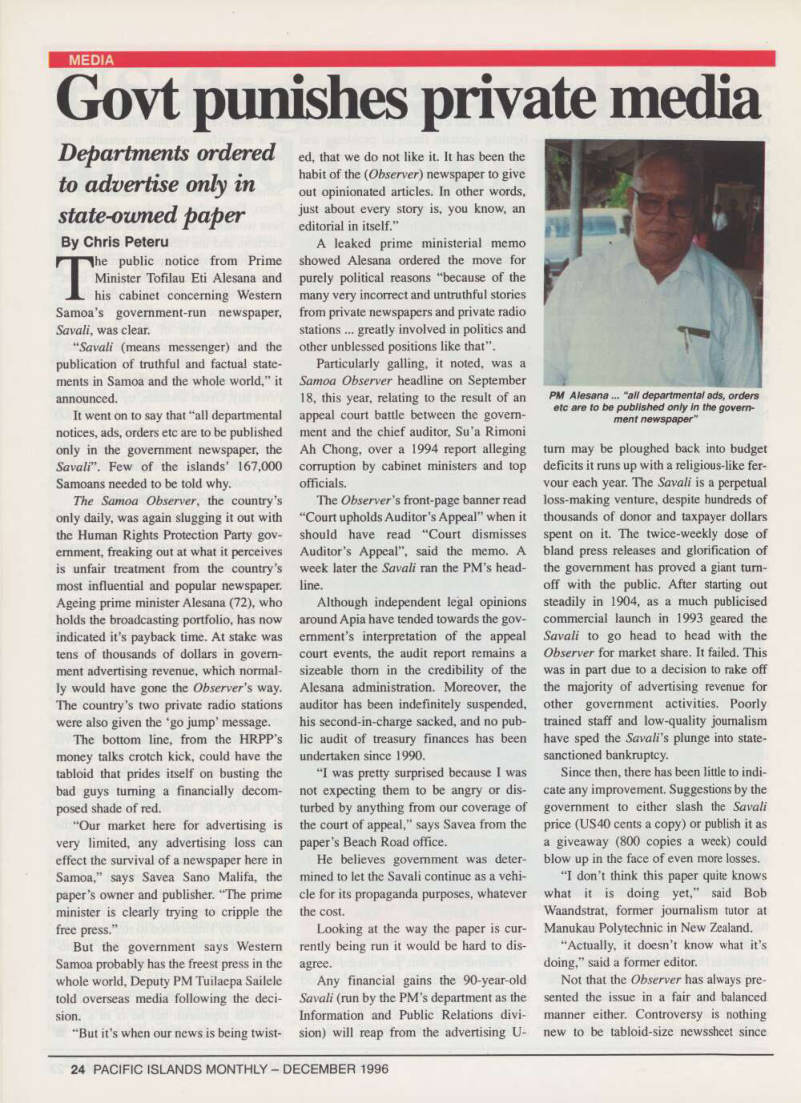
The public notice from Prime Minister Tofilau Eti Alesana and his cabinet concerning Western Samoa’s govemment-run newspaper, Savali, was clear.
“Savali (means messenger) and the publication of truthful and factual state ments in Samoa and the whole world,” it announced.
It went on to say that “all departmental notices, ads, orders etc are to be published only in the government newspaper, the Savali”. Few of the islands’ 167,000 Samoans needed to be told why.
The Samoa Observer, the country’s only daily, was again slugging it out with the Human Rights Protection Party gov ernment, freaking out at what it perceives is unfair treatment from the country’s most influential and popular newspaper.
Ageing prime minister Alesana (72), who holds the broadcasting portfolio, has now indicated it’s payback time. At stake was tens of thousands of dollars in govern ment advertising revenue, which normal ly would have gone the Observer’s way.
The country’s two private radio stations were also given the ‘go jump’ message.
The bottom line, from the HRPP’s money talks crotch kick, could have the tabloid that prides itself on busting the bad guys turning a financially decom posed shade of red.
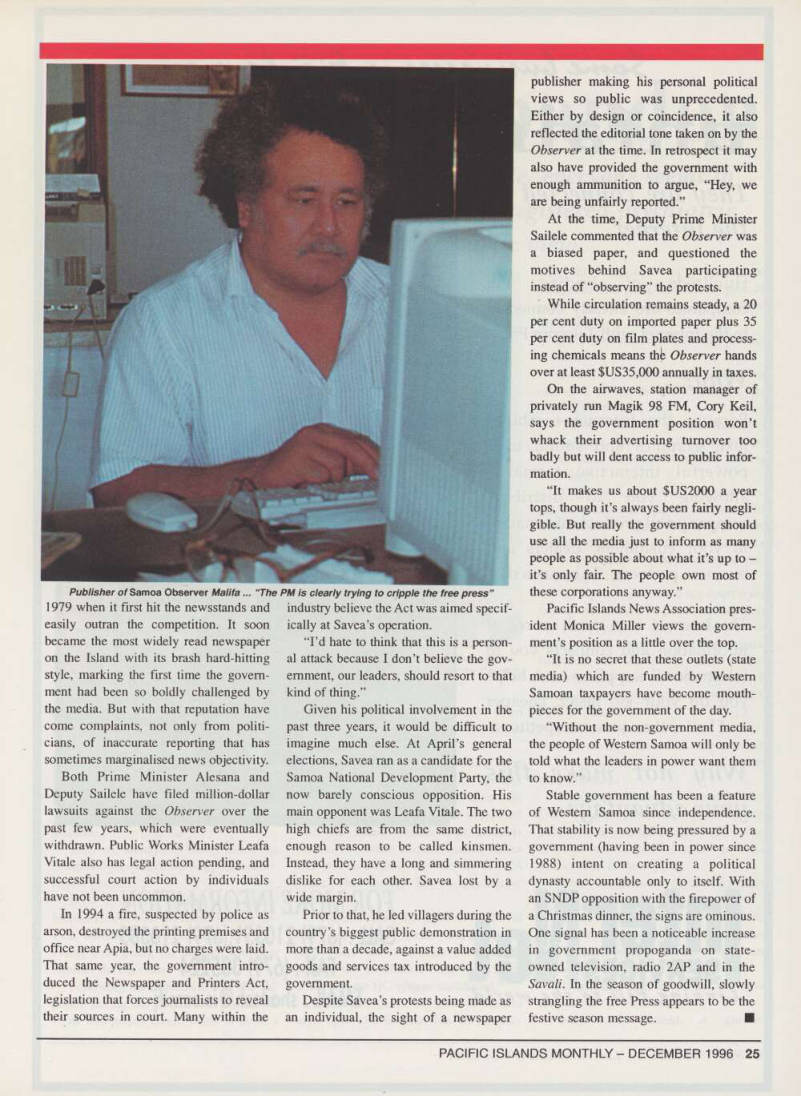
“Our market here for advertising is very limited, any advertising loss can effect the survival of a newspaper here in Samoa,” says Savea Sano Malifa, the paper’s owner and publisher. “The prime minister is clearly trying to cripple the free press.”
But the government says Western Samoa probably has the freest press in the whole world, Deputy PM Tuilaepa Sailele told overseas media following the deci sion.
“But it’s when our news is being twist
ed, that we do not like it. It has been the habit of the ( Observer ) newspaper to give out opinionated articles. In other words, just about every story is, you know, an editorial in itself.”
A leaked prime ministerial memo showed Alesana ordered the move for purely political reasons “because of the many very incorrect and untruthful stories from private newspapers and private radio stations ... greatly involved in politics and other unblessed positions like that”.
Particularly galling, it noted, was a Samoa Observer headline on September 18, this year, relating to the result of an appeal court battle between the govern ment and the chief auditor, Su’a Rimoni Ah Chong, over a 1994 report alleging corruption by cabinet ministers and top officials.
The Observer's front-page banner read “Court upholds Auditor’s Appeal” when it should have read “Court dismisses Auditor’s Appeal”, said the memo. A week later the Savali ran the PM’s head line.
Although independent legal opinions around Apia have tended towards the gov ernment’s interpretation of the appeal court events, the audit report remains a sizeable thorn in the credibility of the Alesana administration. Moreover, the auditor has been indefinitely suspended, his second-in-charge sacked, and no pub lic audit of treasury finances has been undertaken since 1990.
“I was pretty surprised because I was not expecting them to be angry or dis turbed by anything from our coverage of the court of appeal,” says Savea from the paper’s Beach Road office.
He believes government was deter mined to let the Savali continue as a vehi cle for its propaganda purposes, whatever the cost.
Looking at the way the paper is cur rently being run it would be hard to dis agree.
Any financial gains the 90-year-old Savali (run by the PM’s department as the Information and Public Relations divi sion) will reap from the advertising U-
turn may be ploughed back into budget deficits it runs up with a religious-like fer vour each year. The Savali is a perpetual loss-making venture, despite hundreds of thousands of donor and taxpayer dollars spent on it. The twice-weekly dose of bland press releases and glorification of the government has proved a giant turn off with the public. After starting out steadily in 1904, as a much publicised commercial launch in 1993 geared the Savali to go head to head with the Observer for market share. It failed. This was in part due to a decision to rake off the majority of advertising revenue for other government activities. Poorly trained staff and low-quality journalism have sped the Savali’ s plunge into state
sanctioned bankruptcy.
Since then, there has been little to indi
cate any improvement. Suggestions by the
government to either slash the Savali price (US4O cents a copy) or publish it as a giveaway (800 copies a week) could blow up in the face of even more losses.
“I don’t think this paper quite knows what it is doing yet,” said Bob Waandstrat, former journalism tutor at Manukau Polytechnic in New Zealand.
“Actually, it doesn’t know what it’s doing,” said a former editor.
Not that the Observer has always pre sented the issue in a fair and balanced manner either. Controversy is nothing new to be tabloid-size newssheet since
PM Alesana... "all departmental ads, orders etc are to be published only in the govern ment newspaper”
1979 when it first hit the newsstands and easily outran the competition. It soon became the most widely read newspaper on the Island with its brash hard-hitting style, marking the first time the govern ment had been so boldly challenged by the media. But with that reputation have come complaints, not only from politi cians, of inaccurate reporting that has
sometimes marginalised news objectivity.
Both Prime Minister Alesana and Deputy Sailele have filed million-dollar lawsuits against the Observer over the past few years, which were eventually withdrawn. Public Works Minister Leafa Vitale also has legal action pending, and successful court action by individuals have not been uncommon.
In 1994 a fire, suspected by police as arson, destroyed the printing premises and office near Apia, but no charges were laid.
That same year, the government intro duced the Newspaper and Printers Act, legislation that forces journalists to reveal their sources in court. Many within the
industry believe the Act was aimed specif
ically at Savea’s operation.
“I’d hate to think that this is a person al attack because I don’t believe the gov ernment, our leaders, should resort to that kind of thing.”
Given his political involvement in the past three years, it would be difficult to imagine much else. At April’s general elections, Savea ran as a candidate for the Samoa National Development Party, the now barely conscious opposition. His main opponent was Leafa Vitale. The two high chiefs are from the same district, enough reason to be called kinsmen.
Instead, they have a long and simmering dislike for each other. Savea lost by a
wide margin.
Prior to that, he led villagers during the
country’s biggest public demonstration in
more than a decade, against a value added goods and services tax introduced by the government.
Despite Savea’s protests being made as an individual, the sight of a newspaper
publisher making his personal political
views so public was unprecedented.
Either by design or coincidence, it also reflected the editorial tone taken on by the Observer at the time. In retrospect it may also have provided the government with enough ammunition to argue, “Hey, we
are being unfairly reported.”
At the time, Deputy Prime Minister Sailele commented that the Observer was a biased paper, and questioned the motives behind Savea participating instead of “observing” the protests.
While circulation remains steady, a 20 per cent duty on imported paper plus 35 per cent duty on film plates and process ing chemicals means the Observer hands over at least $U535,000 annually in taxes.
On the airwaves, station manager of privately run Magik 98 FM, Cory Keil, says the government position won’t whack their advertising turnover too badly but will dent access to public infor mation.
“It makes us about SUS2OOO a year tops, though it’s always been fairly negli gible. But really the government should use all the media just to inform as many people as possible about what it’s up to it’s only fair. The people own most of
these corporations anyway.”
Pacific Islands News Association pres ident Monica Miller views the govern ment’s position as a little over the top.
“It is no secret that these outlets (state media) which are funded by Western Samoan taxpayers have become mouth pieces for the government of the day.
“Without the non-govemment media, the people of Western Samoa will only be told what the leaders in power want them to know.”
Stable government has been a feature of Western Samoa since independence.
That stability is now being pressured by a government (having been in power since 1988) intent on creating a political dynasty accountable only to itself. With an SNDP opposition with the firepower of a Christmas dinner, the signs are ominous.
One signal has been a noticeable increase in government propoganda on state owned television, radio 2AP and in the Savali. In the season of goodwill, slowly strangling the free Press appears to be the festive season message. ■
Publisher of Samoa Observer Malifa ... “The PM is clearly trying to cripple the free press”