US flag Islands kick
pp. 22-23 · Read in the full issue
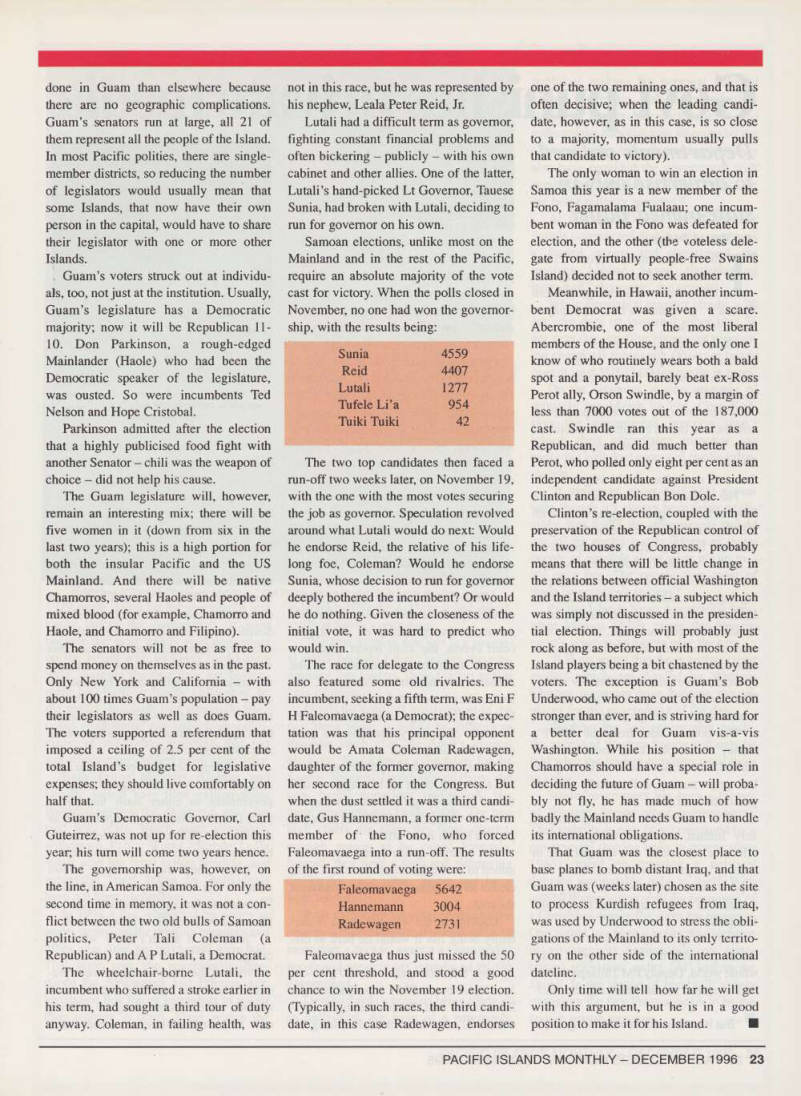
around incumbents
By David North
In the Mainland November elections, US voters were nice to incumbents, re-electing Democratic President Bill Clinton and leaving the Republicans in charge of Congress.
In the Pacific Islands, the voters kicked around the incumbents, with a sin gle exception. For instance: • Guam’s voters evicted the speaker of the Senate and several senior members; • more fundamentally, they reduced the size of the Guam legislature from 21 to 15, and gave it a budget ceil ing; • in American Samoa the incum bent governor came in a bad third when he sought re-election, and the incumbent congressman will have to endure a runoff before his (expected) return to
Washington;
• similarly, Samoan voters rejected 10 of the 18 members of the Fono
seeking re-election;
• further, in Hawaii, though re elected to another term in the House, Democrat Neil Abercrombie only squeaked through while his less flamboy
ant congressional colleague, Patsy Mink,
also a Democrat, was re-elected by a more than two-to-one margin.
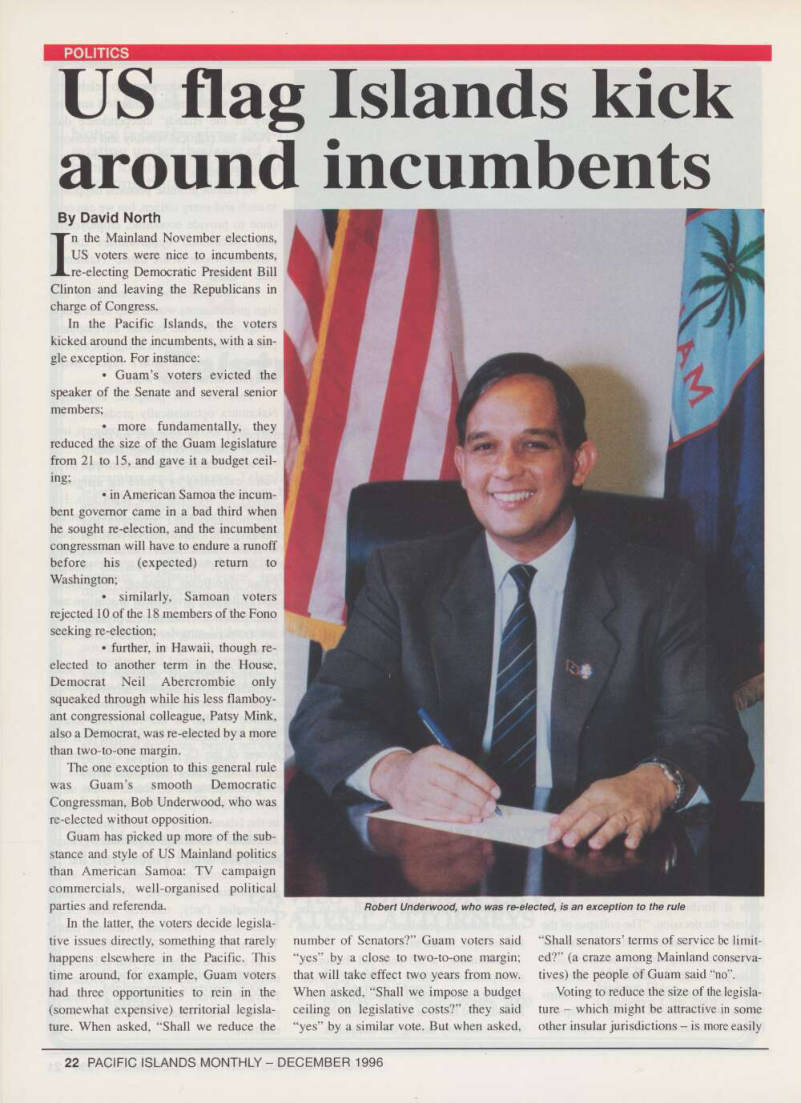
The one exception to this general rule was Guam’s smooth Democratic Congressman, Bob Underwood, who was re-elected without opposition.
Guam has picked up more of the sub stance and style of US Mainland politics than American Samoa: TV campaign
commercials, well-organised political
parties and referenda.
In the latter, the voters decide legisla tive issues directly, something that rarely happens elsewhere in the Pacific. This time around, for example, Guam voters had three opportunities to rein in the (somewhat expensive) territorial legisla ture. When asked, “Shall we reduce the
number of Senators?” Guam voters said “yes” by a close to two-to-one margin; that will take effect two years from now.
When asked, “Shall we impose a budget ceiling on legislative costs?” they said “yes” by a similar vote. But when asked,
“Shall senators’ terms of service be limit ed?” (a craze among Mainland conserva tives) the people of Guam said “no”.
Voting to reduce the size of the legisla ture - which might be attractive in some other insular jurisdictions - is more easily
Robert Underwood, who was re-elected, is an exception to the rule
done in Guam than elsewhere because there are no geographic complications.
Guam’s senators run at large, all 21 of them represent all the people of the Island.
In most Pacific polities, there are single member districts, so reducing the number of legislators would usually mean that some Islands, that now have their own person in the capital, would have to share their legislator with one or more other Islands. , Guam’s voters struck out at individu als, too, not just at the institution. Usually, Guam’s legislature has a Democratic majority; now it will be Republican li lt). Don Parkinson, a rough-edged Mainlander (Haole) who had been the Democratic speaker of the legislature, was ousted. So were incumbents Ted Nelson and Hope Cristobal.
Parkinson admitted after the election that a highly publicised food fight with another Senator - chili was the weapon of choice - did not help his cause.
The Guam legislature will, however, remain an interesting mix; there will be five women in it (down from six in the last two years); this is a high portion for both the insular Pacific and the US Mainland. And there will be native Chamorros, several Haoles and people of mixed blood (for example, Chamorro and Haole, and Chamorro and Filipino).
The senators will not be as free to spend money on themselves as in the past.
Only New York and California - with about 100 times Guam’s population - pay their legislators as well as does Guam.
The voters supported a referendum that imposed a ceiling of 2.5 per cent of the total Island’s budget for legislative expenses; they should live comfortably on half that.
Guam’s Democratic Governor, Carl Guteirrez, was not up for re-election this year; his turn will come two years hence.
The governorship was, however, on the line, in American Samoa. For only the second time in memory, it was not a con flict between the two old bulls of Samoan politics, Peter Tali Coleman (a Republican) and A P Lutali, a Democrat.
The wheelchair-borne Lutali, the incumbent who suffered a stroke earlier in his term, had sought a third tour of duty anyway. Coleman, in failing health, was
not in this race, but he was represented by his nephew, Leala Peter Reid, Jr.
Lutali had a difficult term as governor, fighting constant financial problems and often bickering - publicly - with his own cabinet and other allies. One of the latter, Lutali’s hand-picked Lt Governor, Tauese Sunia, had broken with Lutali, deciding to run for governor on his own.
Samoan elections, unlike most on the Mainland and in the rest of the Pacific, require an absolute majority of the vote cast for victory. When the polls closed in November, no one had won the governor ship, with the results being:
Sunia 4559 Reid 4407 Lutali 1277 Tufele Li’a 954 Tuiki Tuiki 42
The two top candidates then faced a run-off two weeks later, on November 19, with the one with the most votes securing the job as governor. Speculation revolved around what Lutali would do next: Would he endorse Reid, the relative of his life long foe, Coleman? Would he endorse Sunia, whose decision to run for governor deeply bothered the incumbent? Or would he do nothing. Given the closeness of the initial vote, it was hard to predict who would win.
The race for delegate to the Congress also featured some old rivalries. The incumbent, seeking a fifth term, was Eni F H Faleomavaega (a Democrat); the expec tation was that his principal opponent would be Amata Coleman Radewagen, daughter of the former governor, making her second race for the Congress. But when the dust settled it was a third candi date, Gus Hannemann, a former one-term member of the Fono, who forced Faleomavaega into a run-off. The results of the first round of voting were:
Faleomavaega 5642 Hannemann 3004 Radewagen 2731
Faleomavaega thus just missed the 50 per cent threshold, and stood a good chance to win the November 19 election. (Typically, in such races, the third candi date, in this case Radewagen, endorses
one of the two remaining ones, and that is often decisive; when the leading candi date, however, as in this case, is so close
to a majority, momentum usually pulls
that candidate to victory).
The only woman to win an election in Samoa this year is a new member of the Fono, Fagamalama Fualaau; one incum bent woman in the Fono was defeated for election, and the other (the voteless dele gate from virtually people-free Swains Island) decided not to seek another term.
Meanwhile, in Hawaii, another incum bent Democrat was given a scare.
Abercrombie, one of the most liberal members of the House, and the only one I know of who routinely >vears both a bald spot and a ponytail, barely beat ex-Ross Perot ally, Orson Swindle, by a margin of less than 7000 votes out of the 187,000 cast. Swindle ran this year as a Republican, and did much better than Perot, who polled only eight per cent as an
independent candidate against President
Clinton and Republican Bon Dole.
Clinton’s re-election, coupled with the preservation of the Republican control of the two houses of Congress, probably means that there will be little change in the relations between official Washington and the Island territories - a subject which was simply not discussed in the presiden
tial election. Things will probably just
rock along as before, but with most of the Island players being a bit chastened by the voters. The exception is Guam’s Bob Underwood, who came out of the election stronger than ever, and is striving hard for a better deal for Guam vis-a-vis Washington. While his position - that Chamorros should have a special role in deciding the future of Guam - will proba bly not fly, he has made much of how badly the Mainland needs Guam to handle its international obligations.
That Guam was the closest place to base planes to bomb distant Iraq, and that Guam was (weeks later) chosen as the site to process Kurdish refugees from Iraq, was used by Underwood to stress the obli gations of the Mainland to its only territo ry on the other side of the international dateline.
Only time will tell how far he will get with this argument, but he is in a good position to make it for his Island. ■