collapses... with bridge
pp. 19-21 · Read in the full issue
Politics
Palau’s Presidential race collapses... with bridge
By David North
Palau’s presidential race
was shaping up as a tight, two-way contest between the well-financed incumbent, Kuniwo Nakamura, and a strong chal
lenger, Johnson Toribiong, a
well-heeled attorney who had the support not only of his politically powerful uncle, Roman Tmetuchel, but also of the Islands’ ranking tradi tional leader, High Chief Ibedul Yutaka Gibbons.
In the September primary
race, Nakamura had garnered 4641 votes to Toribiong’s 2968 and Gibbons’ 1255.
Toribiong heads the largest opposition party in the Islands - The Palau Nationalist Party. On September 26, he and Gibbons signed a pact committing Gibbons to throw his support behind the challenger in the November general election.
On paper, at least, that put Toribiong only a few hundred votes behind Nakamura.
Later that same day, Toribiong was handed an Island-wide issue that could seriously undermine his opponent: Palau’s K-B bridge - the Islands’ major commer cial artery and key to its economic devel opment plans - collapsed, killing two and injuring several others.
Nakamura’s administration, which had recently completed SUS 3.2 million in repairs to the bridge, had touted the work as a major achievement. But news reports began to point strongly at the repair work as the cause of the collapse. Nakamura’s administration had signed off on a risky fusing of the structure’s independent can tilevers to correct a sag in the middle of the span. That may have changed the dynamics of the bridge and created pres-
sures it was not designed to han dle.
The 800-foot
reinforced concrete structure, which was dedicated in 1978 and cost SUSS million to build, lost all 450 feet of over-the-water span in the collapse. It had linked the bustling capital of Koror with Babeldaob, the largest (151 sq miles) and least devel
oped of Palau’s major islands. Major
water, power, and telephone utility lines from Babeldaob to Koro were lost in the disaster. Palau’s international airport, in southern Babeldaob, was cut off from the tourism and government sectors on Koror.
Nakamura was forced to declare a State of National Emergency and call for international help from the United States,
Japan, and other Asia-Pacific nations.
“That bridge was the backbone of our economy, the water, the power, the tele vision, the transportation all rolled into one,” Toribiong said. “When that thing snapped, it broke our backbone. It will take years for us to recover.”
When Nakamura was forced to cancel the October 1 celebration of the Islands’ second anniversary of its independence, Toribiong could not resist commenting.
“When there’s no water and the power is limited and you haven’t taken a bath, abstract concepts [such as indepen dence] become meaningless,” said
Toribiong.
“One becomes very primitive. People are hauling water and things like that.
We are in no mood to celebrate our sec ond year of independence.”
Toribiong latched on to the “faulty fix” issue, lashing out at Nakamura’s administra tion for “jeopardising” the Islands’ future, and calling for the resignation of the public works officials responsible for signing-off on the repair deal.
Toribiong told Palau’s electorate that if he had been in charge of the government that committed such an act, honour would dic tate that he resign.
Unfortunately for Toribiong,
that’s where the come-from-behind sce nario abruptly ended. A few weeks after his initial attack, it came to light that Toribiong’s running mate, Kione Isechal, who had been a Nakamura appointee before joining Toribiong’s campaign, was one of the top officials who had approved of the controversial repair project.
In an unprecedented move, Toribiong announced on October 7 that he was with drawing from the race. He said his deci sion was based mainly on the primary results “which speak loud and clear”.
“President Nakamura received the vote of confidence of the majority of our peo-
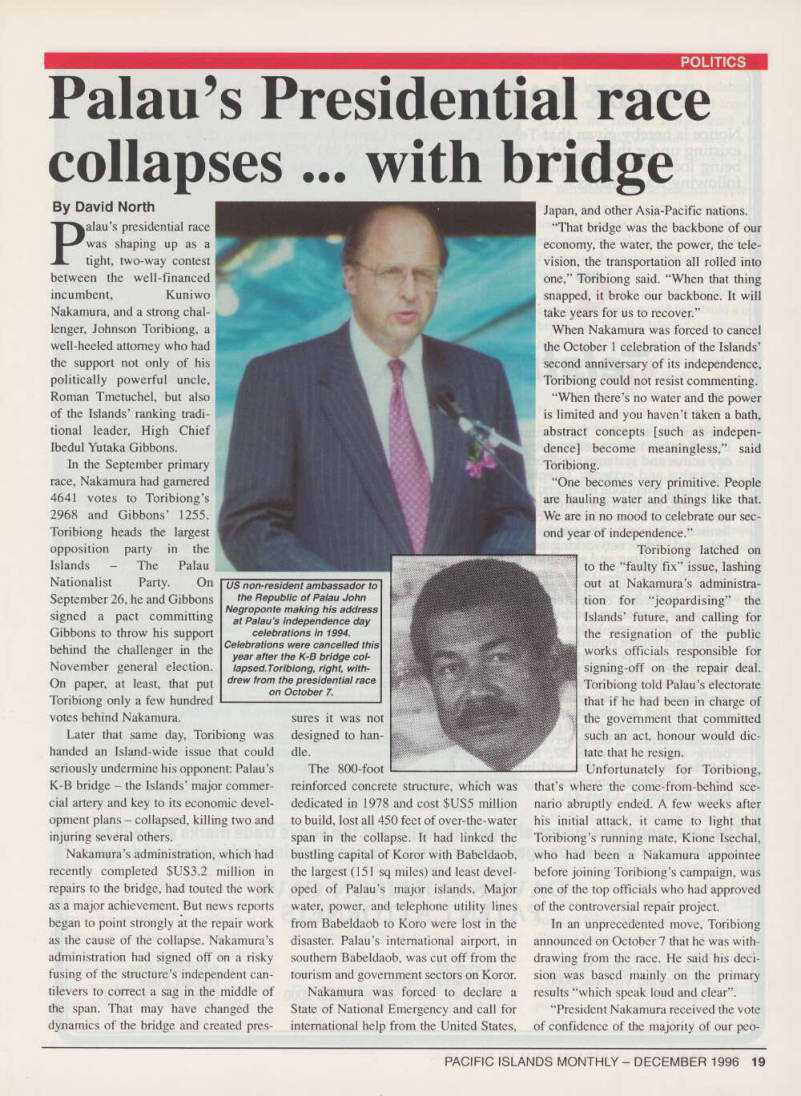
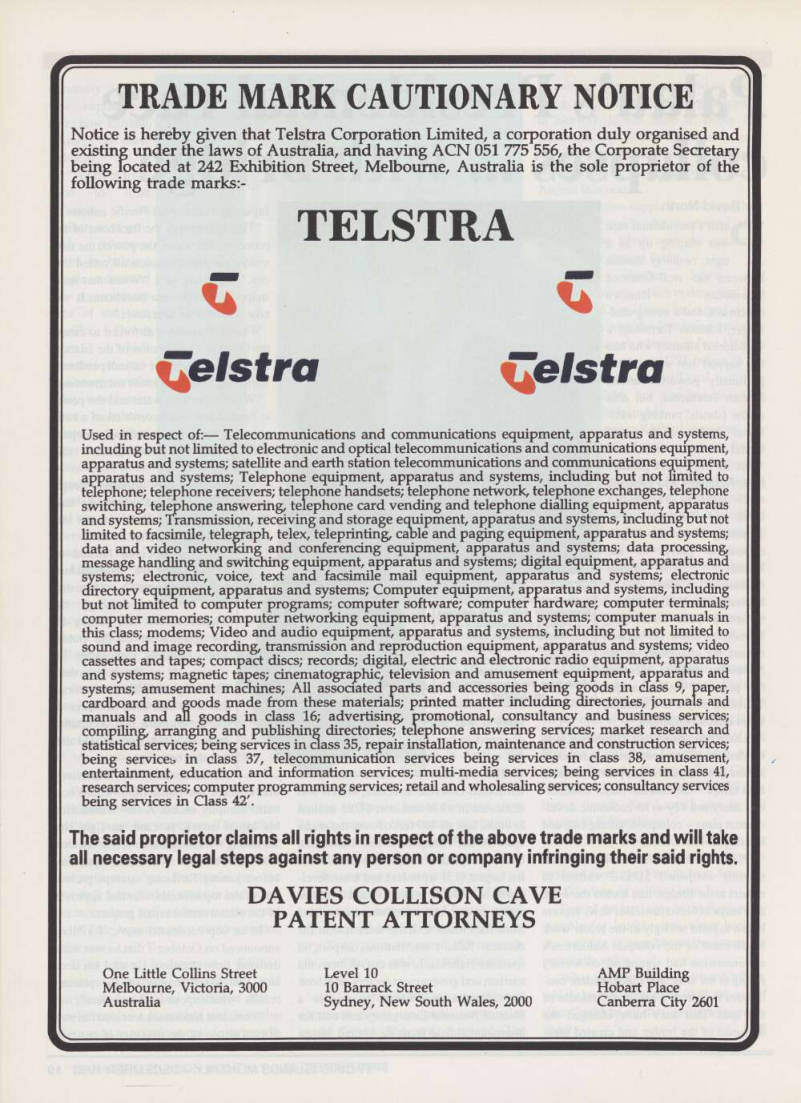
US non-resident ambassador to the Republic of Palau John Negroponte making his address at Palau’s independence day celebrations in 1994.
Celebrations were cancelled this year after the K-B bridge col lapsed.Toribiong, right, with drew from the presidential race on October 7.
pie... I must heed the voice of our people,” he said.
But the loss of the K B Bridge and
with it Toribiong’s aspirations clearly
underlie the decision. “The collapse of the bridge is a calamity that will test our resolve as a young nation,” he said in con cluding his announcement. “My decision is also warranted by the recent hardships to our people caused by the collapse...
President Nakamura and his administra
tion should ... devote undivided attention to the major task of restoring our utilities and replacing our primary link between Babeldaob and Koror as well as to the other national problems associated with the collapse of the bridge.”
Nakamura, a 53-year-old business man-politician whose family has wide ranging commercial interests in the Islands, did his best to put a positive spin on the calamity during the campaign.
“We have good reasons to celebrate,” he said on the largely unmarked anniver sary of the Islands’ independence day.
“Palau has political stability and econom ic potential that promises a bright future for all Palauans.
We cannot promise personal happiness
to each and every citizen, but we can con tinue to provide economic, employment, and educational opportunities for all Palauans whose desire them,” Nakamura said.
He told voters he was confident for eign governments would help build a new bridge and that the Islands’ development plans would be redrawn in light of the col lapse, but that he didn’t expect major delays in construction work.
“This will not postpone anything,”
Nakamura optimistically predicted. “We may also incorporate other projects into the construction of the new bridge.”
Nakamura won the election with 6123 votes, exceeding by a third the margin of victory he received four years ago. His initial victory was carried largely on his support of a free-association compact with the United States. He has adopted a “look north” strategy that has brought
Palau significant Japanese, Taiwanese,
and Philippine investment in tourism and EEZ fisheries. Nakamura is prohibited by law from running for a third consecutive term.
The compact has injected more than $250 million in US assistance into Palau’s economy over the past three years, $lBO million of that in the first year alone.
Palau will receive $5OO million over the course of the 15-year pact. The financial provisions of the compact end in 2008.
Gibbons, head of Koror - the most
developed and powerful village/port town
in the Islands and a perennial presidential candidate - remained in the race, gamer ing 3746 votes for second place. Isechal, the vice presidential candidate of the Palau Nationalist Party, received about 3228 votes, while Nakamura’s running mate, Thomas Remengesau Jr, had 5867.
In addition to the four-year chief exec utive slot, 16 members of the House of Delegates were chosen and 14 Senate positions were filled in the Islands-wide election. ■
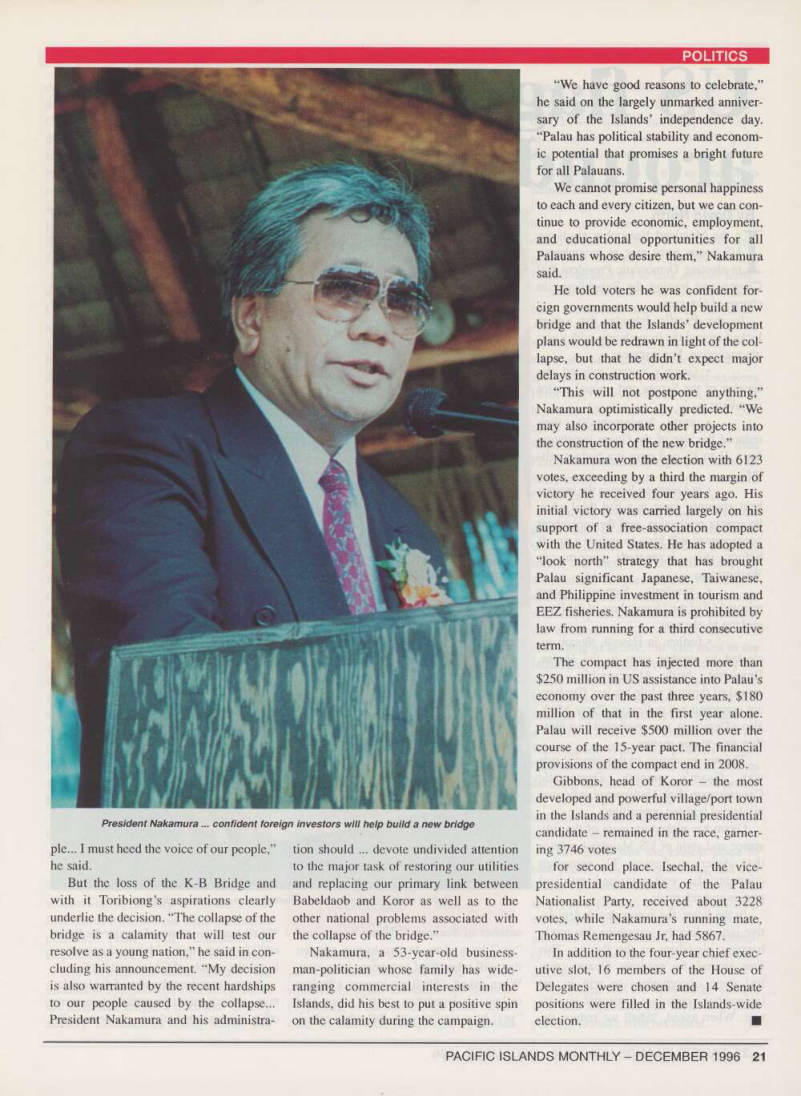
President Nakamura ... confident foreign investors will help build a new bridge