launch
pp. 17-18 · Read in the full issue
Technology
Rocket launch
Kiribati misses out on being launch site
By Michael Field
Kiribati’s long-held dream to be a site for rocket launching is taking shape in European shipyards but the central Pacific state will not get much out of it.
One of the world’s poorest states, Kiribati will find an American-led consor tium cutting right across its own proposal to get the Japanese National Space Agency to use Kiritimati or Christmas Island.
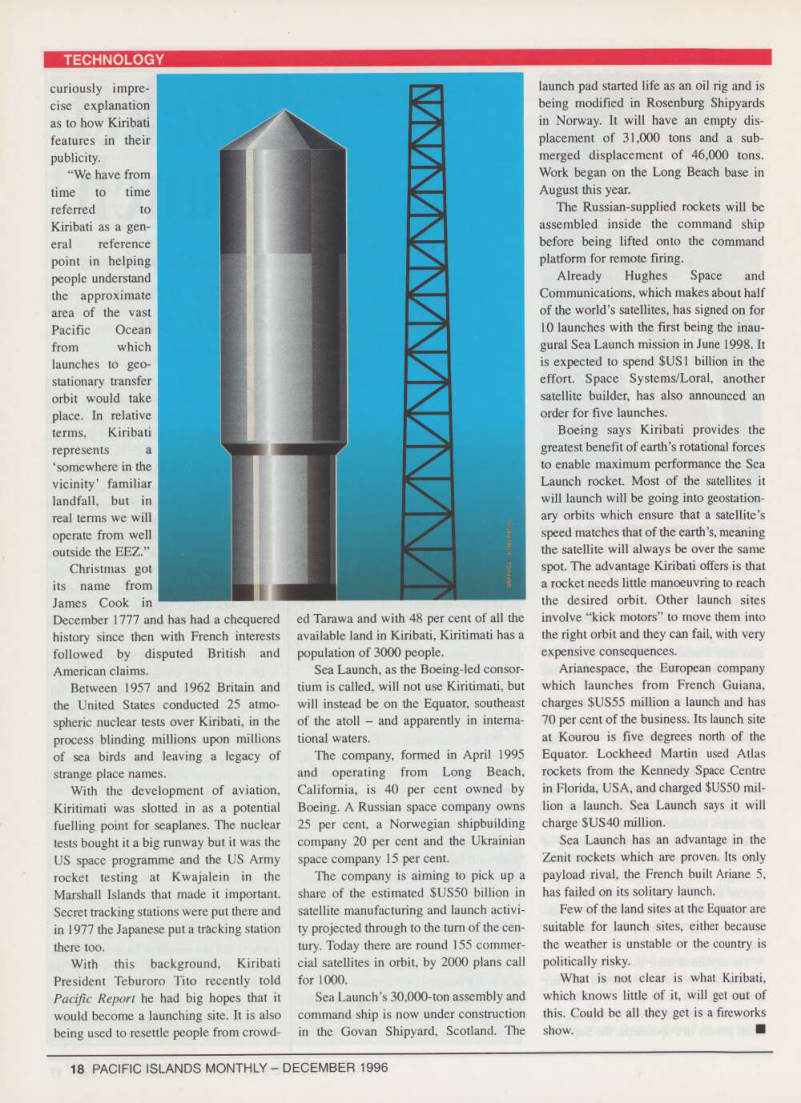
The new consortium, dominated by the giant aircraft company Boeing, will sail into international waters near Kiribati in June 1998 with a purpose-built ship and one of the world’s largest semi-semisable
rigs.
There, once the rig is cleared of people, a 60-metre long Ukrainian, Russian-built Zenit rocket fuelled by kerosene and liq uid oxygen, will blast off, placing up to 5000 kilograms of payload into geosta tionary orbit. Watching on, five kilometres away, will be a big purpose-built control ship - complete with pools and staterooms for invited guests.
What is curious is that billions of dol lars are going into the effort - Boeing alone has invested SUSSOO million - yet Kiribati has not been consulted and knows little about it.
Boeing Commercial Space Company
public relations manager Elliot Pulham told Pacific Islands Monthly that the con sortium did not intend to base any launch related activity within Kiribati or the Kiribati exclusive economic zone (EEZ).
“It has been - and remains - our intent to conduct launch operations from interna tional waters,” he said and then added a
curiously impre cise explanation as to how Kiribati features in their publicity.
“We have from time to time referred to Kiribati as a gen eral reference point in helping people understand the approximate area of the vast Pacific Ocean from which launches to geo stationary transfer orbit would take place. In relative terms, Kiribati represents a ‘somewhere in the vicinity’ familiar landfall, but in real terms we will operate from well outside the FEZ.”
Christmas got its name from James Cook in
December 1777 and has had a chequered history since then with French interests followed by disputed British and American claims.
Between 1957 and 1962 Britain and the United States conducted 25 atmo spheric nuclear tests over Kiribati, in the process blinding millions upon millions of sea birds and leaving a legacy of strange place names.
With the development of aviation, Kiritimati was slotted in as a potential
fuelling point for seaplanes. The nuclear
tests bought it a big runway but it was the US space programme and the US Army rocket testing at Kwajalein in the Marshall Islands that made it important.
Secret tracking stations were put there and in 1977 the Japanese put a tracking station there too.
With this background, Kiribati President Teburoro Tito recently told Pacific Report he had big hopes that it would become a launching site. It is also being used to resettle people from crowd-
ed Tarawa and with 48 per cent of all the available land in Kiribati, Kiritimati has a
population of 3000 people.
Sea Launch, as the Boeing-led consor tium is called, will not use Kiritimati, but will instead be on the Equator, southeast of the atoll - and apparently in interna tional waters.
The company, formed in April 1995 and operating from Long Beach, California, is 40 per cent owned by Boeing. A Russian space company owns 25 per cent, a Norwegian shipbuilding company 20 per cent and the Ukrainian space company 15 per cent.
The company is aiming to pick up a share of the estimated SUSSO billion in satellite manufacturing and launch activi ty projected through to the turn of the cen tury. Today there are round 155 commer cial satellites in orbit, by 2000 plans call for 1000.
Sea Launch’s 30,000-ton assembly and command ship is now under construction in the Govan Shipyard, Scotland. The
launch pad started life as an oil rig and is
being modified in Rosenburg Shipyards
in Norway. It will have an empty dis placement of 31,000 tons and a sub merged displacement of 46,000 tons.
Work began on the Long Beach base in August this year.
The Russian-supplied rockets will be assembled inside the command ship before being lifted onto the command
platform for remote firing.
Already Hughes Space and
Communications, which makes about half of the world’s satellites, has signed on for 10 launches with the first being the inau gural Sea Launch mission in June 1998. It is expected to spend SUSI billion in the
effort. Space Systems/Loral, another
satellite builder, has also announced an order for five launches.
Boeing says Kiribati provides the greatest benefit of earth’s rotational forces to enable maximum performance the Sea Launch rocket. Most of the satellites it will launch will be going into geostation ary orbits which ensure that a satellite’s speed matches that of the earth’s, meaning the satellite will always be over the same spot. The advantage Kiribati offers is that a rocket needs little manoeuvring to reach the desired orbit. Other launch sites involve “kick motors” to move them into the right orbit and they can fail, with very
expensive consequences.
Arianespace, the European company which launches from French Guiana, charges SUSSS million a launch and has 70 per cent of the business. Its launch site at Kourou is five degrees north of the Equator. Lockheed Martin used Atlas rockets from the Kennedy Space Centre in Florida, USA, and charged SUSSO mil lion a launch. Sea Launch says it will charge SUS4O million.
Sea Launch has an advantage in the Zenit rockets which are proven. Its only payload rival, the French built Ariane 5, has failed on its solitary launch.
Few of the land sites at the Equator are suitable for launch sites, either because the weather is unstable or the country is
politically risky.
What is not clear is what Kiribati, which knows little of it, will get out of this. Could be all they get is a fireworks show. ■