killers’
pp. 16-17 · Read in the full issue
' Kill the killers’
Leaders want blood
Calls for the enforcement of the contentious death penalty have been reignited in Papua New Guinea as a result of the country’s law and order problem.
Although the death penalty has been in place for years, it has been carried out only once.
In early 1995, Justice Theresa Doherty, sitting in Popondetta National Court, sentenced one Charles Ombusu to death after he was found guilty of rape and murder. However, the sentence was overridden by a Supreme Court ruling that Ombusu’s trial had not been conduct ed according to procedure.
Leading the debate. Deputy Prime Minister and Finance Minister Chris Haiveta said those guilty of premeditated murder and presenting a danger to society, even after a period of incarceration, ought to be put to death by the state.
“It’s good to have capital punishment for crimes that are heinous, that are really bad. The state must be given the authority to protect the welfare of the citizens from those who present a constant danger to them.” But he tempered his argument by adding that the death penalty should be the last option.
Corrective Services Minister Paul Wanjik was more unyielding in his call for the death penalty. “People who com mit murders such as the killing of a policeman’s wife, the Kutubu landowner and the four high school boys should be hanged,” he said. “They should be hanged because they are animals. Animals do not respect human lives.”
He said he could not agree with human rights advocates, church organisations or other politicians who opposed capital punishment. Cold-blooded murders were becoming more and more common and decision-makers could not sit by and do nothing while the laws of the country were no longer respected, he said.
The criminal code should be amended
to provide the death penalty for people convicted of armed robbery as well, the minister said.
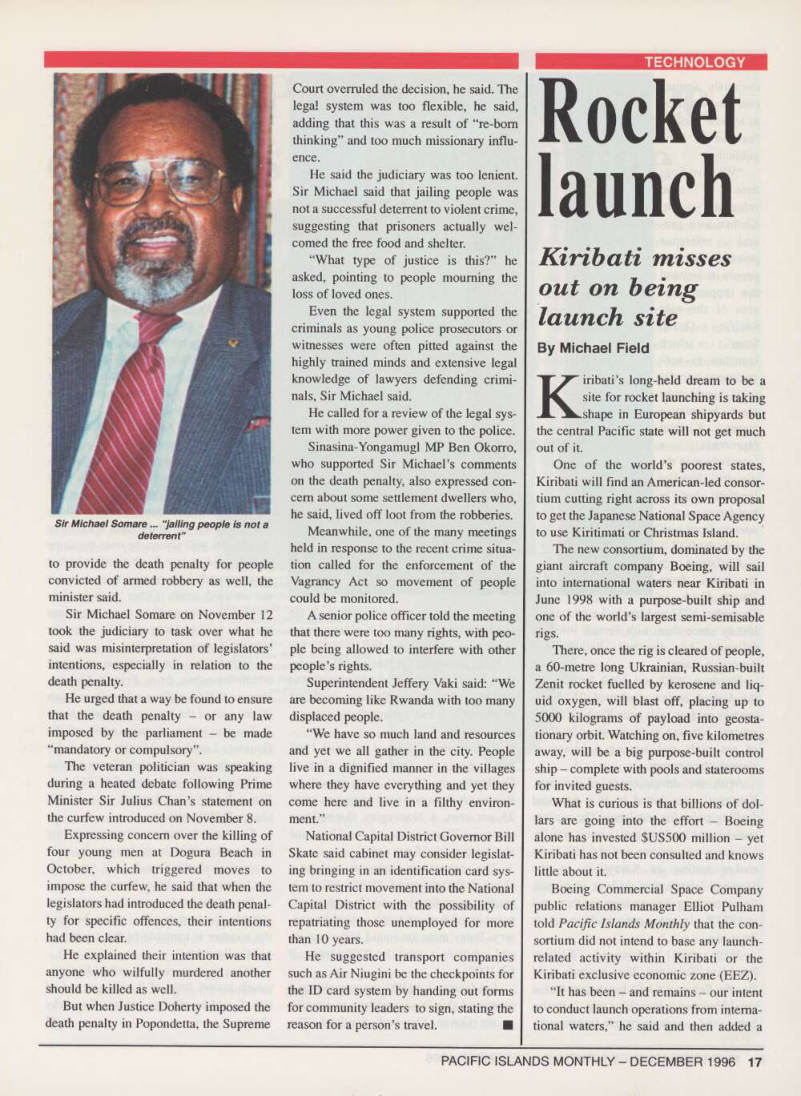
Sir Michael Somare on November 12 took the judiciary to task over what he said was misinterpretation of legislators’ intentions, especially in relation to the
death penalty.
He urged that a way be found to ensure that the death penalty - or any law imposed by the parliament - be made
“mandatory or compulsory”.
The veteran politician was speaking during a heated debate following Prime Minister Sir Julius Chan’s statement on the curfew introduced on November 8.
Expressing concern over the killing of four young men at Dogura Beach in October, which triggered moves to impose the curfew, he said that when the legislators had introduced the death penal ty for specific offences, their intentions had been clear.
He explained their intention was that anyone who wilfully murdered another should be killed as well.
But when Justice Doherty imposed the death penalty in Popondetta, the Supreme
Court overruled the decision, he said. The legal system was too flexible, he said, adding that this was a result of “re-bom thinking” and too much missionary influ ence.
He said the judiciary was too lenient.
Sir Michael said that jailing people was not a successful deterrent to violent crime,
suggesting that prisoners actually wel
comed the free food and shelter.
“What type of justice is this?” he
asked, pointing to people mourning the
loss of loved ones.
Even the legal system supported the criminals as young police prosecutors or witnesses were often pitted against the highly trained minds and extensive legal knowledge of lawyers defending crimi nals, Sir Michael said.
He called for a review of the legal sys tem with more power given to the police.
Sinasina-Yongamugl MP Ben Okorro, who supported Sir Michael’s comments on the death penalty, also expressed con cern about some settlement dwellers who, he said, lived off loot from the robberies.
Meanwhile, one of the many meetings held in response to the recent crime situa tion called for the enforcement of the Vagrancy Act so movement of people could be monitored.
A senior police officer told the meeting that there were too many rights, with peo ple being allowed to interfere with other
people’s rights.
Superintendent Jeffery Vaki said: “We are becoming like Rwanda with too many
displaced people.
“We have so much land and resources and yet we all gather in the city. People live in a dignified manner in the villages where they have everything and yet they come here and live in a filthy environ ment.”
National Capital District Governor Bill Skate said cabinet may consider legislat ing bringing in an identification card sys tem to restrict movement into the National Capital District with the possibility of repatriating those unemployed for more than 10 years.
He suggested transport companies such as Air Niugini be the checkpoints for the ID card system by handing out forms for community leaders to sign, stating the reason for a person’s travel. ■
Sir Michael Somare ... “jailing people is not a deterrent”