In time
pp. 55-56 · Read in the full issue
with tradition
By Liz Thompson
I first met Stephen Page six years ago when I was researching a book about contemporary Aboriginal artists, writ ers and performers. At the time he was with the Sydney Dance Company work ing with choreographer Graham Murphy.
He told me then that he was interested in traditional Aboriginal bodies: “They are completely different from the anatomy that we are so used to. The Aboriginals keep their heel on the ground for so long without even lifting it off while they squat on the ground.” Page began to work out a routine to develop this movement and found that many Aboriginal dancers were able to do it. He also encouraged exercis es in which dancers would spend a whole day in a parallel line concentrating. This, he said, inspired the sense of focus he sees in traditional dancers.
Page was interested in drawing influ ence from traditional Aboriginal dance
but never copying it. Ownership of tradi tional dance comes under strict laws of custodianship - performers like Page are not allowed to use movements which do not belong to them without the permission of these custodians - besides which Page was not seeking to imitate but to create something new, a fusion of traditional and contemporary, a dance which expressed his own reality, a dance form unique to Australia which drew on his own cultural roots but which also expressed his urban reality, his own existence. In this way, his vision of a kind of fusion was also to act as a bridge between black and white, a meeting, a step towards reconciliation.
Now, six years later, he has realised many of these dreams. In 1991 Page became artistic director of Bangarra, an Aboriginal dance company, the first pro fessional indigenous dance group in Australia and initially formed to showcase talent from Sydney’s National Aboriginal
and Torres Strait Islander Dance School.
Bangarra means “to make fire” in the Wirandjuri language of New South Wales.
The logo of Bangarra represents a flame, the headdress of a Torres Strait Islander warrior and the point of a spear used by Aboriginal and Torres. Strait Island hunters. Bangarra and its recent produc tion Ochres has hit the Australian dance scene by storm. Page is now acclaimed as an outstanding choreographer and per former.
In 1993, under his creative director ship, Bangarra was voted the joint winner of the prestigious Sidney Myer Performing Arts Award and Page was recipient of the 1993 Mo Award for Dance Performer of the Year. He also won Best Director at the 1995 Green Room Awards for his direction of Ochres. He recently received an inaugural Young Australian Creative Fellowship worth $U526,000 from then Prime Minister Paul Keating.
Most recently Page was appointed chore ographer and artistic director of the Olympic Flag Handover Ceremony for the 1996 Atlanta Games Closing Ceremony.
One of 12 children - six girls and six boys - Stephen is a descendant of the Mundaldjali clan of the Yugambeh tribe in south-east Queensland.
“We had a good upbringing,” he says.
“With a big family you’re really close and communication is a really important
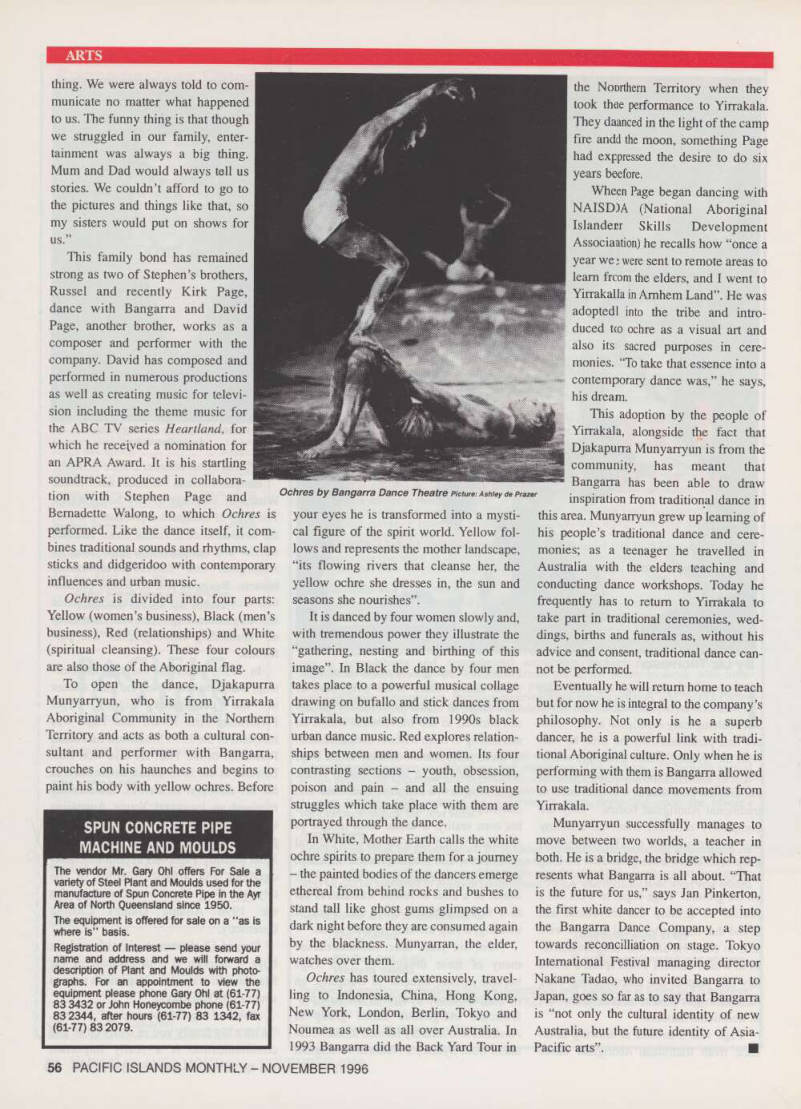
Stephen Page... a burning flame in Australian dance
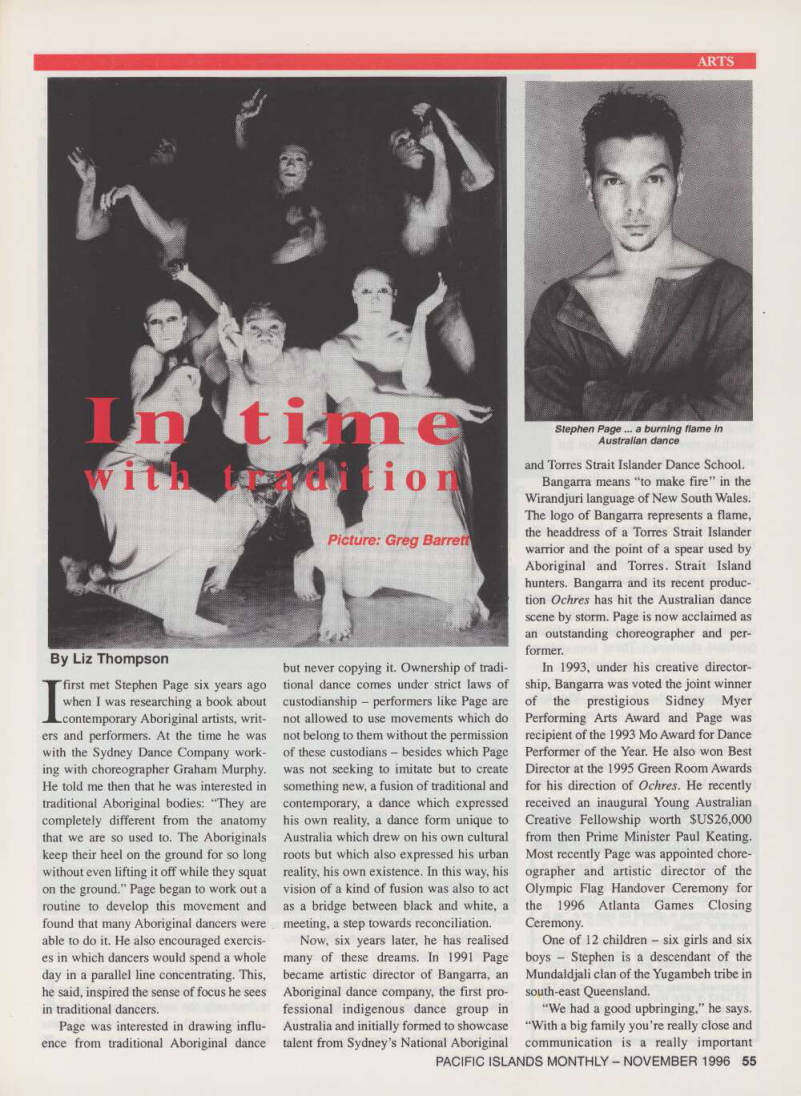
Picture: Greg Barre tt
thing. We were always told to com municate no matter what happened to us. The funny thing is that though we struggled in our family, enter tainment was always a big thing.
Mum and Dad would always tell us stories. We couldn’t afford to go to the pictures and things like that, so my sisters would put on shows for us.”
This family bond has remained strong as two of Stephen’s brothers, Russel and recently Kirk Page, dance with Bangarra and David Page, another brother, works as a composer and performer with the company. David has composed and
performed in numerous productions
as well as creating music for televi sion including the theme music for the ABC TV series Heartland, for which he received a nomination for an APRA Award. It is his startling soundtrack, produced in collabora tion with Stephen Page and
Bernadette Walong, to which Ochres is performed. Like the dance itself, it com bines traditional sounds and rhythms, clap sticks and didgeridoo with contemporary influences and urban music.
Ochres is divided into four parts: Yellow (women’s business). Black (men’s business). Red (relationships) and White (spiritual cleansing). These four colours are also those of the Aboriginal flag.
To open the dance, Djakapurra Munyarryun, who is from Yirrakala Aboriginal Community in the Northern Territory and acts as both a cultural con sultant and performer with Bangarra, crouches on his haunches and begins to paint his body with yellow ochres. Before
your eyes he is transformed into a mysti cal figure of the spirit world. Yellow fol lows and represents the mother landscape, “its flowing rivers that cleanse her, the yellow ochre she dresses in, the sun and seasons she nourishes”.
It is danced by four women slowly and, with tremendous power they illustrate the
“gathering, nesting and birthing of this
image”. In Black the dance by four men takes place to a powerful musical collage drawing on bufallo and stick dances from Yirrakala, but also from 1990 s black urban dance music. Red explores relation ships between men and women. Its four contrasting sections - youth, obsession, poison and pain - and all the ensuing struggles which take place with them are portrayed through the dance.
In White, Mother Earth calls the white ochre spirits to prepare them for a journey - the painted bodies of the dancers emerge ethereal from behind rocks and bushes to stand tall like ghost gums glimpsed on a dark night before they are consumed again by the blackness. Munyarran, the elder, watches over them.
Ochres has toured extensively, travel
ling to Indonesia, China, Hong Kong,
New York, London, Berlin, Tokyo and Noumea as well as all over Australia. In 1993 Bangarra did the Back Yard Tour in
the Noorthem Territory when they took thee performance to Yirrakala.
They daanced in the light of the camp fire andd the moon, something Page had exppressed the desire to do six years beefore.
Wheen Page began dancing with
NAISD)A (National Aboriginal Islandecr Skills Development Associaation) he recalls how “once a year we; were sent to remote areas to leant frcom the elders, and I went to Yirrakalla in Arnhem Land”. He was adopted 1 into the tribe and intro duced tco ochre as a visual art and also its sacred purposes in cere monies. “To take that essence into a contemporary dance was,” he says, his dream.
This adoption by the people of Yirrakala, alongside the fact that Djakapurra Munyarryun is from the community, has meant that Bangarra has been able to draw inspiration from traditional dance in
this area. Munyarryun grew up learning of his people’s traditional dance and cere monies; as a teenager he travelled in Australia with the elders teaching and
conducting dance workshops. Today he
frequently has to return to Yirrakala to take part in traditional ceremonies, wed dings, births and funerals as, without his advice and consent, traditional dance can not be performed.
Eventually he will return home to teach but for now he is integral to the company’s philosophy. Not only is he a superb dancer, he is a powerful link with tradi tional Aboriginal culture. Only when he is performing with them is Bangarra allowed to use traditional dance movements from Yirrakala.
Munyarryun successfully manages to
move between two worlds, a teacher in both. He is a bridge, the bridge which rep resents what Bangarra is all about. “That is the future for us,” says Jan Pinkerton, the first white dancer to be accepted into the Bangarra Dance Company, a step towards reconcilliation on stage. Tokyo International Festival managing director Nakane Tadao, who invited Bangarra to Japan, goes so far as to say that Bangarra is “not only the cultural identity of new Australia, but the future identity of Asia- Pacific arts”. ■
Ochres by Bangarra Dance Theatre Picture: Ashley de Prazer