From the sublime to the
pp. 51-53 · Read in the full issue
Arts
From the sublime to the absurd ... the Festival of Arts unveils its treasures
By Chris Peteru
It was a fitting fusion of cultures as Howard Morrison junior, the son of Maori entertainer Sir Howard Morrison, teamed with veteran Samoan entertainers the Yandall Sisters to close out the Seventh Pacific Festival of Arts.
Because, for 10 stunning days, 2000 musicians, dancers and artisans, from 21 neighbouring Islands stood as one and saturated crowds with a canvas of perfor mances that breathed life into the festi val’s theme of “Tala Measina ”, that is, unveiling of treasures.
The only sub par performance
was government efforts to turn a
celebration of identity into a plat
form of cultural misinformation
It was often uplifting, sometimes som bre but consistently full of Pacific pride and passion.
“I almost didn’t make it because I thought it was going to be just a dance
circus like that Mormon cultural centre in Hawaii,” said Palauan dancer Lina Tivo, “but this, this was from the heart.”
As participants and tourists hailed the event a success, despite niggly things like timetable clashes, the only sub par perfor mance came in the shape of several efforts by the government to turn a cele bration of identity into a platform for cul tural misinformation.
Rain drenched the opening of the fes tival and the wet welcome also had an effect on the water. Two ocean-going canoes from yesteryear voyaged from the Cook Islands and neighbouring American Samoa. Although T Au o Toga (Southern Mist) under the helm of former Cooks Prime Minister Sir Tom Davis made the five-day sailing easily, “it’s all about fol lowing the zenith star”, the Samoan ves sel, Folauga o Samoa (Navigators of Samoa) was plagued with problems from the start. As the 30-foot boat was being taken to its launching site, the low brow crane carrying her careered into the ocean
smashing the main outrigger, and left many saying the incident was a divine message about not launching a boat on a Sunday.
At sea, what should have been a bit of island hopping became an ordeal with huge waves almost enveloping the vessel.
Eventually, the Foulauga Samoa had to be towed the final stretch into Apia Harbour. “We were surfing out there,” a relieved co-skipper, Tau Hunkin, said fol lowing the 19-hour roller-coaster ride.
Back on land, delegates settled into their digs, many living at three converted high schools near Apia, or one of half-a dozen billeting villages. Hotels across the island were booked out.
After-hours partying packed out bars
and nightclubs, prompting plenty of
impromptu performances and late-night
revelry around town. The winner? The Tokelauans’ Maori haka on the back of a
bouncing pick-up truck going through
Apia’s main street. And the jubilant Papua New Guineans singing on the bus
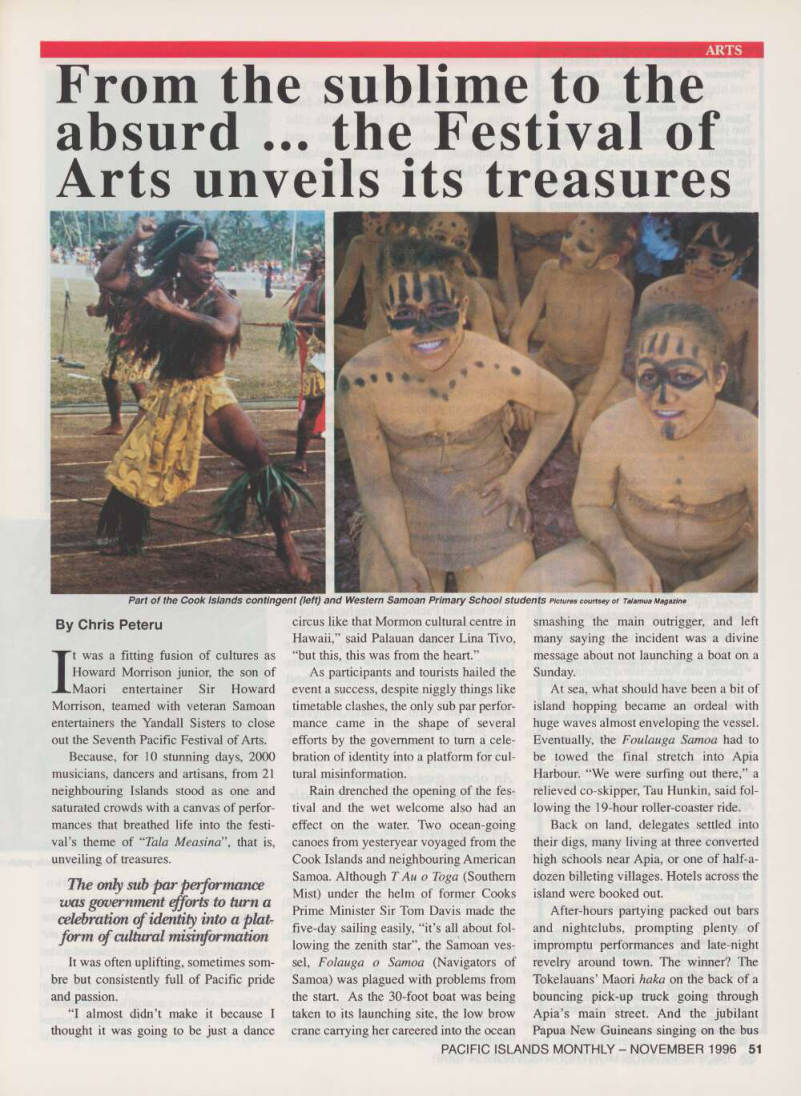
Part of the Cook Islands contingent (left) and Western Samoan Primary School students pictures counsey of Taiamua Magazine
home after giving another knockout per formance. It also put smiles on the busi ness community’s face, with the Department of Trade, Industry and Commerce estimating a welcome $U5204,000 boost in over-the-counter sales.
“Pacific cultures are not really
primitive people, they are very
together”
The festival village, a cluster of grass huts located behind the government square in the middle of town, was given over to dozens of live demonstrations and the sell ing of wares - everything from Tahitian mats to Solomon Islands woodcarving.
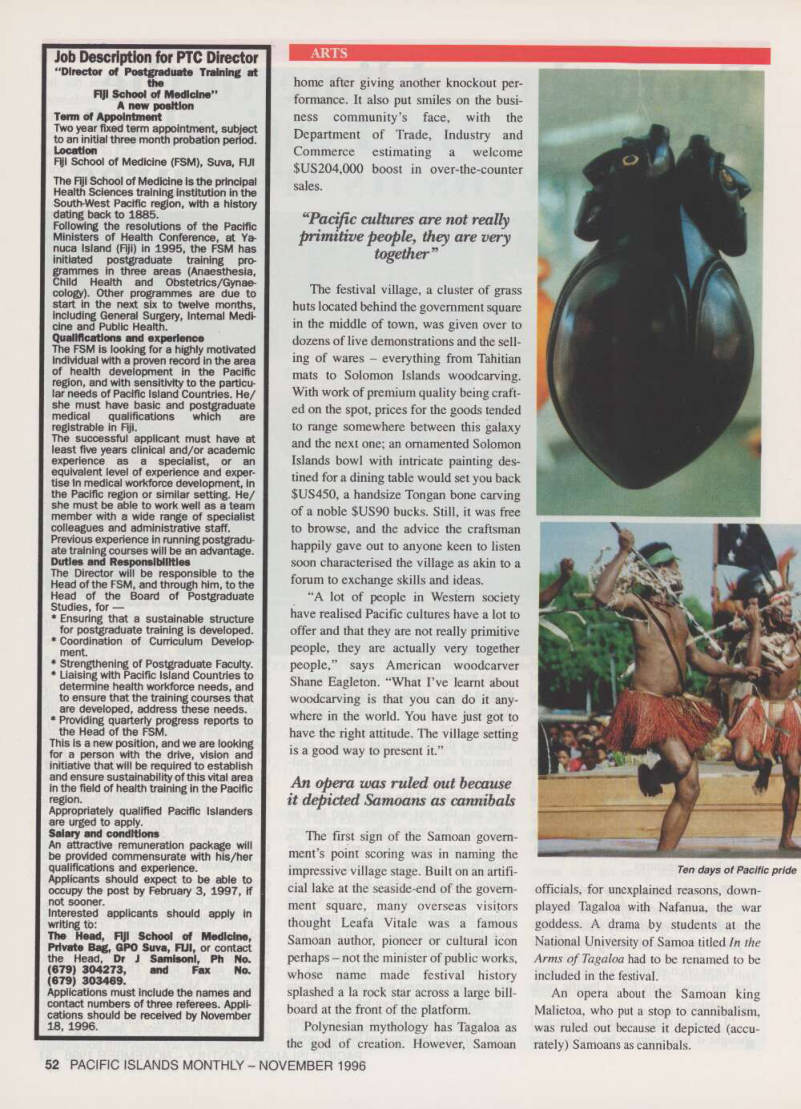
With work of premium quality being craft ed on the spot, prices for the goods tended to range somewhere between this galaxy and the next one; an ornamented Solomon Islands bowl with intricate painting des tined for a dining table would set you back SUS4SO, a handsize Tongan bone carving of a noble SUS9O bucks. Still, it was free to browse, and the advice the craftsman happily gave out to anyone keen to listen soon characterised the village as akin to a forum to exchange skills and ideas.
“A lot of people in Western society have realised Pacific cultures have a lot to offer and that they are not really primitive people, they are actually very together people,” says American woodcarver Shane Eagleton. “What I’ve learnt about woodcarving is that you can do it any where in the world. You have just got to have the right attitude. The village setting is a good way to present it.”
An opera was ruled out because
it depicted Samoans as cannibals
The first sign of the Samoan govern ment’s point scoring was in naming the impressive village stage. Built on an artifi cial lake at the seaside-end of the govern ment square, many overseas visitors thought Leafa Vitale was a famous Samoan author, pioneer or cultural icon perhaps - not the minister of public works, whose name made festival history splashed a la rock star across a large bill board at the front of the platform.
Polynesian mythology has Tagaloa as the god of creation. However, Samoan
officials, for unexplained reasons, down played Tagaloa with Nafanua, the war goddess. A drama by students at the National University of Samoa titled In the Arms of Tagaloa had to be renamed to be included in the festival.
An opera about the Samoan king Malietoa, who put a stop to cannibalism, was ruled out because it depicted (accu rately) Samoans as cannibals.
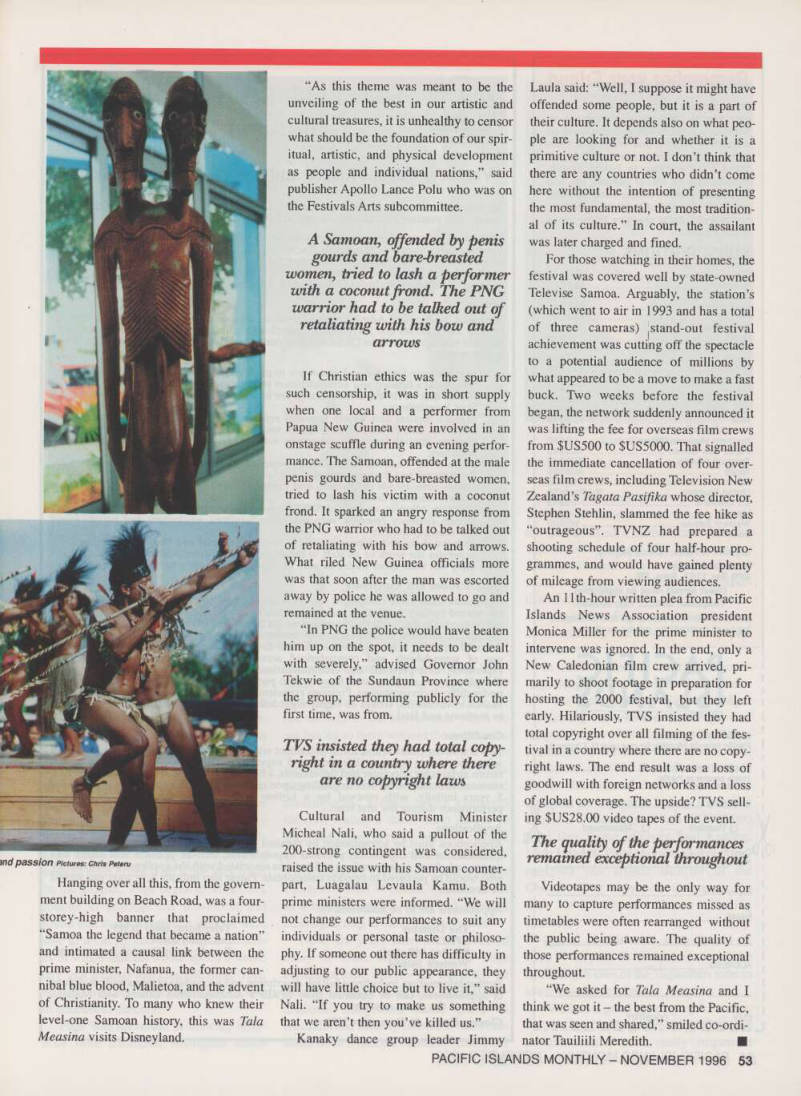
Ten days of Pacific pride
Hanging over all this, from the govern ment building on Beach Road, was a four storey-high banner that proclaimed “Samoa the legend that became a nation” and intimated a causal link between the prime minister, Nafanua, the former can nibal blue blood, Malietoa, and the advent of Christianity. To many who knew their level-one Samoan history, this was Tala Measina visits Disneyland.
“As this theme was meant to be the unveiling of the best in our artistic and cultural treasures, it is unhealthy to censor what should be the foundation of our spir itual, artistic, and physical development as people and individual nations,” said publisher Apollo Lance Polu who was on the Festivals Arts subcommittee.
A Samoan, offended by penis
gourds and bare-breasted women, tried to lash a performer with a coconut frond. The PNG warrior had to be talked out of retaliating with his bow and arrows If Christian ethics was the spur for such censorship, it was in short supply when one local and a performer from Papua New Guinea were involved in an onstage scuffle during an evening perfor mance. The Samoan, offended at the male penis gourds and bare-breasted women, tried to lash his victim with a coconut frond. It sparked an angry response from the PNG warrior who had to be talked out of retaliating with his bow and arrows.
What riled New Guinea officials more was that soon after the man was escorted away by police he was allowed to go and remained at the venue.
“In PNG the police would have beaten him up on the spot, it needs to be dealt with severely,” advised Governor John Tekwie of the Sundaun Province where the group, performing publicly for the first time, was from.
TVS insisted they had total copy right in a country where there are no copyright laws Cultural and Tourism Minister Micheal Nali, who said a pullout of the 200-strong contingent was considered, raised the issue with his Samoan counter part, Luagalau Levaula Kamu. Both prime ministers were informed. “We will not change our performances to suit any individuals or personal taste or philoso phy. If someone out there has difficulty in adjusting to our public appearance, they will have little choice but to live it,” said Nali. “If you try to make us something that we aren’t then you’ve killed us.”
Kanaky dance group leader Jimmy
Laula said: “Well, I suppose it might have offended some people, but it is a part of their culture. It depends also on what peo ple are looking for and whether it is a primitive culture or not. I don’t think that there are any countries who didn’t come here without the intention of presenting the most fundamental, the most tradition al of its culture.” In court, the assailant was later charged and fined.
For those watching in their homes, the festival was covered well by state-owned Televise Samoa. Arguably, the station’s (which went to air in 1993 and has a total of three cameras) ( stand-out festival achievement was cutting off the spectacle to a potential audience of millions by what appeared to be a move to make a fast buck. Two weeks before the festival began, the network suddenly announced it was lifting the fee for overseas film crews from SUSSOO to SUSSOOO. That signalled the immediate cancellation of four over seas film crews, including Television New Zealand’s Tagata Pasifika whose director, Stephen Stehlin, slammed the fee hike as “outrageous”. TVNZ had prepared a shooting schedule of four half-hour pro grammes, and would have gained plenty of mileage from viewing audiences.
An 11 th-hour written plea from Pacific Islands News Association president Monica Miller for the prime minister to intervene was ignored. In the end, only a New Caledonian film crew arrived, pri marily to shoot footage in preparation for hosting the 2000 festival, but they left early. Hilariously, TVS insisted they had total copyright over all filming of the fes tival in a country where there are no copy right laws. The end result was a loss of goodwill with foreign networks and a loss of global coverage. The upside? TVS sell ing SUS2B.OO video tapes of the event.
The quality of the performances
remained exceptional throughout
Videotapes may be the only way for many to capture performances missed as timetables were often rearranged without the public being aware. The quality of those performances remained exceptional throughout.
“We asked for Tala Measina and I think we got it - the best from the Pacific, that was seen and shared,” smiled co-ordi nator Tauiliili Meredith. ■
[?]nd passion Pictures: Chris Peteru