Baguettes and bureaucracy
pp. 57-58 · Read in the full issue
Yachting
By Sally Andrew
Landfalls are exciting but challeng ing - reefs, shipping traffic and other navigational hazards can tax a weary crew. And often, relief at being in port is ruined by endless rounds of paper
work. Noumea is different. Baie de la Moselle marina is absolutely wonderful top-notch facilities, great people, a free night on the dock for visiting yachts.
Their helpful staff welcomes cruisers with open arms and makes all arrival arrange ments for quarantine, customs and immi
gration clearance. It couldn’t be easier.
Our formalities were completed quick ly. We tracked down our friend, Jean- Baptiste Fortier, on his French yacht, Fuli.
He stopped by Fellowship later that evening and we cracked open a bottle of French wine, then tore into some fresh baguettes and blue cheese. It was a bril liant opportunity to catch up on each other’s lives.
But even in paradise, bureaucracy can rear its ugly head.
In New Caledonia it was immigration.
The standard one-month visa is not long enough to cruise to the outer isles of the Loyalty group and back. So we searched out the Bureau d’Etrangers - we soon took to calling it the “Bureau of Strangers” - and requested an extension.
The town of Noumea has lots of charm. Old buildings dating to the late
1800 s stand alongside modern shops
filled with exotic French and European goods. It has a colourful market where Kanak ladies in modest Mother Hubbards sell their fresh fish and vegetables.
Noumea also boasts beaches where female tourists, wearing little more than mono-kinis, can worship the sun. The Latin quarter is filled with cafes, on the side streets there are crafts shops such as Le Coin du Cuir and, near the marina, an icon of American culture - McDonalds.
Noumea’s museum has a good selec tion of common and ceremonial artefacts, including wood carvings, masks, petro glyphs and pottery from New Caledonia, Vanuatu, the Solomon Islands, and Papua New Guinea. It is the best South Pacific Island museum - or would be, if the
descriptive labels were bilingual.
A walking tour of Noumea is not com plete without a trip to Mt Coffyn, after which you feel like you need one. The view from the top is spectacular - you can see all the islets and reefs as far away as the Amedee Lighthouse.
Down in the Latin Quarter we renewed ourselves with a Citroen sorbet and a double espresso. The nearby patis serie was filled with mouth-watering pas tries bursting with calories, and cakes that cost $3O and $4O. Unfortunately, we had a
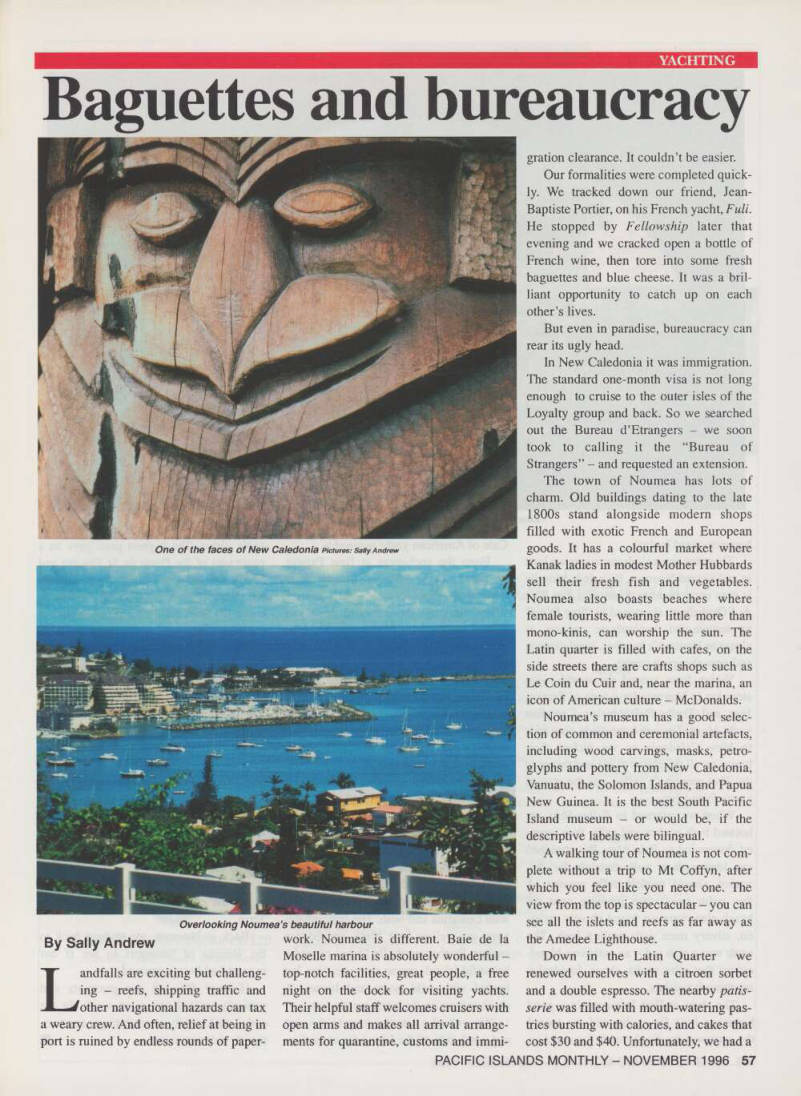
One of the faces of New Caledonia pictures: sally Andrew
Overlooking Noumea’s beautiful harbour
baguette-sized budget.
There are several places to moor a boat in and around Noumea. Baie de la Moselle is very convenient to downtown, but Baie de FOrphelinat, shortened to “Bay D’orf ’ by tongue-tied Anglophone cruisers, is closer to Noumea’s beaches, hotel district, and new shopping centre.
Yachts from around the world enjoy stopping in Noumea for a taste of France.
Jane and Shelly Deßidder on Canadian yacht Magic Dragon have made nine trips to New Caledonia so we picked their brains on all the places to see and things to do. That morning’s coffee was the start of a new friendship.
When we returned to Fellowship, we hoisted both anchor and sails, then coast ed downwind to Baie Maa. We stretched our legs with a walk through the dry, grassy, almost treeless roily country. A few palm trees were growing near the beach elsewhere we found ghostly, twist ed, silvery trees with peeling bark. The earth was a rich red - an insidious blood colour that ruins socks, shoes, foredecks, anything it touches.
The river at Port Laguerre is a good hurricane hole for yachts and we toured the waterway by dinghy with Jim and Ann
Cate of American yacht Insatiable.
From the anchorage at Bale Papaye, we raced into the mangrove swamp, throt tled back, then cruised gently upriver.
When Jim shut the outboard down, we drifted quietly with the current, listening to the sounds of the birds, marvelling at the reflections of the mangroves in the still, green water. On our way to Hot Moro, we considered stopping at Tangue and several other sandy isles along the way but the wind was good, the sun was bright, the tide was low. With such perfect conditions, we kept going.
Turtles surfaced like submarines, heads erect, to spy on us. Although an endangered species, turtles are legal quar ry in New Caledonia three months of the year. We anchored shortly after noon, packed a lunch and rowed ashore. Goat trails cut across the island, which has raised limestone outcrops interspersed with casuarina and bush. The only inhabi tants are yellow and black striped sea snakes. Further north, He Ducos proved a beautiful island, sparse on vegetation but loaded with wild goats and horses. A rancher lives on the north-west coast.
We walked a circular loop to the east and north side of the island for some fan
tastic vistas. The highest peak gave us a panorama of the Passe de St Vincent and lovely sandy islets strung along the reef like beads. It was much too windy to move the boat, so we remained secure in the snug anchorage.
The wind dropped overnight and Fellowship was southbound at the crack of dawn. By noon, we had our anchor down in a sandy patch behind the reef at Kuendu Beach, five miles from Noumea.
In 1864, the first convict settlement build ings were built here.
Now, however, a hotel with Melanesian-style cottages lines the beach.
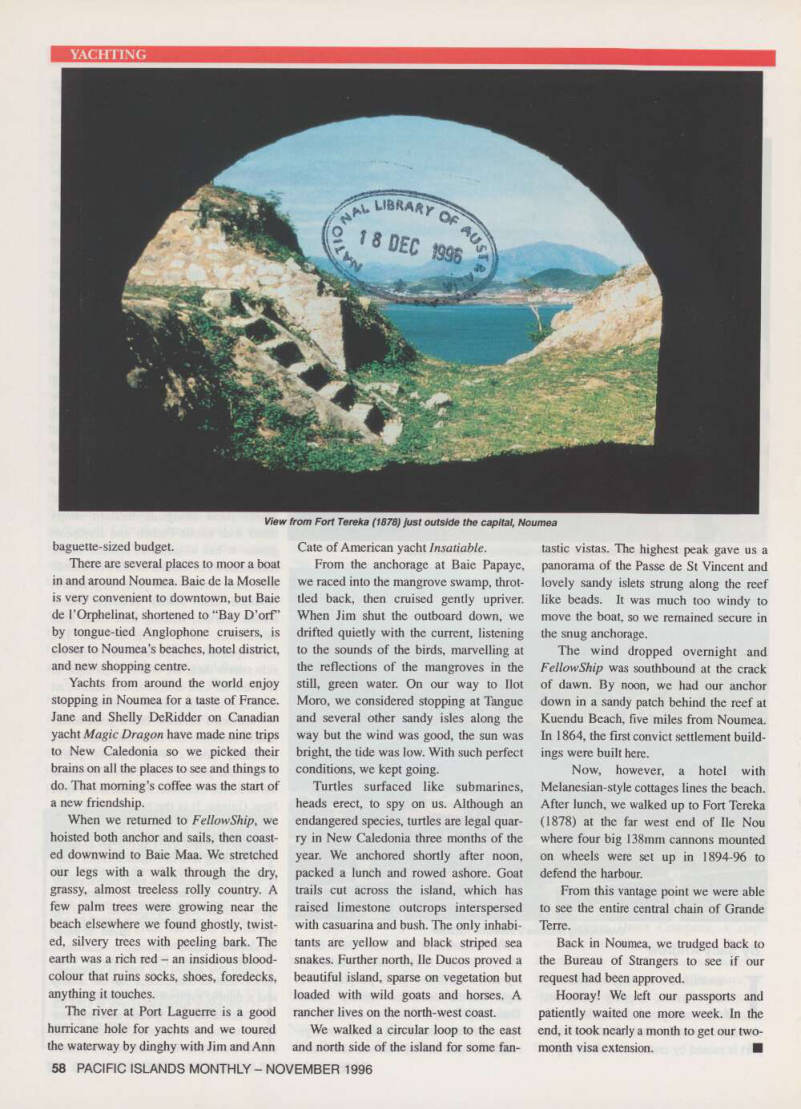
After lunch, we walked up to Fort Tereka (1878) at the far west end of He Nou where four big 138 mm cannons mounted on wheels were set up in 1894-96 to defend the harbour.
From this vantage point we were able to see the entire central chain of Grande Terre.
Back in Noumea, we trudged back to the Bureau of Strangers to see if our request had been approved.
Hooray! We left our passports and patiently waited one more week. In the end, it took nearly a month to get our two month visa extension. ■
View from Fort Tereka (1878) just outside the capital, Noumea