Wages of corruption
p. 32 · Read in the full issue
By Chris Peteru
The Western Samoa Supreme Court rulings that cost a cabinet minister, a party leader and three govern ment members of parliament their jobs, was not unexpected.
In fact, shady political dealings are so common in the 49-seat parliament, a sense of indifference now fills a public vacuum once inhabited by feelings of dissatisfac tion about the whole situation. To many Samoans, it was yet another chapter that questioned the political ethics of the Human Rights Protection Party which has ruled the country since the mid-80s, and politicians in general.
Eighteen petitions were filed in court following the April elections. By the time the cases went to hearing, the number had been culled to 11 - all but one petition involving a government member.
Although the HRPP - which stayed tight-lipped throughout - may have come out of the affair with another loss of cred ibility, it seems the alternatives to their sometimes warped electioneering are little better.
The first to the dole queue was Labour Party leader Toleapaialii Toesulusulu, who narrowly won a bitterly contested nomina tion and his party’s seat in parliament. His
campaign included a much-publicised
commitment to stamping out alleged gov ernment corruption. Describing himself as a “future prime minister of Samoa” and
“Moses leading his people to the promised land”, it may have been a divine revela tion that led the brash Toleapaialii to quit on several bribery charges.
Showing the lines between political correctness and survival are truly blurred, he even applied to join the same govern ment he had earlier enthusiastically denounced. Not suprisingly, his applica tion to join was abruptly quashed.
“Toleapaialii anticipated an unfavourable settlement and he decided to resign,” said Chief Justice Tiavaasue
Falefatu Sapolu.
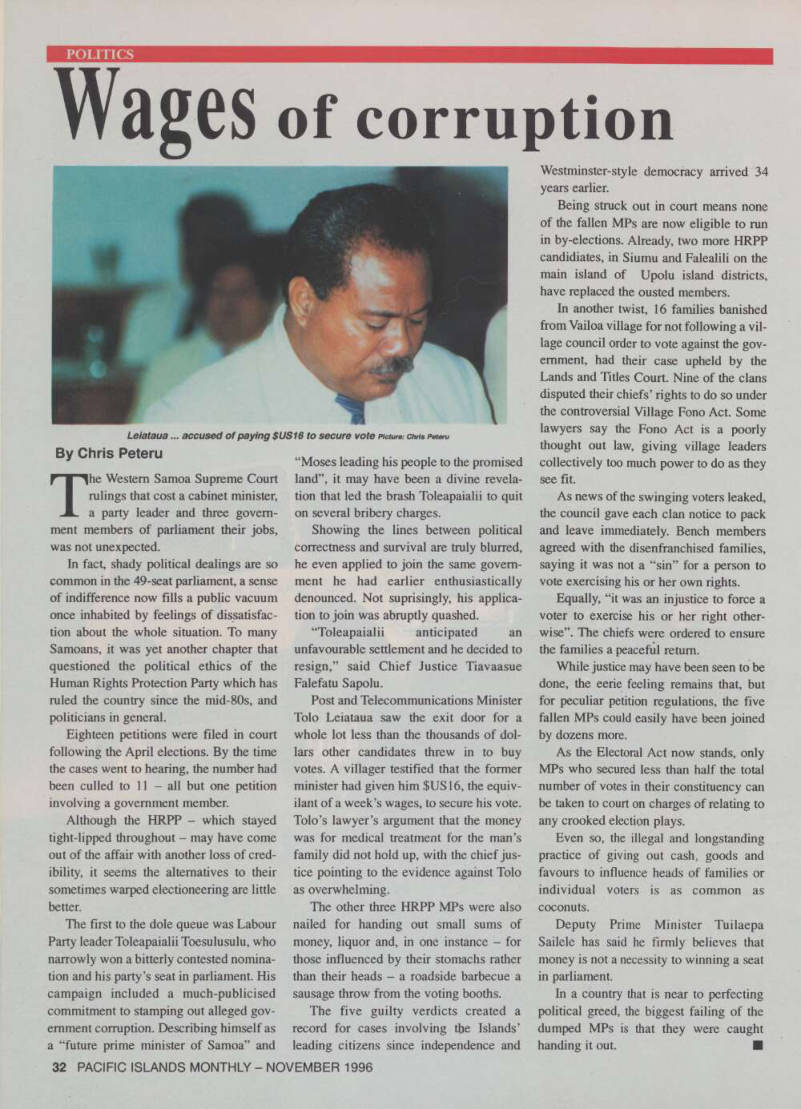
Post and Telecommunications Minister Tolo Leiataua saw the exit door for a whole lot less than the thousands of dol lars other candidates threw in to buy votes. A villager testified that the former minister had given him SUS 16, the equiv ilant of a week’s wages, to secure his vote.
Tolo’s lawyer’s argument that the money was for medical treatment for the man’s family did not hold up, with the chief jus tice pointing to the evidence against Tolo
as overwhelming.
The other three HRPP MPs were also nailed for handing out small sums of money, liquor and, in one instance - for those influenced by their stomachs rather than their heads - a roadside barbecue a sausage throw from the voting booths.
The five guilty verdicts created a record for cases involving the Islands’ leading citizens since independence and
Westminster-style democracy arrived 34
years earlier.
Being struck out in court means none of the fallen MPs are now eligible to run in by-elections. Already, two more HRPP candidiates, in Siumu and Falealili on the main island of Upolu island districts, have replaced the ousted members.
In another twist, 16 families banished from Vailoa village for not following a vil lage council order to vote against the gov ernment, had their case upheld by the Lands and Titles Court. Nine of the clans disputed their chiefs’ rights to do so under the controversial Village Fono Act. Some lawyers say the Fono Act is a poorly
thought out law, giving village leaders
collectively too much power to do as they see fit.
As news of the swinging voters leaked, the council gave each clan notice to pack and leave immediately. Bench members agreed with the disenfranchised families, saying it was not a “sin” for a person to vote exercising his or her own rights.
Equally, “it was an injustice to force a voter to exercise his or her right other wise”. The chiefs were ordered to ensure the families a peaceful return.
While justice may have been seen to be done, the eerie feeling remains that, but for peculiar petition regulations, the five fallen MPs could easily have been joined by dozens more.
As the Electoral Act now stands, only MPs who secured less than half the total number of votes in their constituency can be taken to court on charges of relating to any crooked election plays.
Even so, the illegal and longstanding practice of giving out cash, goods and favours to influence heads of families or individual voters is as common as coconuts.
Deputy Prime Minister Tuilaepa
Sailele has said he firmly believes that money is not a necessity to winning a seat
in parliament.
In a country that is near to perfecting political greed, the biggest failing of the dumped MPs is that they were caught handing it out. ■
Leiataua... accused of paying $US16 to secure vote Picture: Chris Peteru