State of limbo
pp. 28-29 · Read in the full issue
Election results cast New Zealand into uncertain future
By Atama Raganivatu
New Zealand faces weeks, or pos sibly months, of uncertainty after its General Election on October 12 failed to provide any party with a clear
majority.
The ruling National Party won 44 seats, the opposition Labour Party 37, New Zealand First 17, Alliance 13, ACT 8 and United 1. A union between the left leaning Alliance and Labour would seem logical while National, ACT and United have sufficient in common for a reason ably smooth marriage of the right. The bugbear though is the centrist New Zealand First which, at the time of writ ing, has given no indication of which grouping it feels most comfortable with.
When it became clear that any coali tion could only govern with the support of New Zealand First, its leader, Winston Peters, gave a statesman-like speech pledging he would act responsibly, with the nation’s welfare alone in mind, and pleaded for patience while a deal was
being cobbled together.
There will be much soul-searching within New Zealand First ranks before a decision is made. Peters himself is a for mer National member of parliament as is his chief strategist. However, much of New Zealand First’s support comes from Maori (it made a clean sweep of the five seats reserved purely for them) and a National-ACT-United-New Zealand First coalition would find little favour in Maoridom.
Also, Peters had, only several occa sions before the election, stated vehement ly that he would not enter into a coalition with National if Prime Minister Jim Bolger continued as its leader and several other prominent leaders remained in the cabinet.
Peters’ credibility will be immeasur ably harmed should he now keep him in power. The possibility of National dump ing the King Country farmer to accommo
date Peters can be all but discounted as a National Party caucus devoid of Bolger and his supporters would offer few people with the credentials for positions of
responsibility.
Peters will also be aware that the only obvious conclusion to be drawn by the election was that Kiwis no longer want Bolger as their prime minister. What they could not determine was who should suc ceed him.
The likeliest scenario then is that New Zealand First will, when it realises that the public has become intolerant of the uncer tainty it is causing and when it has wrung as many concessions as possible from Labour and Alliance by maintaining the threat of an accommodation with National, enter into a formal coalition with the two socialist parties.
Another possibility is that New Zealand First will not officially enter into any arrangement other than promise to support a Labour-Alliance government in votes of confidence for the duration of the
next parliament.
The New Zealand public could have spared themselves the perplexity they are now experiencing by not opting for an MMP (Mixed Member Proportional) form of government in a referendum three years ago.
Under the old first-past-the-post sys tem, the status quo would almost certainly have been maintained with Bolger leading a minority government, propped up by the support of United and ACT.
Much of MMP’s appeal was derived from its success in Germany, where the Christian Democrat Party and its long term coalition partner, the Free Democrats, have supplied stable govern ment for many years. Only time will tell if the system can provide New Zealand with
similar solidity.
But New Zealand’s Pacific Islands community has every reason to view MMP positively - at least for the time being. It delivered them three MPs where as previously they only had the one.
Labour’s Taito Phillip Field has been
joined by Samoan compatriot and fellow
party member Mark Gosche, as well as
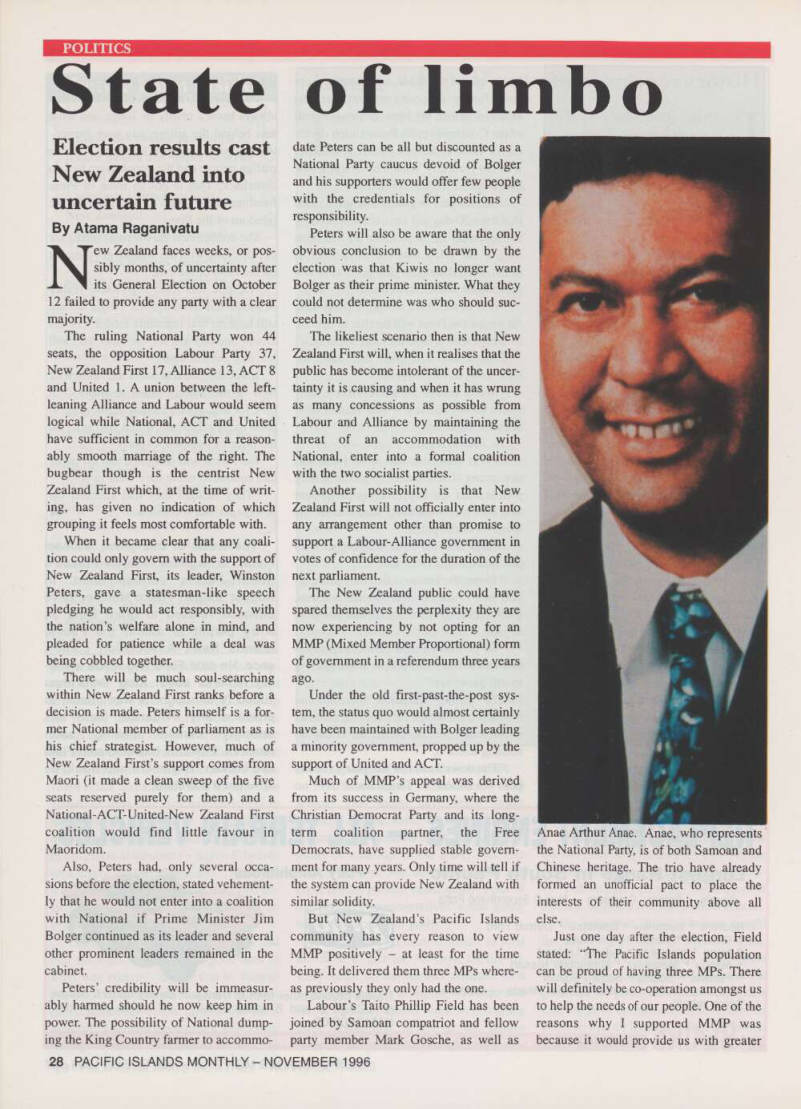
Anae Arthur Anae. Anae, who represents the National Party, is of both Samoan and Chinese heritage. The trio have already formed an unofficial pact to place the interests of their community above all else.
Just one day after the election, Field stated: “The Pacific Islands population can be proud of having three MPs. There will definitely be co-operation amongst us to help the needs of our people. One of the reasons why I supported MMP was because it would provide us with greater
representation in parliament. I am confi dent that the three of us together work for the advancement of Pacific Islands peo
ple.”
Anae added: “The National Party has long been perceived as not being a party for Pacific Islands people, so I am parti clularly grateful for the help of those who worked to get me into parliament. We now have a voice in the National Party, which has historically been the party of the government. I have always stated that it is extremely important that we have voices in both major parties.”
The words of Field and Anae were echoed by veteran Samoan political corre spondent Lualemana Tino Pareira of Radio New Zealand. He enthused: “We should be very pleased about the outcome of this election. Politics for minority groups depends so much upon access to those in power and we now have much greater access. Pacific Islands interest groups can now advocate in an intimate way and form links with people in power.
MMP has also given our people a much greater feeling that their vote really counts. The electorates with large Pacific Islands populations suggest that about 90 per cent of us voted - that’s a far higher
percentage than ever before.
Although voting figures for racial
groups have not been itemised, it seems
likely that Pacific Islands people opted
overwhelmingly for the Labour Party, despite the appeals of community sport ing icons Peter Fatialofa, Frank Bunce and Paea Wolfgramm (for the Alliance) and Michael Jones and Eroni Clarke (for the Christian Coalition).
The Alliance lost half of the support it gained at the election three years ago and the Christian Coalition failed to gain the fiver per cent of the vote required for a seat in parliament. The Christians had hoped to capture the imaginations of vot ers in the predominantly church-going Pacific Islander constituency of Mangere, with their emphasis on family values and literal interpretation of the Bible.
However, the coalition’s social poli cies are similar to those of the Christian Right which dominates the Republican Party in the United States and have no more appeal to the Tongan and Samoan Methodists of south Auckland than they do to the black Baptists of South Carolina.
Field gained more than three times the amount of votes cast for his nearest rival at Mangere and delivered nearly as many
for Labour’s party vote in the constituen cy. Under New Zealand’s MMP system, the 65 constituencies spread throughout the country each produce one MP and the rest - 55 of them - are decided through the party vote, to which all electors con tribute.
The latter ultimately establishes the percentage of MPs each party can claim in parliament, with list MPs, who were cho sen by their parties and ranked several months earlier, ‘topping up’ the electorate winners until all seats are fdled. Both Anae and Gosche are listed MPs.
A coalition led by labour would cer tainly be welcomed by the majority of New Zealand’s Pacific Islanders because of its campaign promises to improve the public health and education systems, increasing overseas aid and alleviating
unemployment.
However, they will be concerned by what level of influence New Zeland First can finally exert as one of Peters’ major platforms has been a large reduction in
immigration.
While all of New Zealand waits intent ly for coalition talks to conclude, the Pacific Islands community may be more anxious than most. ■
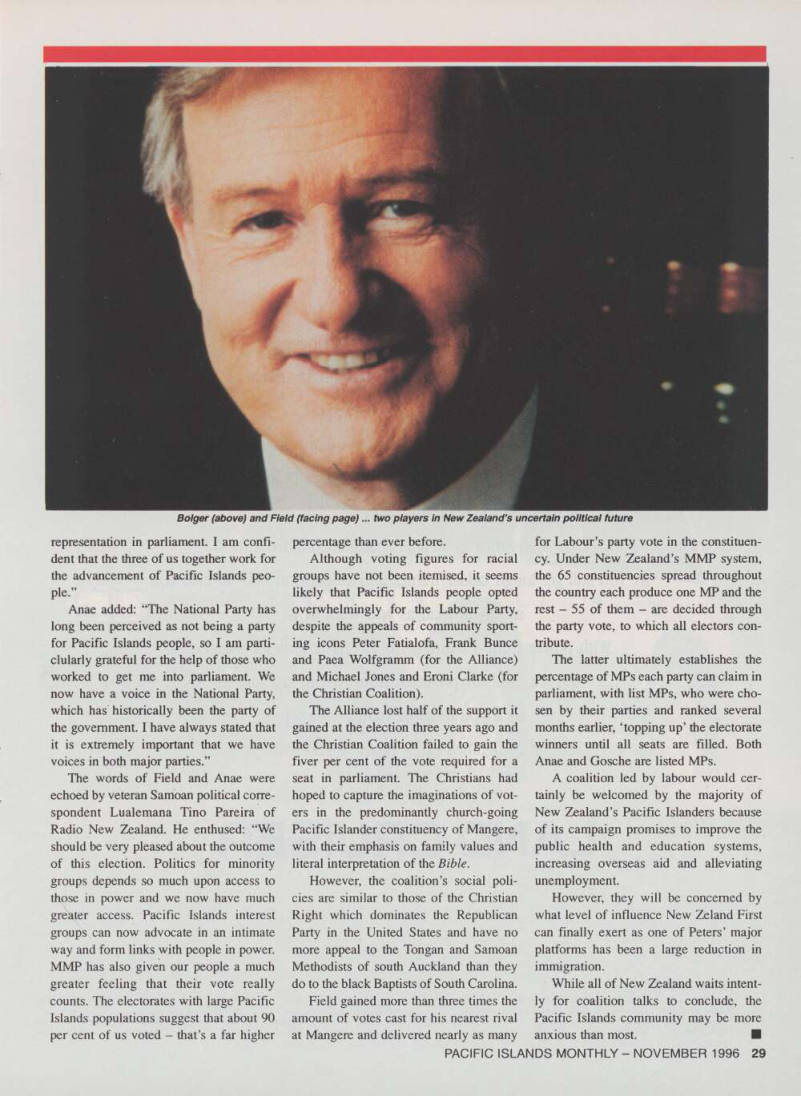
Bolger (above) and Field (facing page) ... two players in New Zealand’s uncertain political future