It’s in the bag...
p. 34 · Read in the full issue
Telecommunications Feature
Atlas Australia releases first-of-its-kind mobile version of the satellite communications briefcase
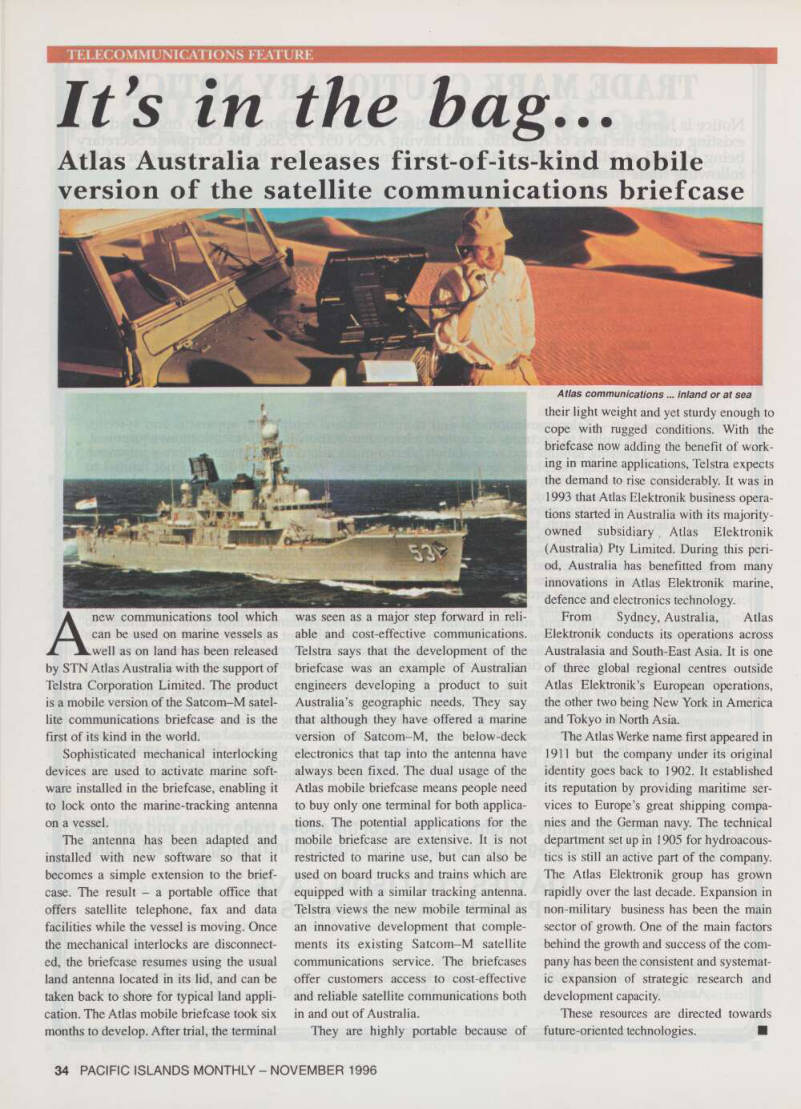
Anew communications tool which can be used on marine vessels as well as on land has been released by STN Atlas Australia with the support of Telstra Corporation Limited. The product is a mobile version of the Satcom-M satel lite communications briefcase and is the first of its kind in the world.
Sophisticated mechanical interlocking
devices are used to activate marine soft ware installed in the briefcase, enabling it to lock onto the marine-tracking antenna on a vessel.
The antenna has been adapted and installed with new software so that it becomes a simple extension to the brief case. The result - a portable office that offers satellite telephone, fax and data facilities while the vessel is moving. Once the mechanical interlocks are disconnect ed, the briefcase resumes using the usual land antenna located in its lid, and can be taken back to shore for typical land appli cation. The Atlas mobile briefcase took six months to develop. After trial, the terminal
was seen as a major step forward in reli able and cost-effective communications.
Telstra says that the development of the briefcase was an example of Australian engineers developing a product to suit Australia’s geographic needs. They say that although they have offered a marine version of Satcom-M, the below-deck electronics that tap into the antenna have always been fixed. The dual usage of the Atlas mobile briefcase means people need to buy only one terminal for both applica tions. The potential applications for the mobile briefcase are extensive. It is not restricted to marine use, but can also be used on board trucks and trains which are equipped with a similar tracking antenna.
Telstra views the new mobile terminal as an innovative development that comple ments its existing Satcom-M satellite communications service. The briefcases offer customers access to cost-effective and reliable satellite communications both in and out of Australia.
They are highly portable because of
their light weight and yet sturdy enough to cope with rugged conditions. With the briefcase now adding the benefit of work ing in marine applications, Telstra expects the demand to rise considerably. It was in 1993 that Atlas Elektronik business opera tions started in Australia with its majority owned subsidiary . Atlas Elektronik (Australia) Pty Limited. During this peri od, Australia has benefitted from many innovations in Atlas Elektronik marine, defence and electronics technology.
From Sydney, Australia, Atlas Elektronik conducts its operations across Australasia and South-East Asia. It is one of three global regional centres outside Atlas Elektronik’s European operations, the other two being New York in America and Tokyo in North Asia.
The Atlas Werke name first appeared in 1911 but the company under its original identity goes back to 1902. It established
its reputation by providing maritime ser
vices to Europe’s great shipping compa nies and the German navy. The technical department set up in 1905 for hydroacous tics is still an active part of the company.
The Atlas Elektronik group has grown rapidly over the last decade. Expansion in non-military business has been the main sector of growth. One of the main factors behind the growth and success of the com pany has been the consistent and systemat ic expansion of strategic research and
development capacity.
These resources are directed towards future-oriented technologies. ■
Atlas communications ... inland or at sea