New Caledonia’s nickel rush
pp. 23-24 · Read in the full issue
By David North
A strong demand for stainless steel in Asia, a corporate disappoint ment regarding an ice-shrouded minefield in Labrador, the slowed flows of Russian exports and the politics of
independence have all brought something
like a nickel rush to New Caledonia.
World nickel prices are strong, thanks to demand for nickel to use in stainless steel in Asia and elsewhere, with the recent price on the London Metal Exchange coming to better than $U53.34 a pound, up more than 11 per cent since Pacific Islands Monthly last wrote on nickel (in December, 1994.) One reason for the stronger price is that increasing world demand has absorbed the formerly depressing massive nickel exports from Russia, the world’s leading producer. Russia, given its sick economy, was happy to sell the metal at any price. Earlier, when Russia was part of the USSR, the Soviet military had used a lot of nickel in building weapons, so
exports were inhibited; those exports soared when the communists lost power.
These long-term trends - spiced by a strong dash of Island politics - have apparently created a rush for nickel-min ing properties in New Caledonia, accord ing to a phone call from the usually unflappable US civil servant who keeps track of nickel developments worldwide for the US Department of Interior.
The expert, other sources and the
world’s mining publications, recounted
half a dozen new regional nickel develop ments mostly in New Caledonia, but oth ers in Papua New Guinea and in Indonesia’s Irian Jay a.
Another out-of-region factor stimulat ing the competition for nickel ore in the South Pacific was the recent loss by one Canadian mining giant, Falconbridge, in a bidding contest with another Canadian
giant, International Nickel Company
(Inco). A small exploring firm, which had neither the capital nor the resources to actually operate a mine, had found a rich
lode of nickel and other ores in a remote part of oft-frozen Labrador in Northern Canada; it put its stake up for bids and, after a long battle, Inco beat Falconbridge: the latter is now trying to even the score on the other side of the globe.
According to the trade publication, The Tex Report, Falconbridge had joined a smaller French mining firm, Societe Minerale Sud Pacifique (SMSP); the two companies, in turn, have entered into an informal alliance with the Kanak indepen dence party, FLNKS. The two firms have
announced a feasibility study regarding a
potential major mine in New Caledonia’s Northern District.
Meanwhile the big daddy of French nickel mining, Societe Le Nickel (SLN), similarly has announced plans to develop nickel mines in the Tiebaghy section of the Northern District. As the writer for The Tex Report puts it: “..the area as an object to be developed as announced by SMSP is located in the
Tiebaghy area possessed by SLN where is unintentionally the same area as that pro jected by SLN. Therefore, it is interested to see the consequence.”
It will be interested to see the conse quences. We suspect that the writer is Japanese, as the article translates the value of Pacific francs into yen and Japan has a fierce need for the metal and none of its own.
The writer continues: “This exception al occurrence ... has included an inside of a political nature. The struggle between Independent Party and Conservative Party, which has been symbolised in the inhabitants’ voting on the independence of New Caledonia scheduled in 1998, has deeply rooted and therefore the develop ment in the Northern District is also a
political matter.”
SLN, which has been working in New Caledonia for over a century, is presum ably allied with the conservative faction, the pro-French RPCR. It has brought much capital and much high-technology to its nickel mine at Nepoui, 250 kilome tres northwest of Noumea. (See “Mine of the future” PIM, August 1994.) It makes sense, from everyone’s view point in New Caledonia, that investment is going into the Kanak-controlled, low income Northern District, as opposed to the RPCR-controlled Southern District,
which includes Noumea, and a substan tial, largely well-off French population.
For the conservatives, it is useful to bring a little prosperity and, presumably, prosperity-induced calm to the Kanak ruled Northern District. For the pro-inde pendence group, investment in the Northern District will produce jobs and, hopefully, some economic justice for the Kanaks.
Why the two political groupings are backing different and rival mining claims is not reported by The Tex Report but, pre sumably, the outsiders (Falconbridge and SMSP) are perceived by the Kanaks as more likely to produce a kind of econom ic development useful to the Kanaks than the insiders (SLN).
Meanwhile Inco, not resting on its Labrador laurels, has worked out an 85 per cent -15 per cent deal with the French government to determine the feasibility of developing the Goro nickel property in New Caledonia. Inco says this is a poten tially rich mine or, in the words of the geologists: “The Goro project includes extensive deposits consisting of nickelife rious laterites with currently identified reserves of 165 million tons grading 1.6 per cent nickel and 0.16 per cent nickel cobalt [which is about nine times as valu able as nickel]. These reserves are capable
of supporting a major long-term nickel
mining operation.”
Yet another New Caledonia nickel deal was reported in September by South Sea Digest. Brisbane-based QNI announced that it had signed an agreement with Societe des Mines de la Tontouta (SMT) to develop a site formerly owned by SMT alone on the Bogota Peninsula. The Australian firm will pay the French one SUS2B million over 15 years, with QNI holding 67 per cent interest in the joint venture and SMT the other 33 per cent.
The Australians said that they would invest another SUS 32 million in the site and expected to secure “arbund one mil lion wet tons of limonitic ore annually”. (Nickel ore is sometimes mixed with water and moved through large pipes or slurries as a technique to transport it effi ciently over rough terrain.) New Caledonia is the world’s third
largest producer of nickel ore, following
Russia and Canada. Its ore, according to David Stanley’s South Pacific Handbook, is “high grade, being free of arsenic although the presence of asbestos has been linked to a high lung-cancer rates among the miners”.
So a Kanak getting a job as a miner is
experiencing a mixed blessing.
The nickel fever is not confined to New Caledonia. In PNG there were reports that Highlands Gold Ltd, a major player in the area, was thinking about looking around for a joint-venture partner with experience in nickel mining (not Highland’s long suit). The conversation would revolve around Highland’s 65 per cent-owned Ramu nickel-cobalt project in
Png.
This project is expected to produce 32,500 tons of nickel and 2770 tons of cobalt a year at a cost of less than SUSI a
pound.
If these calculations are approximately correct, and with nickel and cobalt at any thing like current prices, this would pre sent Highland, if you will pardon the
expression, with a golden opportunity.
Finally, the huge Australian firm, Broken Hill Propriety (BHP), has signed a joint venture with the Indonesian govern ment’s mining company, PT Aneka
Tambang, to conduct a feasibility study
into the development of the nickel deposits on Gag Island, just off the Western tip of Irian Jaya. ■
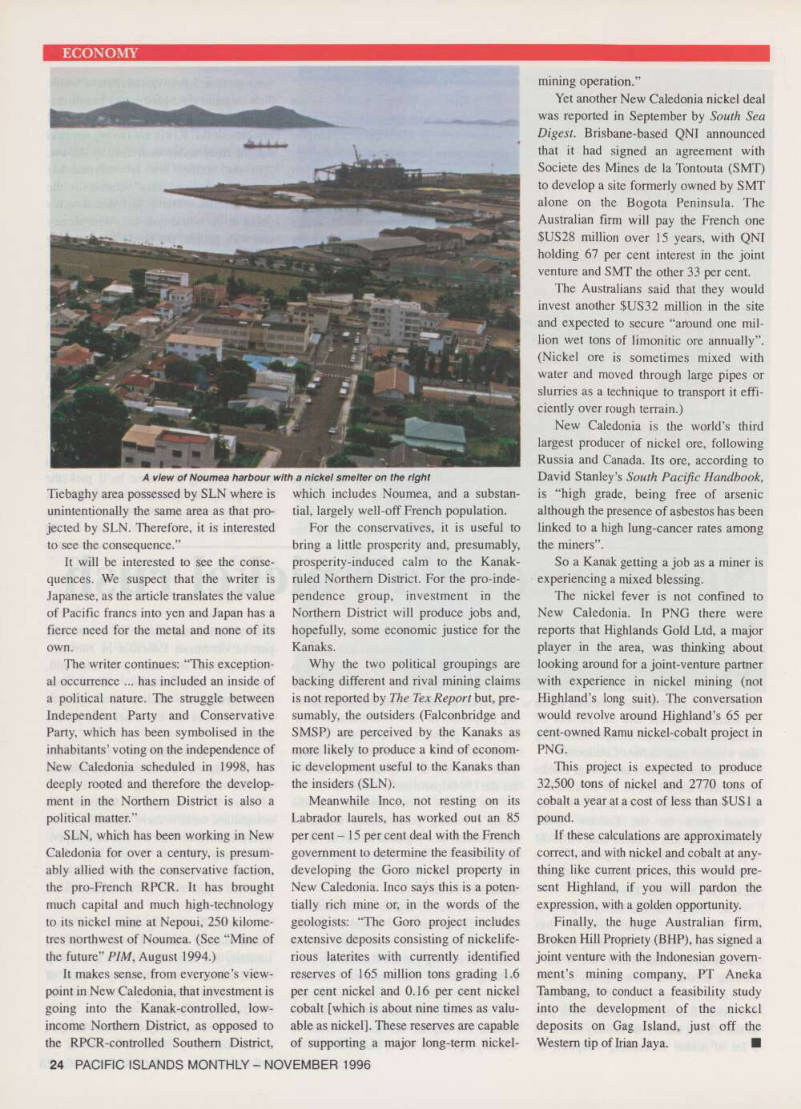
A view of Noumea harbour with a nickel smelter on the right