Sign of the times?
pp. 25-27 · Read in the full issue
Media Freedom
Reports by Michael Field
Two Tongan journalists and a mem ber of parliament have achieved the rare distinction of being declared “prisoners of conscience” by the
human rights organisation Amnesty
International after being held 26 days in a
maximum security prison.
Tongan government spokeswoman Eseta Fusitu’a declared it was “media ter rorism” and Tongan Police Minister Clive Edwards said the three had wanted to become “political martyrs” and the king
dom’s Legislative Assembly obliged.
On September 20 the assembly found Taimi o Tonga editor Kalafi Moaia, deputy editor Filokalafi ’Akau’ola and
people’s representative ’Akilisi Pohiva in
contempt of parliament and imprisoned them for 30 days.
On October 14, less than a week before they were to be released, a New Zealand lawyer, Barry Wilson, won their freedom when Chief Justice Nigel Hampton, ruled the detentions had been unconstitutional
and illegal.
“For 26 days we have been held in jail illegally,” Moaia said on October 14, just after coming out of jail. “When I heard the judgment I wept because we had spent 26 days in jail as innocent people. I never felt
guilty.”
Tonga’s 30-seat assembly is controlled
by King Taufa’ahau Tupou IV who
appoints to life terms the 12-strong cabi-
net which sits in the house without elec tion. Thirty noble titles are entitled to vote for nine noble representatives. Tonga’s 100,000 commoners ( kainangaefon.ua , which literaly translates as “eaters of the soil”) elect another nine people’s repre sentatives.
This saga began at the Atlanta Olympics where boxer Paea Wolfgramm won a silver medal. Among the team of Tongan officials was Justice Minister Tevita Tupou who had the permission of cabinet to go but not of assembly Speaker Noble Fusitu’a.
Pohiva, who has tried unsuccessfully to impeach other ministers, wrote a motion asking for the impeachment of
Tupou.
Before he submitted his motion, he gave the contents to Taimi, an Auckland based independent weekly, which pub lished details hours before they were released in parliament. Contempt pro ceedings were launched for, as Fusitu’a said, prior publication was an offence.
“The Times published falsely that the minister was being impeached,” she said the day after the men went to prison. “The fact is that up until this day there is no
impeachment.”
Parliament’s outrage was selective.
Two weeks earlier, Matangi Tonga magazine ran this: “The people who are elected in Tonga are those who cannot be used for anything else, they have been
sacked from their jobs and they are going into the house in order to make a living.”
It was the unchallenged statement of the king. Taimi’s offence was to be the first with the news. On September 30 the assembly voted to begin impeachment
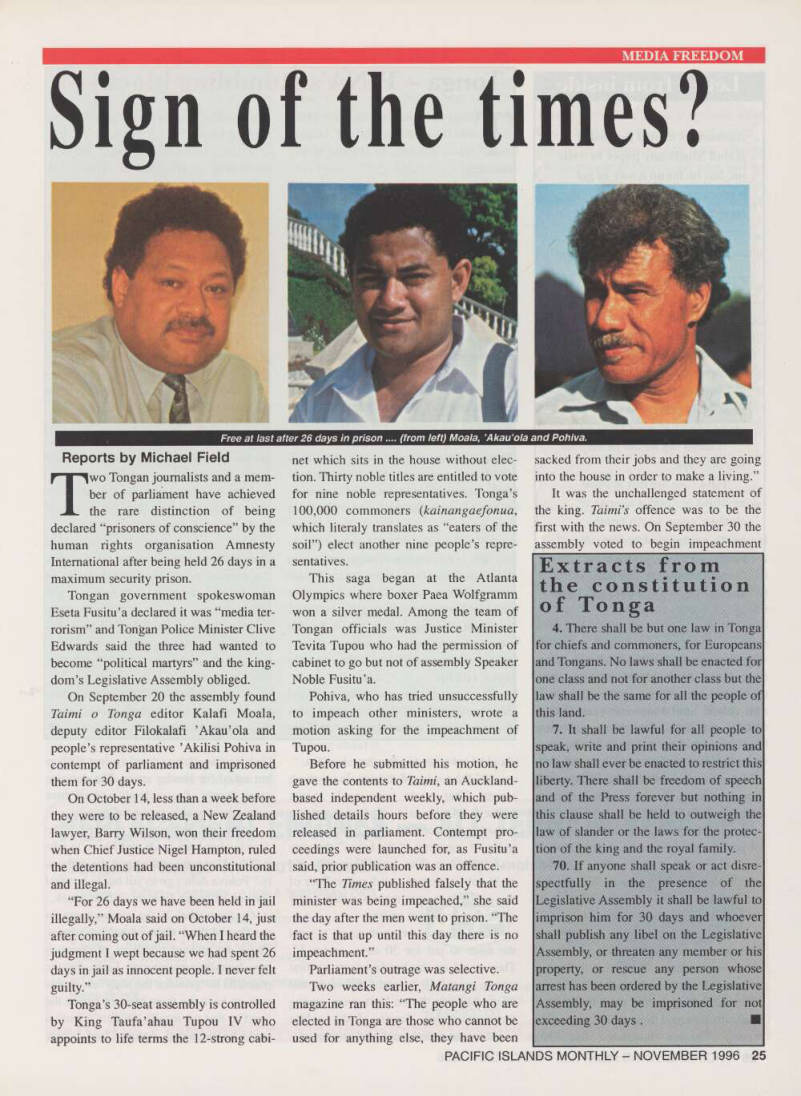
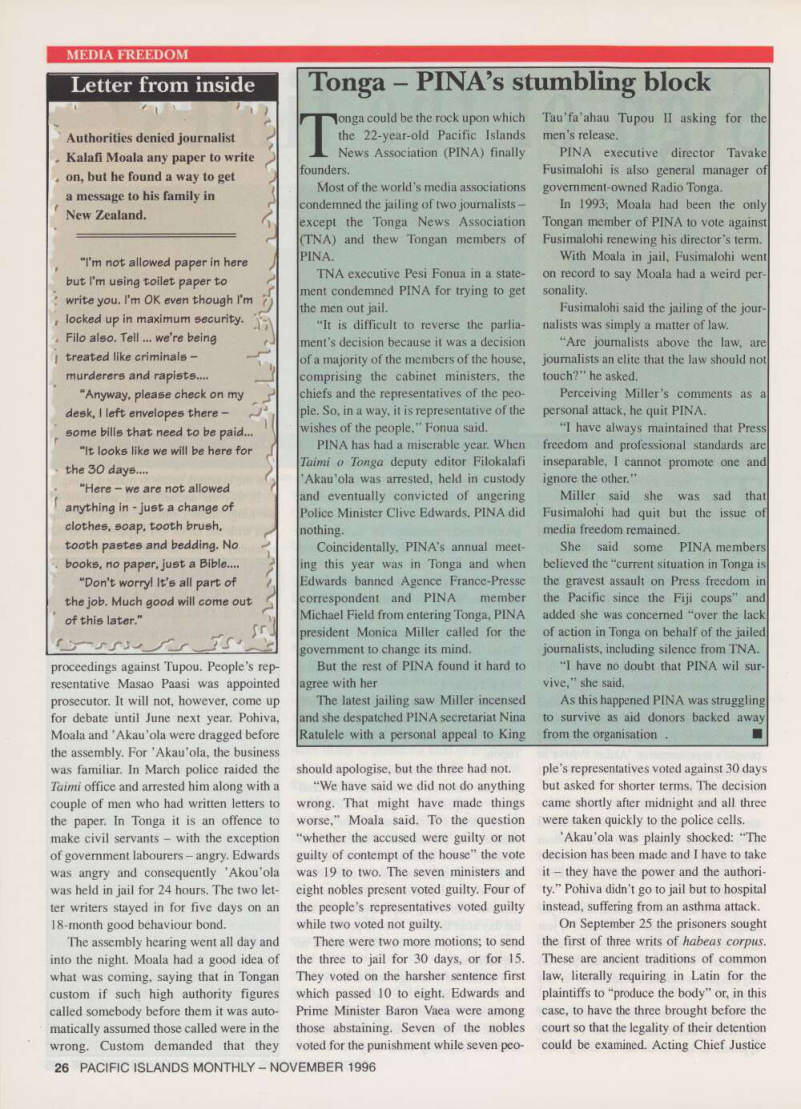
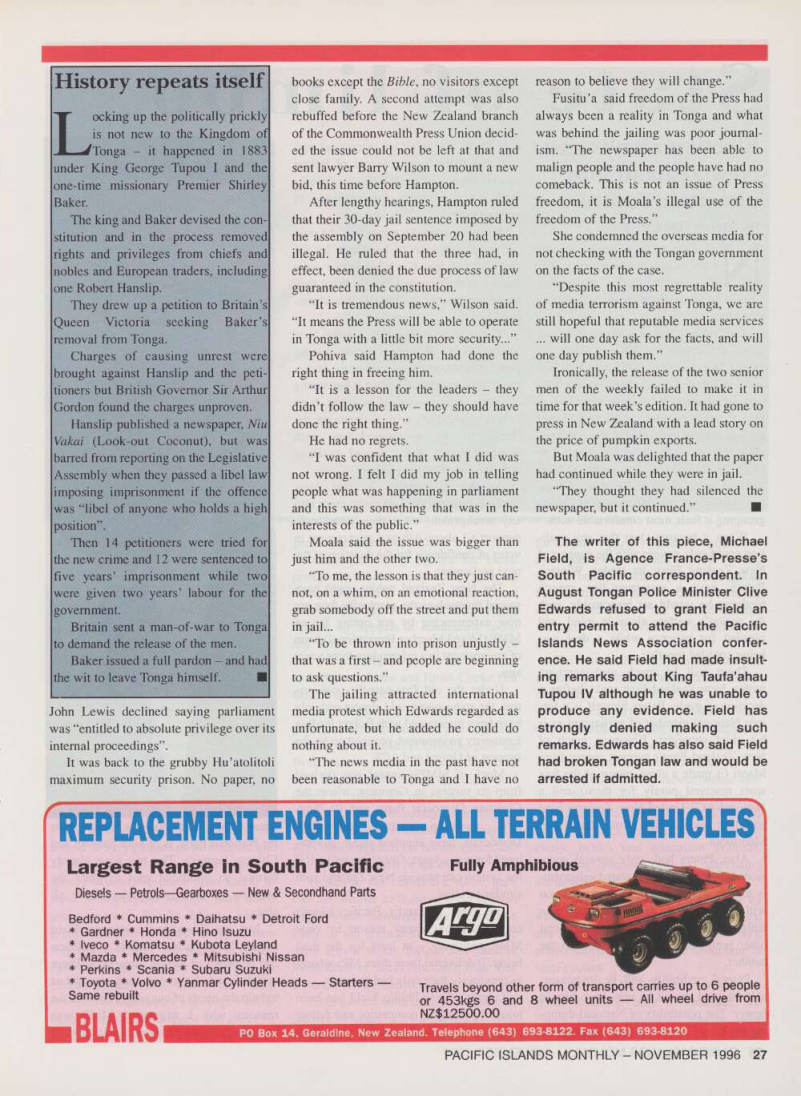
Free at last after 26 days in prison ... (from left) Moaia, 'Akau’ola and Pohiva.
proceedings against Tupou. People’s rep resentative Masao Paasi was appointed prosecutor. It will not, however, come up for debate until June next year. Pohiva, Moala and ’Akau’ola were dragged before the assembly. For ’Akau’ola, the business was familiar. In March police raided the Taimi office and arrested him along with a couple of men who had written letters to the paper. In Tonga it is an offence to make civil servants - with the exception of government labourers - angry. Edwards was angry and consequently ’Akou’ola was held in jail for 24 hours. The two let ter writers stayed in for five days on an 18-month good behaviour bond.
The assembly hearing went all day and into the night. Moala had a good idea of what was coming, saying that in Tongan
custom if such high authority figures
called somebody before them it was auto matically assumed those called were in the wrong. Custom demanded that they
should apologise, but the three had not.
“We have said we did not do anything wrong. That might have made things worse,” Moala said. To the question “whether the accused were guilty or not guilty of contempt of the house” the vote was 19 to two. The seven ministers and eight nobles present voted guilty. Four of
the people’s representatives voted guilty
while two voted not guilty.
There were two more motions; to send the three to jail for 30 days, or for 15.
They voted on the harsher sentence first which passed 10 to eight. Edwards and Prime Minister Baron Vaea were among those abstaining. Seven of the nobles voted for the punishment while seven peo
pie’s representatives voted against 30 days but asked for shorter terms. The decision came shortly after midnight and all three were taken quickly to the police cells. ’Akau’ola was plainly shocked: “The decision has been made and I have to take it - they have the power and the authori ty.” Pohiva didn’t go to jail but to hospital instead, suffering from an asthma attack.
On September 25 the prisoners sought
the first of three writs of habeas corpus.
These are ancient traditions of common law, literally requiring in Latin for the plaintiffs to “produce the body” or, in this case, to have the three brought before the court so that the legality of their detention could be examined. Acting Chief Justice
John Lewis declined saying parliament was “entitled to absolute privilege over its internal proceedings”.
It was back to the grubby Hu’atolitoli maximum security prison. No paper, no
books except the Bible , no visitors except close family. A second attempt was also rebuffed before the New Zealand branch of the Commonwealth Press Union decid ed the issue could not be left at that and sent lawyer Barry Wilson to mount a new bid, this time before Hampton.
After lengthy hearings, Hampton ruled that their 30-day jail sentence imposed by the assembly on September 20 had been illegal. He ruled that the three had, in effect, been denied the due process of law guaranteed in the constitution.
“It is tremendous news,” Wilson said.
“It means the Press will be able to operate in Tonga with a little bit more security...”
Pohiva said Hampton had done the
right thing in freeing him.
“It is a lesson for the leaders - they didn’t follow the law - they should have
done the right thing.”
He had no regrets.
“I was confident that what I did was not wrong. I felt I did my job in telling people what was happening in parliament and this was something that was in the interests of the public.”
Moala said the issue was bigger than just him and the other two.
“To me, the lesson is that they just can not, on a whim, on an emotional reaction, grab somebody off the street and put them in jail...
“To be thrown into prison unjustly that was a first - and people are beginning to ask questions.”
The jailing attracted international media protest which Edwards regarded as unfortunate, but he added he could do nothing about it.
“The news media in the past have not been reasonable to Tonga and I have no
reason to believe they will change.”
Fusitu’a said freedom of the Press had always been a reality in Tonga and what was behind the jailing was poor journal ism. “The newspaper has been able to malign people and the people have had no comeback. This is not an issue of Press freedom, it is Moala’s illegal use of the freedom of the Press.”
She condemned the overseas media for not checking with the Tongan government on the facts of the case.
“Despite this most regrettable reality
of media terrorism against Tonga, we are still hopeful that reputable media services ... will one day ask for the facts, and will one day publish them.”
Ironically, the release of the two senior men of the weekly failed to make it in time for that week’s edition. It had gone to press in New Zealand with a lead story on the price of pumpkin exports.
But Moala was delighted that the paper had continued while they were in jail.
“They thought they had silenced the newspaper, but it continued.” ■ The writer of this piece, Michael Field, is Agence France-Presse’s South Pacific correspondent. In August Tongan Police Minister Clive Edwards refused to grant Field an entry permit to attend the Pacific Islands News Association confer ence. He said Field had made insult ing remarks about King Taufa’ahau Tupou IV although he was unable to produce any evidence. Field has
strongly denied making such
remarks. Edwards has also said Field had broken Tongan law and would be arrested if admitted.