to foreign ownership
pp. 21-23 · Read in the full issue
Cooks govt faces up to foreign ownership ... but what do the people want?
By Lisa Williams
£ £ "Ik "To, I don’t want foreigners to I own our airports,” said one JL major landowner, a tradi tional paramount chief, when the Cook Islands government announced its plans. . “Everyone - the Asians, you name it - will be coming into the country. And before you know it, the mafia will be here.”
It wasn’t news by the time the Cook Islands Prime Minister decided to announce government was to sell its assets: it made sense - to some.
And while the country facing financial crisis goes through an identity shock as its people take up the debate on “selling out to foreigners”, there is one fact that stands out - like the hundreds of public servants who lost their jobs, it’s not politically nice but, hey ... there is just no other way.
“If there were Cook Islanders with the money we’d have no problem with that at all,” said Prime Minister and finance man Sir Geoffrey Henry on letting the ‘crown
jewels’ go.
“But our situation is the people with money aren’t living in the country. The ones with the money are, in fact, living overseas ... and that just makes assets sales a more difficult exercise.”
But despite the mammoth task of doing a public relations job on the theme, “the Cook Islands will always belong to Cook Islanders”. Sir Geoffrey’s determination to sell has been welcomed by a business community straining for evidence of more reforms after months had passed since the prime minister made the first painful cuts to the state workforce.
Sir Geoffrey, and the close-knit bunch of official experts who number crunch and spin solutions day and night in a bid to save the Cooks economy, is adamant the whole process of selling state assets will work.
“We’re not selling assets unless the buyer or developer pays attention to equi ty as well,” he says when asked how Cook
Islanders will remain part of the process even if they don’t have the money.
Defining that equity, as well as tackling the thorny issue of whether crown lands taken for the good of the people now have to be surrendered because of their “com mercialisation”, is part of the comeback from the Cook Islanders looking govern ment in the eye on the issue.
And so the consultation, which has swept in on the wave of economic reforms, continues.
How will selling up government assets worth SUSB7 million save the country from economic ruin? Private ownership, predicts Sir Geoffrey, will bring in addi tional investments of up to sUS3Bmillion beyond the year 2000, add SUSB.7 million to the gross domestic product, create an extra SUS 2.4 million in tax revenues, and get employment figures up by 11 per cent - enough to keep all school leavers work
ing.
Despite the urgency everyone admits the sales are going to take time - only the hotels are actually on the market, every thing else is still the subject of information papers. Still, Sir Geoffrey has the com mercial bank managers of the Westpac and ANZ bank outlets in the country on his side, as well as the business sector and heads of the marine, offshore, tourism and
agriculture industries.
These are industries government has targeted for growth and investment to keep Cook Islanders working - and in the Cook Islands.
Predictions on who gets what are rife.
First to jump on the bandwagon will be the private sector in the Cooks, led by a group of canny businessmen (the gender is literal) who have survived government after government and have either the money or/and the contacts to make first bid for whatever state business they want.
But there is a small problem - and it isn’t just that figures are fine on paper and when making presentations but often
don’t present reality as it will eventuate.
The PM now has to take his plan to the tangata rikiriki. The problem is the little people have always felt left out and resentful of the whole reform process.
Last to feel the trickle-down benefits of the coming sales, they will also be the last to understand, explains an official.
“Do you want to try explaining the interest margin from banking economic growth figures to a bunch of tangata rikiriki ?” he asks. “You’ve got to be able to understand what’s going on - it will be tough for the prime minister because he has to do the numbers and economic theo ry, and once he starts doing that he starts
losing people.”
The PM’s problem so far is he has been explaining the same numbers the same way to different types of audiences, with a nod-nod reaction beginning with his departmental heads that steadily decreases by the time he reaches the village meet ings.
Another problem, which will actually make government look more action-like than it may want to be, is the urgency of the asset sales.
There is no money in the coffers, not unless you call a couple of grand when someone checked at one stage big bickies, and for a government that still pays wel fare up to SUS4BO,OOO per month and its workers $U5550,000 in monthly totals, that’s nowhere near what’s needed.
Take the local media. In a Press con ference that served as an impromptu brief ing and interview session, local journalists were told they would get copies of figures and documents whipped on and off an overhead projector - then staggered when later informed that the documents were too sensitive to be given to them.
With the job of reporting what they had just been told, they pushed for copies and were finally given eight pages of a 28page report.
No problem, say the ever-positive offi cials.
“At the end of the day, if people start seeing the hotel is sold - boom! They’re going to see change and confidence,” promises one. So why not try public floats so more of the public can afford a little sense of ownership? Or offer local employees shares?
“I think it’s because we really have no
time to contemplate all that,” says one member of parliament, “there’s just no time.” Development Bank went up because the bank has long faced criticism that it wasn’t doing anything for develop ment anyway.
But like others, he is keen to see the intentions on equity kept. Until then, like the former public servants surviving on the false economy of three months’ grace in “Transition” funded by New Zealand aid, the reality of having to sell up state assets will not set in.
“That’s the thing with us locals here. It doesn’t sink in until it’s action,” comes the prediction. “You can talk all you want but it won’t sink in until they feel it. They either have a job or are making more money. They have got to see it. To talk
abstract things - forget it.”
But while Sir Geoffrey begins the sales pitch to the tangata rikiriki, literally the “little people”, who only tend to take on power during election campaigns, offi cials close to his task realise what a tough job he has.
“Emotionally we all want to see own ership by Cook Islanders - I want to see that too,” says one observer. “But when you crunch the numbers and think about it intellectually, it doesn’t make sense at all.
There’s so much crossflow of money and investment more and more now, it’s becoming less and less important what country you’re in.
“Everybody’s moving international
now - if you’re not up with that game you’re out of the picture and what we’re
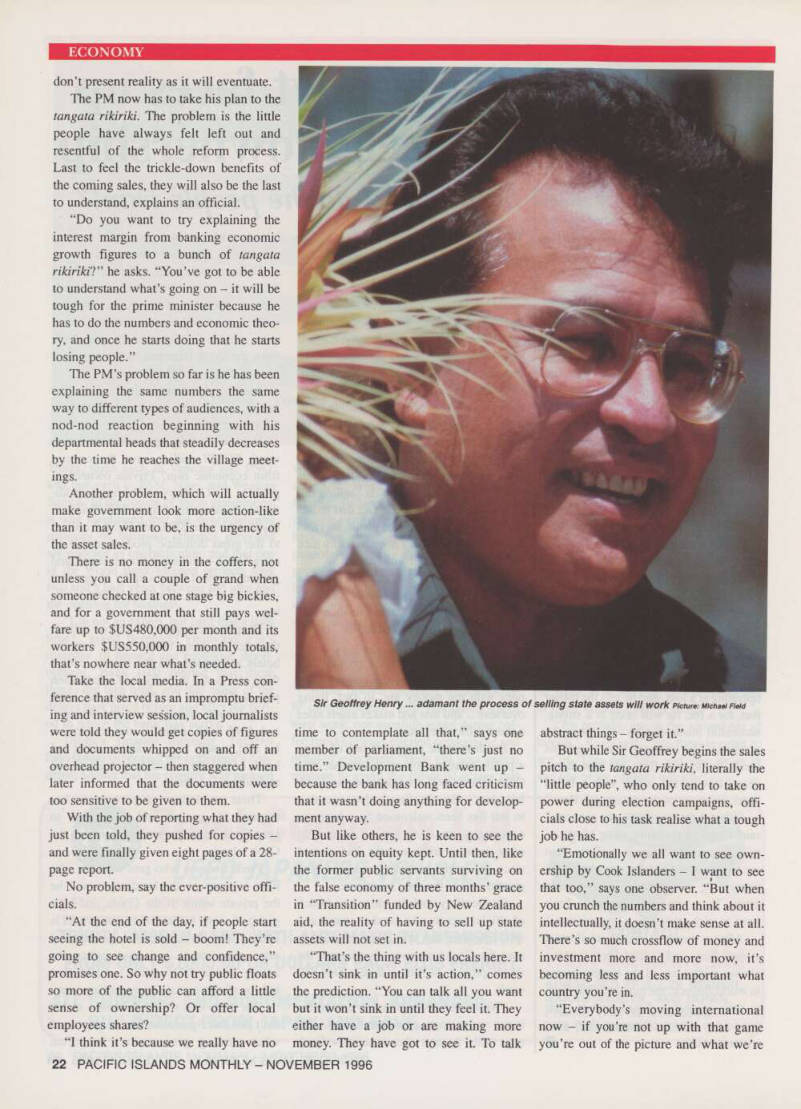
Sir Geoffrey Henry... adamant the process of selling state assets will work Picture: Michael Field
saying now is we want to be part of the game and that’s what we’re doing.”
But do Cook Islanders have the savvy and knowledge of the rules to stay at the winning edge? Economists would think so.
How does Sir Geoffrey and his FEM team know they’ve made the right choice?
Banks guaranteed up to SUSI3.B million of Cook Islands money which shifted overseas two years ago will come back as those who took it out make their bids.
The private sector has never been so pleased with the government.
“There’s a big urgency for the asset sales,” admits the optimist. “We’re under the gun right now to sell these things.
Anyone can see it.”
Jobs, a couple of thousand of them, will be needed for those coming off the high of being paid for three months in Transition. Not even the sale of the Akitua resort, the crown in the tourism jewel that is Aitutaki, will make much of a differ ence. The big dollars making a significant difference will come when government closes on the Rarotongan sale (soon) or
the Sheraton (eventually).
“The Sheraton is the biggest,” comes the official observer-style comment.
“Once we sell the Sheraton, it’s going to show everyone here confidence and cred ibility. The Rarotongan (sale) will happen first and sneak up on people but every one’s waiting for the Sheraton.
“You know why the United States kicks ass economically? Because they say to everyone, ‘lf you want to do business, aere mai, acre mai konei, tavivikV (wel come, come here, hurry). They say that to the whole world, and that’s why they’re number one.”
Closer to home, Fiji is another eco nomic tiger, for pretty much the same rea son - “because everything goes, they want to do business”.
Social, racial and religious problems are the other side of the coin that is invest ment in Fiji but, like New Zealand, the South Pacific nation is enjoying the pros perity foreign dollars bring. But those bemoaning the impending reality of for eign ownership can take heart from New
Zealand neighbours contemplating the
same picture. Sure, Winston Peters’ whole New Zealand First philosophy has direct ly resulted from a growing antipathy and resentment that Kiwis are having the land bought from under their feet by Asians, “but the bottom line is everyone has money in their pockets”, comments the same official. “That’s just the way it’s going in the world now too. With money and with people, the borders are starting to come down.
“It’s becoming this international econ omy where it doesn’t matter who you are and where you’re from. If you want to do business let’s do business - the hell with the rest of it.
“AH of us emotionally want our own people to own. The prime minister knows that too. But at the same time he says, ‘You got the money, come play the game.’
But the bottom line is nobody has the money to play,” says one number-crunch er. “If it’s a local group and foreign group and everything the same he’ll pick the local group. No question about it. But it’s not going to happen. Sorry, that’s just the way it is.” ■