Finance ministers wined,
pp. 19-21 · Read in the full issue
dined ... and lectured
By David North
The Islands’ finance ministers gath ered in Washington with their peers from around the world in September for a menu of: • a little direct investment; • some useful technical assitance; and • several gentle lectures on how to run their countries’ finances.
The occasion was the annual meeting of the governors of the World Bank; a round of high policy and splendid parties for the participants, but regarded as a headache by most Washingtonians as the assembled rental limousines from up and down the East Coast clustered for what the Washington Post described as the yearly gold-plated traffic jam.
The most useful part of the proceed ings was a two-day regional session for the Island members of the World Bank; Fiji, FSM, Kiribati, PNG, the Marshalls, the Solomons, Tonga, Vanuatu, and Western Samoa. (Nauru, Tuvalu and Palau are not members). The World Bank runs a tight, if elegant, ship. The Islands’ finance ministers were assembled in a hotel conference room at 9am one Sunday morning for a briefing on financial policy trends around the world, and how not to run one’s nation into bankruptcy.
For the most part, things went smooth ly, as the beautiful people of the World Bank staff are good at what they do; they are bright, hard-working, cosmopolitan, polylingual, gracious, slim and well dressed.
But the advice on expenditure reduc tions, from one staffer with a British accent, must have grated the ears of the Kiribati delegation as she, twice, referred to the nation as “Kir-i-ba-tee”.
The messages on how-to-run-your govemments’ finances were gentle, well documented, illustrated with slides ... and numerous. The basic advice: hold down expenditures, do not raise taxes, spend more on health and education than on sub sidising state-run enterprises (like those champion money-losers, national air
lines), and restrict the size of your bureau cracy. On the last point, one of the staff speakers had a scatter diagram - from which the names of nations had thought fully been erased - which showed the direct, negative correlation between civil servants’ salaries and corruption. The lower the general pattern of wages, the higher the incidence of corruption - so lay off some of the less useful people, and pay the ones you keep enough to assure effi ciency and to discourage theft of public funds. (The bank takes its own advice - its people are the best paid public servants in a comparatively affluent city, and there are never any scandals at the bank.) Another diagram showed the relation ship between bureaucratic efficiency (measured in a complex way) and nation al growth; the more efficient the bureau crats, the more growth. Bank officials said that there was enough governmental effi ciency to stimulate economic growth.
“They are doing some of the basic things right - such as investment in education and that makes a difference.”
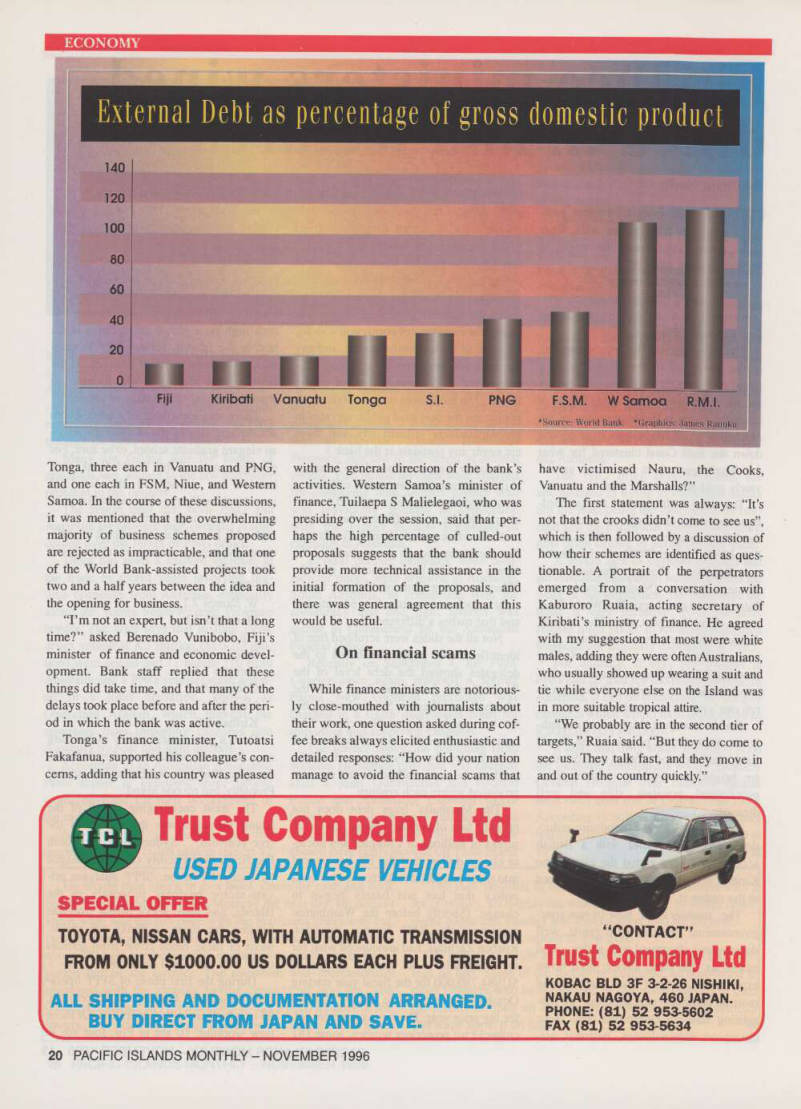
Not all the slides were scrubbed free of identifiers. One paper distributed to the delegates showed the debt level of the World Bank’s Island members, with the Marshalls and Western Samoa leading the list by a wide margin. (See chart). The measure used was the size of the external debt divided by annual gross domestic product, the sum of all goods and services produced within each country.
The Marshalls’ huge debt does not reflect a lack of outside funding, given the scores of millions of Compact and nucle ar claims dollars that the US has poured into those islands, it reflects a spend-thrift policy that has just barely begun to
change. (Shortly before the Washington
meetings, the RMI finance minister, Rueben Zachrais, had announced what for the Marshalls is an austere budget of $U584,780,000 for the fiscal year starting October 1, compared to $U591,700,000 for the prior year. The most numerous job cutbacks hit powerless women, some 181
cooks for the outer island schools.) In Washington, the World Bank offered another measure of fiscal sturdi ness, or lack thereof, and that is the amount of a nation’s overseas financial reserves as compared to the volume of imports. Kiribati, with overseas reserves equalling 8.2 months of imports may not rank high on a global scale, but it is the best in the Islands, followed by Vanuatu with 7.5 months worth of reserves. At the bottom is the Marshalls, with its reserves
equalling exactly three days of imports.
There was something of a schoolroom atmosphere about parts of these sessions an elegant graduate school, to be sure. For example, one of the World Bank staff handed out grades on the level of investor-friendliness of Island nation poli cies. With a range from a low of 1 to a high of 5, he noted a general lack of suffi cient investor-orientation as he gave out
these grades:
Fsm 1.7
W. Samoa 2.1 Marshalls 2.1
Fiji 2.3
Solomons 2.5 Vanuatu 2.5 Cooks 2.6 Niue 2.7 Kiribati 2.8 Does a government policy of insisting on a decent minimum wage for its work ers give that government a low score?
Probably, but no one asked.
The most encouraging aspect of the Island meetings was the report on the
five-year-old, Sydney-based South
Pacific Project Facility (SPPF) managed
by Richard Pearson. SPPF analyses pri vate-sector business proposals in the Islands, and then, seeks partial overseas funding for those it thinks are viable.
Most of these funds come from sources other than the World Bank itself.
During the first phase of SPPF opera tions, it secured funding for 25 projects, 23 of which are still in operation. Of those now working, 10 are in Fiji, four are in
Tonga, three each in Vanuatu and PNG, and one each in FSM, Niue, and Western Samoa. In the course of these discussions, it was mentioned that the overwhelming majority of business schemes proposed are rejected as impracticable, and that one of the World Bank-assisted projects took two and a half years between the idea and the opening for business.
“I’m not an expert, but isn’t that a long time?” asked Berenado Vunibobo, Fiji’s minister of finance and economic devel opment. Bank staff replied that these things did take time, and that many of the delays took place before and after the peri od in which the bank was active.
Tonga’s finance minister, Tutoatsi Fakafanua, supported his colleague’s con cerns, adding that his country was pleased
with the general direction of the bank’s activities. Western Samoa’s minister of finance, Tuilaepa S Malielegaoi, who was presiding over the session, said that per haps the high percentage of culled-out proposals suggests that the bank should provide more technical assistance in the initial formation of the proposals, and there was general agreement that this would be useful.
On financial scams While finance ministers are notorious ly close-mouthed with journalists about their work, one question asked during cof fee breaks always elicited enthusiastic and detailed responses: “How did your nation manage to avoid the financial scams that
have victimised Nauru, the Cooks, Vanuatu and the Marshalls?”
The first statement was always; “It’s not that the crooks didn’t come to see us”, which is then followed by a discussion of how their schemes are identified as ques tionable. A portrait of the perpetrators emerged from a conversation with Kaburoro Ruaia, acting secretary of Kiribati’s ministry of finance. He agreed with my suggestion that most were white males, adding they were often Australians, who usually showed up wearing a suit and tie while everyone else on the Island was in more suitable tropical attire.
“We probably are in the second tier of targets,” Ruaia said. “But they do come to see us. They talk fast, and they move in and out of the country quickly.”
Earlier, a senior World Bank staffer when asked what the bank was doing to try to head off such schemes said: “You can’t help someone who does not want help. Often there is so little political sta bility they sense that they have only six months to do whatever it is they want to do.” In Kiribati, in contrast, the finance minister (who was at the meetings) in Beniamina Tinga; he has held that posi tion for two years, and prior to that he served seven years as the ministry’s per manent secretary. He also serves, cur rently, as a member of the national legis lature.
Fiji has some defence mechanisms in place to avoid being defrauded, Lionel Yee, chief executive of Fiji’s National Provident Fund, suggested. He said that shady businesmen have a long list of dis honest tricks, in addition to the letters of guarantee and the prime bank notes that have been used against the four nations mentioned earlier.
His typology included those who want to pay too little for an Island asset - some of the overseas operators of fish ing vessels, for example. Then there are those, in manufacturing, who bring in overvalued machinery from overseas as their part of an investment, and then profit illicitly from the cash invested in the enterprise by other investors.
He mentioned a third category, some times encountered in the resort industry.
“The shady operator sees a hotel operating at a loss, and he tells the owner that, for a fee, he will bring in a strong, successful manager who will rescue the operation. The manager, in turn, gets his hands on the cash flow, and then disap pears, leaving the owner with a failed hotel, and none of the recent cash flow.”
“It’s not that we don’t take chances,” said Tonga’s Fakafanua, citing his coun try’s successful venture in satellites, “but we have a set of bureaucrats who check everything out before decisions are made. These guys (the con men) don’t want to stick around for a long process.”
After a heady week of intellectual
stimulation and sociability, rubbing
elbows with some of the biggest names in world finance, the ministers flew back to their respective Islands and to their day-to-day chores of keeping their gov ernments alfoat. ■