best medicine
pp. 14-16 · Read in the full issue

Laughter ... the best medicine
By Liz Thompson
At the Royal Hobart Hospital
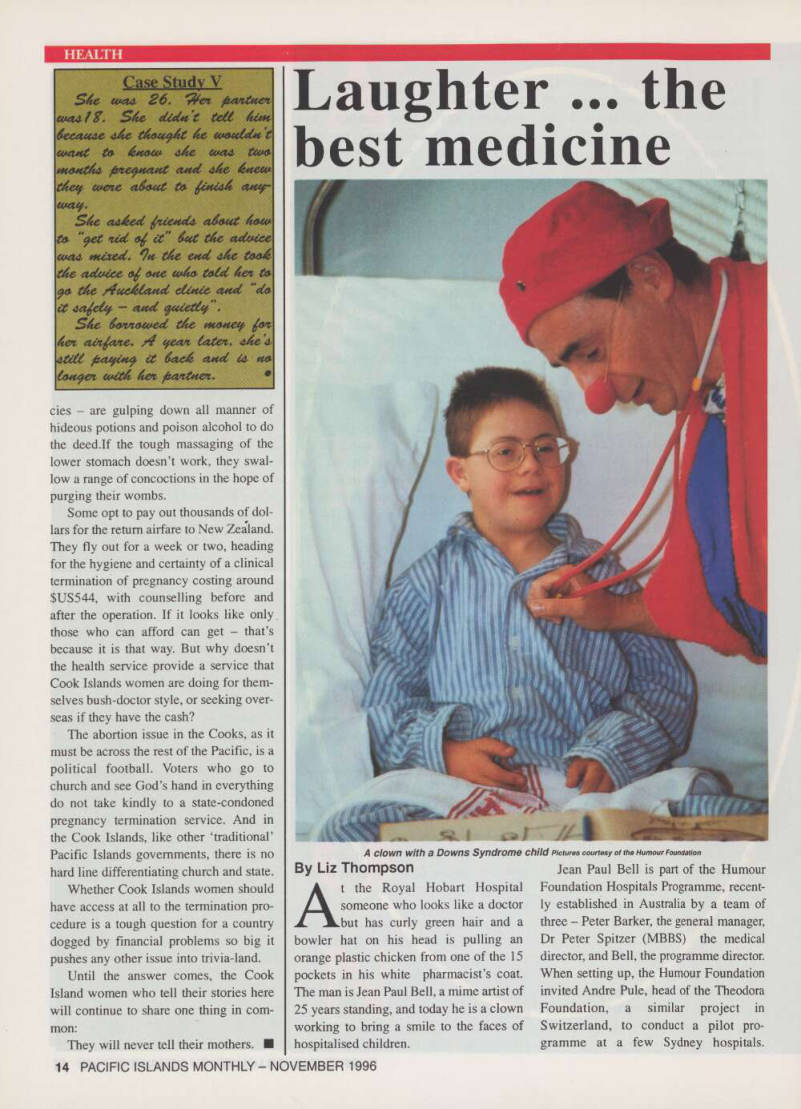
someone who looks like a doctor but has curly green hair and a bowler hat on his head is pulling an orange plastic chicken from one of the 15 pockets in his white pharmacist’s coat.
The man is Jean Paul Bell, a mime artist of 25 years standing, and today he is a clown working to bring a smile to the faces of
hospitalised children.
Jean Paul Bell is part of the Humour Foundation Hospitals Programme, recent ly established in Australia by a team of three - Peter Barker, the general manager, Dr Peter Spitzer (MBBS) the medical director, and Bell, the programme director.
When setting up, the Humour Foundation invited Andre Pule, head of the Theodora Foundation, a similar project in Switzerland, to conduct a pilot pro gramme at a few Sydney hospitals.
A Clown With a Downs Syndrome child Pictures courtesy of the Humour Foundation
Language was a bit of a problem but Bell teamed up with him for what was a very successful day. It was this which con firmed the team’s feeling that it would be beneficial to establish a formal pro gramme.
Humour therapy in hospitals is already
an international success. The Theodora Foundation runs clown doctor pro grammes in Europe, Brazil, South Africa and Russia. Clini Clowns work in Austrian hospitals. The Humour Project and The Clown Care Unit of The Big Apple Circus are just two of the long-run ning programmes in the United States.
Despite overseas acknowledgment of the importance of humour in hospitals, the Humour Foundation’s Hospital Programme is the first of its kind in Australia.
Inspirational and incredibly sensible in its philosophical approach, the foundation advocates humour, not only as a way of making hospital patients more relaxed and comfortable but also as making contribu tion to the actual healing process.
“International research,” says Barker, “has shown that laughter has physiological and psychological benefits, it has a positive effect on the heart rate and blood pressure, it reduces pain and relaxes the muscles.
Laughter reduces stress and helps main tain a positive outlook.”
Jack Thompson, one of the founda tion’s patrons, adds, “The specially trained performers of the foundation will bring to Australian hospitals the simple truth that the ability to embrace life, love, laughter is synonymous with healing.”
Watching the clowns at work amongst the staff and patients at The Royal Hobart Hospital in Tasmania, recently trauma tised by the terrible Port Arthur massacre, there can be little doubt that laughter is certainly a potent medicine. The clowns move amongst the young children’s beds
conducting a humour diagnosis. They
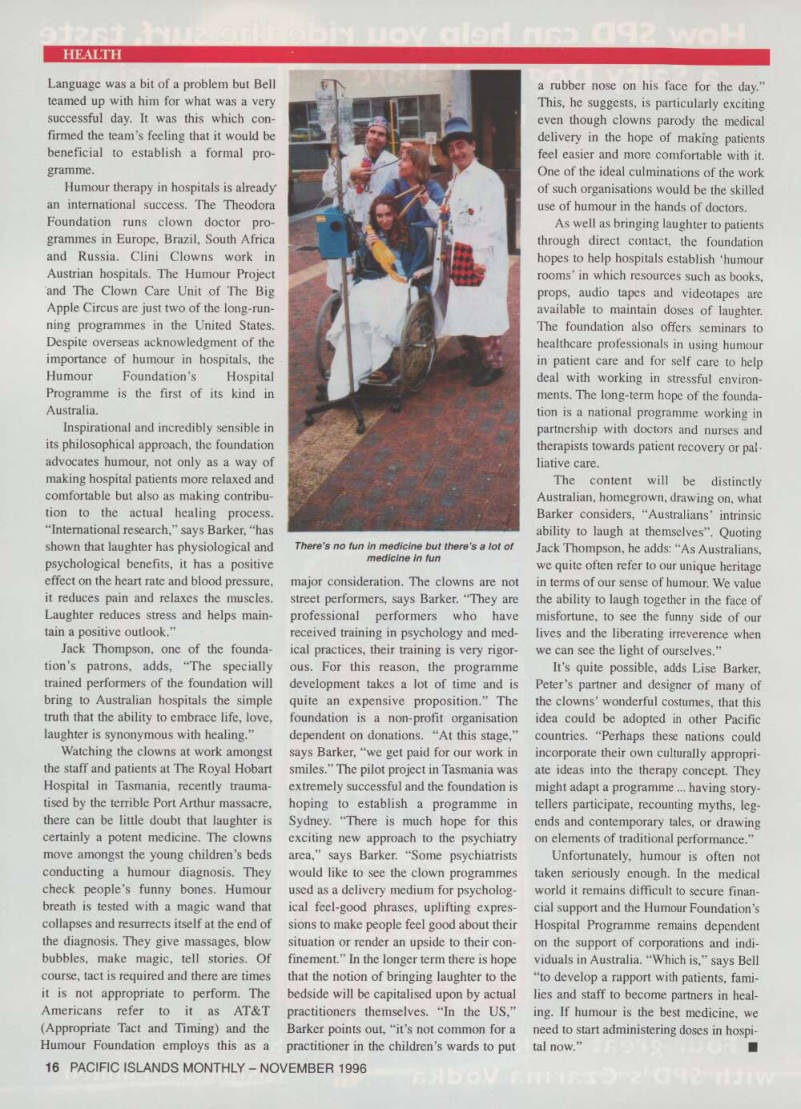
check people’s funny bones. Humour breath is tested with a magic wand that collapses and resurrects itself at the end of the diagnosis. They give massages, blow bubbles, make magic, tell stories. Of course, tact is required and there are times it is not appropriate to perform. The Americans refer to it as AT&T (Appropriate Tact and Timing) and the Humour Foundation employs this as a
major consideration. The clowns are not street performers, says Barker. “They are professional performers who have received training in psychology and med ical practices, their training is very rigor ous. For this reason, the programme development takes a lot of time and is quite an expensive proposition.” The foundation is a non-profit organisation dependent on donations. “At this stage,” says Barker, “we get paid for our work in smiles.” The pilot project in Tasmania was extremely successful and the foundation is hoping to establish a programme in Sydney. “There is much hope for this exciting new approach to the psychiatry area,” says Barker. “Some psychiatrists would like to see the clown programmes used as a delivery medium for psycholog
ical feel-good phrases, uplifting expres
sions to make people feel good about their situation or render an upside to their con finement.” In the longer term there is hope that the notion of bringing laughter to the bedside will be capitalised upon by actual practitioners themselves. “In the US,”
Barker points out, “it’s not common for a practitioner in the children’s wards to put
a rubber nose on his face for the day.”
This, he suggests, is particularly exciting even though clowns parody the medical delivery in the hope of making patients feel easier and more comfortable with it.
One of the ideal culminations of the work of such organisations would be the skilled use of humour in the hands of doctors.
As well as bringing laughter to patients through direct contact, the foundation
hopes to help hospitals establish ‘humour
rooms’ in which resources such as books, props, audio tapes and videotapes are available to maintain doses of laughter.
The foundation also offers seminars to healthcare professionals in using humour in patient care and for self care to help deal with working in stressful environ ments. The long-term hope of the founda tion is a national programme working in partnership with doctors and nurses and
therapists towards patient recovery or pal
liative care.
The content will be distinctly Australian, homegrown, drawing on, what Barker considers, “Australians’ intrinsic ability to laugh at themselves”. Quoting Jack Thompson, he adds: “As Australians, we quite often refer to our unique heritage in terms of our sense of humour. We value the ability to laugh together in the face of misfortune, to see the funny side of our lives and the liberating irreverence when we can see the light of ourselves.”
It’s quite possible, adds Lise Barker, Peter’s partner and designer of many of the clowns’ wonderful costumes, that this idea could be adopted in other Pacific countries. “Perhaps these nations could incorporate their own culturally appropri ate ideas into the therapy concept. They might adapt a programme ... having story
tellers participate, recounting myths, leg
ends and contemporary tales, or drawing on elements of traditional performance.”
Unfortunately, humour is often not taken seriously enough. In the medical world it remains difficult to secure finan cial support and the Humour Foundation’s
Hospital Programme remains dependent
on the support of corporations and indi viduals in Australia. “Which is,” says Bell “to develop a rapport with patients, fami lies and staff to become partners in heal ing. If humour is the best medicine, we need to start administering doses in hospi tal now.” ■
There’s no fun in medicine but there’s a lot of medicine in fun