Abortion
pp. 12-14 · Read in the full issue
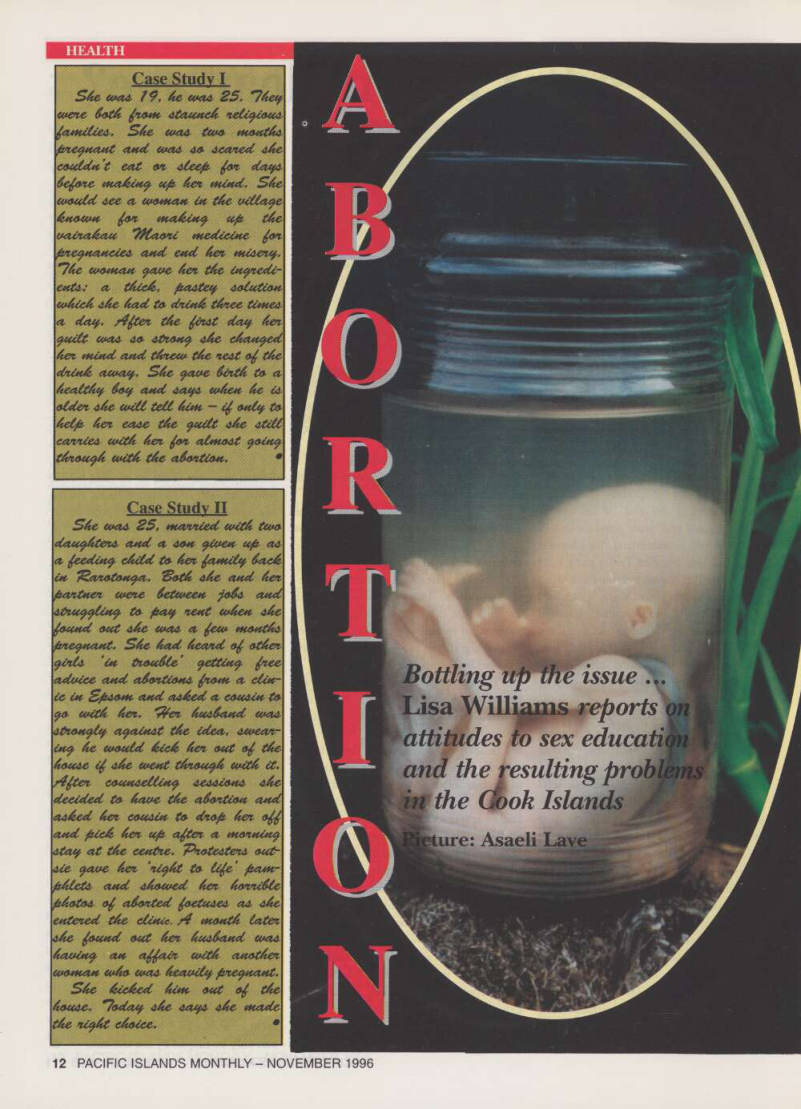
Bottling up the issue ...
Lisa Williams reports on attitudes to sex education and the resulting problems in the Cook Islands Picture: Asaeli Lave
It’s a three-syllable word unspoken in
polite conversation, and ignored in the Cook Islands medical jargon. In the Cook Islands, abortions are illegal - but not unheard of.
At a national conference on the status and rights of Cook Islands women in October and at another on reproductive health and the family the month before, abortion remained on the list of unspeak able topics, still belonging to the realm of secrets Cook Islands women will never share with their mothers.
Local doctors won’t go near the topic, unless it’s off the record and there’s no one around.
Yet they admit it is happening.
Cook Islands women - most of them young, still in school and with next to no knowledge of birth control - are begging them for abortions.
Their tears and woeful faces don’t cut them much slack - the doctors are too busy reminding them it’s a crime against the state to perform the procedure.
You can count the number performed in the national hospital based in Rarotonga in any given year on either hand. The “terminating of pregnancy”, or TOP, procedure is done only when preg nancy is the result of incest or rape.
But doctors - and the wider communi ty - in a country that is so small the coconut wireless is a fierce supplier of stories to the local media, have heard whispers of TOPs being done as D and C’s, the dilate and curretage procedure which doesn’t need the approval of a medical panel, yet can essentially be a TOP if the pregnancy is in the early stages.
But they also deny anything to do with
that practice.
“Is it happening here?” is the response from the acting head for health about the policy on abortion in the Cook Islands.
With Health Minister Dr Joe Williams and his secretary, Dr Roro Daniel, over seas, it lies with Sister Ngapoko Short to repeat the official line that TOPs are ille
gal.
It is safer for all to discuss why there are so many teenage pregnancies or mul tiple boom-boom-boom pregnancies. In a country where birth control is free, no one seems to be getting the message out on
planning families.
Down at Avarua town’s major pharma cy, one of two in the Cooks, staff sell pregnancy kits in three varieties - and turn away the frequent requests for ‘abor tion drugs’ from teenagers freaking out over being pregnant.
“They come in here crying and stressed out,” says one employee. “I have to feel sorry for them because they are so misinformed and scared.”
Most of the teenagers don’t seem to believe that the morning-after pill, which has to be taken within 72 hours of inter course, is not an abortion pill. Most of them are finding out too late about birth control - and as a result experts on family planning can see the Cooks problem lies in an education, health and social system that is still playing catchup with children
having children.
Overseas, while both sides of the abor tion argument take up their stance with a passion, the battle for doctors and the health system on the home front is trying to make “the Christian nation” understand it’s OK to talk to your kids about The Pill ... or The Condom.
“I find it so hard to believe that our culture comes up with a relaxed attitude to songs about sex, or finds it funny to sing these songs,” says one young woman, “but we can’t use the words to get the message across; everyone is just so shy when it comes to the topic.”
Many parents - and teachers - oppose the teaching of sex education in Cook Islands schools. Talks from public health nurses about contraception and what hap pens when boy (biblically) knows girl are few and far between.
When it comes to abortion, it’s consid ered widely that there is no argument over what to do when life begins, planned or not.
“You have the baby,” says one young mother. “You have it, give it away to someone else, or decide to keep it and struggle on anyway. Because you have to.”
But also an issue is that in the Cooks’
tiny, 20,000 and dropping population,
abortion is not as unheard of as its deci sion makers might like to pretend.
So long as the topic is kept out of polite conversation and medical profes sionals aren’t involved, women - and children who want to end their pregnan
cies - are gulping down all manner of hideous potions and poison alcohol to do the deed.lf the tough massaging of the lower stomach doesn’t work, they swal low a range of concoctions in the hope of purging their wombs.
Some opt to pay out thousands of dol lars for the return airfare to New Zealand.
They fly out for a week or two, heading for the hygiene and certainty of a clinical termination of pregnancy costing around SUSS44, with counselling before and after the operation. If it looks like only those who can afford can get - that’s because it is that way. But why doesn’t the health service provide a service that Cook Islands women are doing for them selves bush-doctor style, or seeking over seas if they have the cash?
The abortion issue in the Cooks, as it must be across the rest of the Pacific, is a political football. Voters who go to church and see God’s hand in everything do not take kindly to a state-condoned pregnancy termination service. And in the Cook Islands, like other ‘traditional’
Pacific Islands governments, there is no hard line differentiating church and state.
Whether Cook Islands women should have access at all to the termination pro cedure is a tough question for a country dogged by financial problems so big it pushes any other issue into trivia-land.
Until the answer comes, the Cook Island women who tell their stories here will continue to share one thing in com mon: They will never tell their mothers. ■