PNG’s guns-for-drugs
pp. 17-18 · Read in the full issue
trade gains momentum
Reports by Sam Vulum
More marijuana producers are opting to accept guns in exchange for drugs than money in what is reported to be an increasing trend in the illegal drug trade between Papua New Guinea and Australia in recent months.
Although there is no statistics avail able to prove what is now referred to as the “drugs-for-guns trade”, government authorities, especially in PNG, have strongly indicated that this appears to be the situation following changes to gun rules in Australia and PNG’s June imposi tion of the ban on the sale and issue of new firearms licences.
In an interview with ABC’s PNG cor respondent, Sean Dorney, in Port Moresby Police Commissioner Bob Nenta indicated that this was a “big worry”.
“Although we’ve not made any big breakthrough in guns coming into this country, the feeling has always been there
... We know for a fact that drugs have gone across the other side. We’ve had guns coming into the country.
“In fact, on the border, in the Western
Province, we’ve had some successful arrests of people coming in with guns but not on a very large scale, mainly perhaps because of the big coastline. We have no ways of keeping constant surveillance,”
Nenta told the ABC.
The National Narcotics Bureau also cited the increasing trend in marijuana trade in the Western Province and the Sanduan Province.
A senior bureau officer said earlier this year that they had established PNG as a transit point for drugs and weapons, espe cially with the guns-for-drugs trade.
He said because of inadequate infor mation, law enforcement agencies could only make an “educated guess” on the extent of the problem.
“But we know for a fact that drugs and weapons have been getting through. We can also say that PNG is a transit point but we have yet to substantiate this informa tion,” he said.
The problem is further highlighted in excerpts of a report by the National
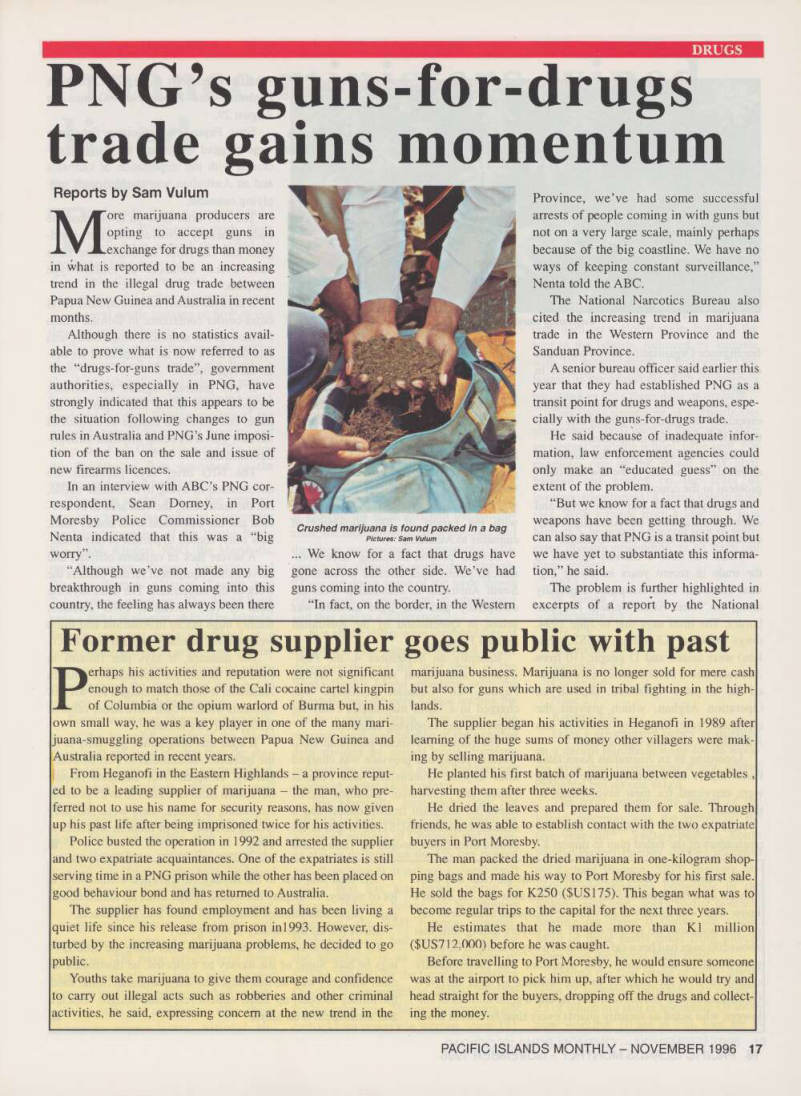
Crushed marijuana is found packed in a bag Pictures: Sam Vulum
Intelligence Organisation (NIO) published
on the front page of the Post Courier in
August.
The report said that more firearms, especially shotguns, are getting into PNG
through the guns-for-drugs trade.
Many are falling into the hands of criminals and adding to the law and order problem in the country.
The report said that both PNG and Australia are affected and Australia is con cerned over the influx of PNG drugs.
There has been a marked increase in the trade in recent years involving big time criminals from Australia, especially along the Torres Strait/Westem Province border. The brief says that in June 1994, drugs valued at K 3 million (SUS 2.3 mil lion) were seized and 11 people (10 from Australia and a PNG soldier) were arrest ed in a joint operation, known as Operation Afghan, which prevent the criminals from importing cannabis into Australia by boat and light aircraft.
According to an Australian Associated Press report in February, three people were convicted for their involvement in the racket.
AAP reported in August that the ringleaders of the failed plan to import $7
million of cannabis lost their appeals
against 10-year jail sentences.
Another incident, not cited in the NIO brief, was reported in 1995. According to newspaper reports, a major police opera tion in Goroka, Eastern Highlands Province, resulted in the arrest of several people. Two public servants were charged for conspiring with another partner who was previously arrested in connection with the export of 200 kilograms of cannabis to Australia.
Several people, including three com mercial pilots, were arrested in Adelaide, South Australia, in connection with the conspiracy and one light aircraft was seized in Queensland by the Australian Federal Police.
Recently on September 4, the Post- Courier once again reported a former Papua New Guinean politician was charged in a Cairn magistrates court for
importing and supplying cannabis.
The former provincial politician from
Western Highlands province was charged
after a joint Queensland and Federal Police and Australian Customs patrol found 3.5 kilogram from cannabis and a suitcase containing SUS 1180 in $5O notes aboard three boats moored off Tudu Island
- halfway between the tip of Cape York Peninsula and Papua New Guinea on
August 29.
Four Papua New Guinea fishermen
were charged with being knowingly con
cerned with the importation of cannabis and an Australian was charged with sup
plying cannabis.
The NIO brief goes on to say that the trade generally involves shotguns, hand guns and .22 rifles although there have been a few instances of military-type weapons.
It says the recent fourth Australia/PNG cross-border conference in Goroka which focused on the arms-and-drugs trade, was told that there was an urgent need for bet ter surveillance.
It was generally agreed that military weapons were not a major part of the trade, but this could change as a result of the new gun laws being imposed through out Australia.
The NIO brief says problems are encountered in trying to overcome traffic, not the least being the vast area to be cov ered and the traditional cross border links, now often abused in pursuit of this trade.
A severe lack of customs officials and surveillance equipment further hinders the work of the authorities. The brief says the trade is very lucrative. PNG cannabis fetches huge prices in Australia and illicit weapons are similarly expensive in PNG.
For instance, it says one firearm in PNG can be sold for thousands of kina. In Australia, it can be exchanged for 40kg of cannabis which would have street value of
K 200,000 (Us 140,000).
It adds that drug abuse generally is on the increase. Admissions to Port Moresby General Hospital over cannabis misuse have risen from five in 1990 to 27 in 1995.
According to police, there were 382 drug related arrests, 339 of them in the NCD in 1995. ■
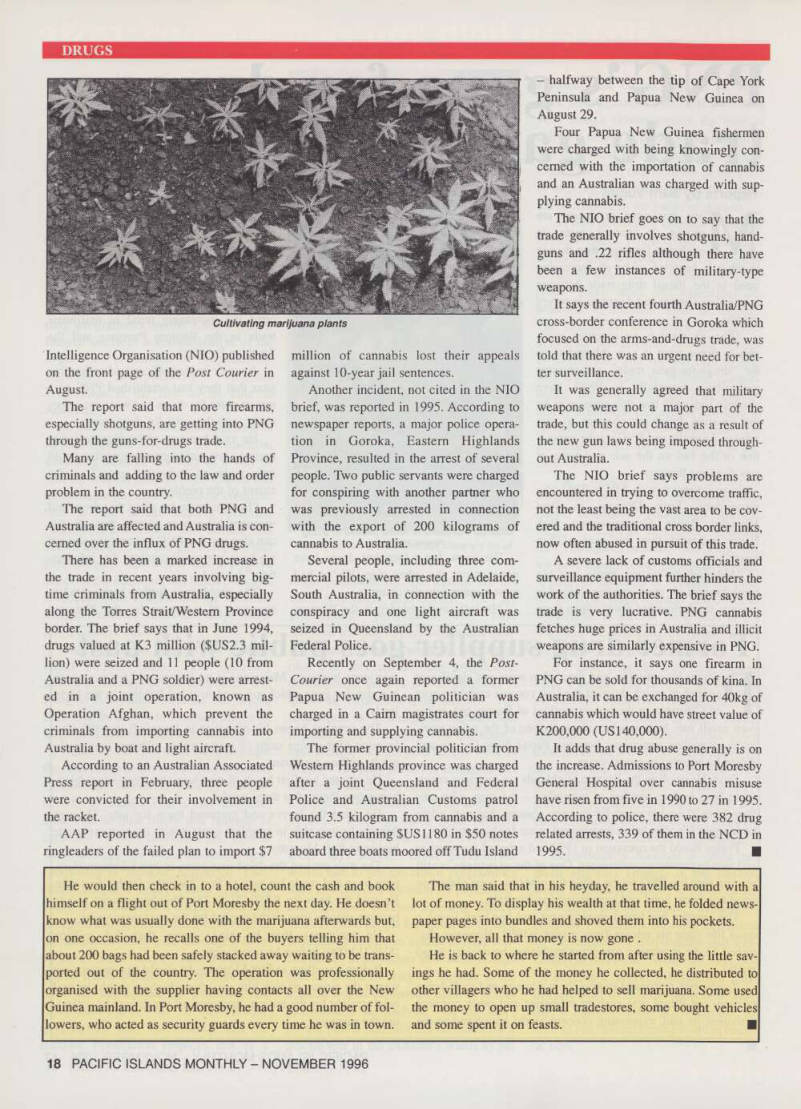
Cultivating marijuana plants