worlds of
pp. 53-54 · Read in the full issue
The two worlds of Lali Karembeu
By Atama Raganivatu
Throughout the rest of the world he is known as Christian Karembeu and feted as a supremely gifted interna tional sportsman but in Canala, his New Caledonian home village, he is referred to as Lali Karembeu and receives little rever ence, due to his having a lowly place with in the tribal hierarchy. In Genoa, where he now resides, the current Oceania Footballer of the Year enjoys the opulent lifestyle of a highly paid soccer superstar, complete with an expensive car, regular visits to top-class restaurants, a luxurious apartment and flock of beautiful young female admirers. When visiting Canala, he happily strolls around barefoot, helps tend the family garden and eats the local cui sine, usually a stew comprising fish, banana leaves and coconut milk.
Karembeu is truly a man of two worlds and is equally comfortable in both. Canala lies on the coast of New Caledonia’s Nord Province, at the end of a long and bumpy track winding through dense bush. Its 3000 inhabitants are, almost exclusively, Kanaks. The Lali Karembeu story, though, starts in Lifou Island’s Gaitcha district, where his mother, Hudrenie, has her fami ly roots. She and Paul-Marcel Karembeu married there and began producing a fami ly of five sons and four daughters. Lali was bom in Lifou on December 3, 1970. In 1979, the Karembeus moved to Canala, Paul-Marcel’s bithplace and the spiritual home of his tribe.
Amazingly, Lali played no soccer what soever at either Gaitcha or Canala and only participated in informal versions of the game immediately after moving to Noumea and attending the capital’s Dokamo School.
Lali contented himself playing in inter school matches and beach “kickarounds” with friends. Athletics was then his major sporting interest and he displayed great promise as a sprinter. It took a cunning subterfuge to introduce him to organised
soccer. Emile Wanapopo coached the youth team of F C Gaitcha, a Noumea based club which fielded only players bom in the Lifou district bearing its name.
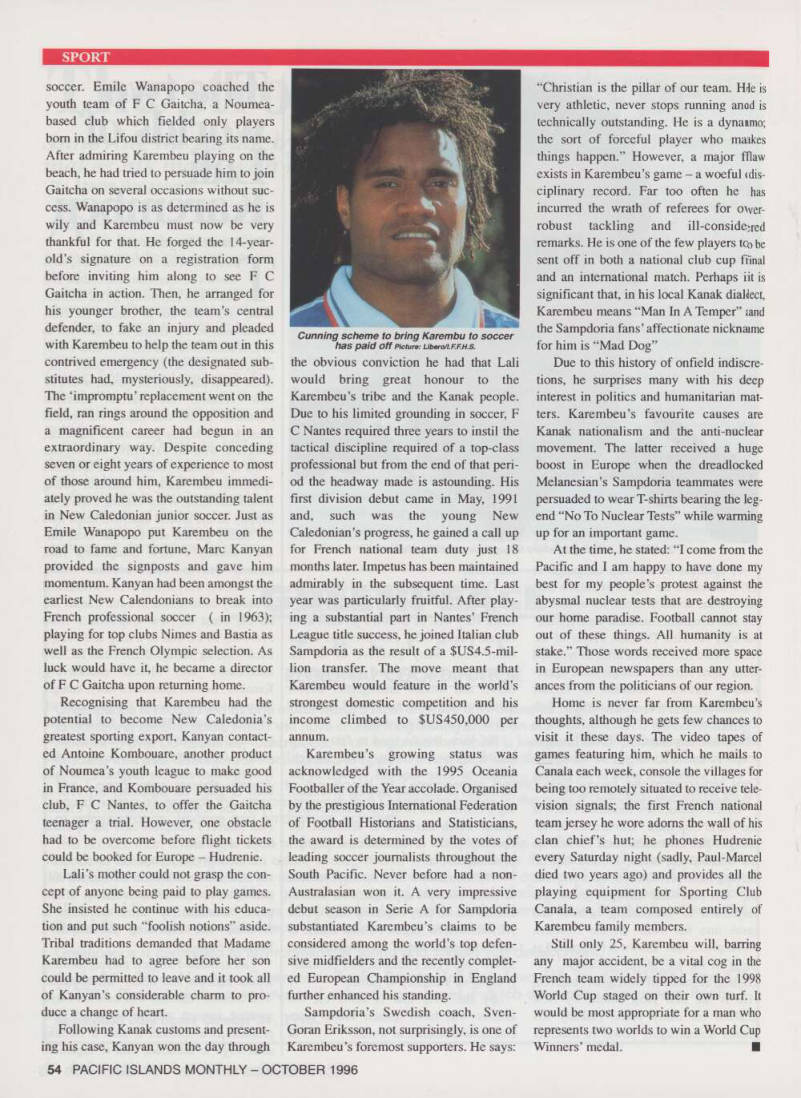
After admiring Karembeu playing on the beach, he had tried to persuade him to join Gaitcha on several occasions without suc cess. Wanapopo is as determined as he is wily and Karembeu must now be very thankful for that. He forged the 14-year old’s signature on a registration form before inviting him along to see F C Gaitcha in action. Then, he arranged for his younger brother, the team’s central defender, to fake an injury and pleaded with Karembeu to help the team out in this contrived emergency (the designated sub stitutes had, mysteriously, disappeared).
The ‘impromptu’ replacement went on the field, ran rings around the opposition and a magnificent career had begun in an extraordinary way. Despite conceding seven or eight years of experience to most of those around him, Karembeu immedi ately proved he was the outstanding talent in New Caledonian junior soccer. Just as Emile Wanapopo put Karembeu on the road to fame and fortune, Marc Kanyan provided the signposts and gave him momentum. Kanyan had been amongst the earliest New Calendonians to break into French professional soccer ( in 1963); playing for top clubs Nimes and Bastia as well as the French Olympic selection. As luck would have it, he became a director of F C Gaitcha upon returning home.
Recognising that Karembeu had the potential to become New Caledonia’s greatest sporting export, Kanyan contact ed Antoine Kombouare, another product of Noumea’s youth league to make good in France, and Kombouare persuaded his club, F C Nantes, to offer the Gaitcha teenager a trial. However, one obstacle had to be overcome before flight tickets could be booked for Europe - Hudrenie.
Lali’s mother could not grasp the con cept of anyone being paid to play games.
She insisted he continue with his educa tion and put such “foolish notions” aside.
Tribal traditions demanded that Madame Karembeu had to agree before her son could be permitted to leave and it took all of Kanyan’s considerable charm to pro duce a change of heart.
Following Kanak customs and present ing his case, Kanyan won the day through
the obvious conviction he had that Lali would bring great honour to the Karembeu’s tribe and the Kanak people.
Due to his limited grounding in soccer, F C Nantes required three years to instil the tactical discipline required of a top-class professional but from the end of that peri od the headway made is astounding. His first division debut came in May, 1991 and, such was the young New Caledonian’s progress, he gained a call up for French national team duty just 18 months later. Impetus has been maintained admirably in the subsequent time. Last year was particularly fruitful. After play ing a substantial part in Nantes’ French League title success, he joined Italian club Sampdoria as the result of a SUS4.S-mil lion transfer. The move meant that Karembeu would feature in the world’s strongest domestic competition and his income climbed to $U5450,000 per annum.
Karembeu’s growing status was acknowledged with the 1995 Oceania Footballer of the Year accolade. Organised by the prestigious International Federation of Football Historians and Statisticians, the award is determined by the votes of
leading soccer journalists throughout the
South Pacific. Never before had a non- Australasian won it. A very impressive debut season in Serie A for Sampdoria substantiated Karembeu’s claims to be considered among the world’s top defen sive midfielders and the recently complet
ed European Championship in England
further enhanced his standing.
Sampdoria’s Swedish coach, Sven- Goran Eriksson, not surprisingly, is one of Karembeu’s foremost supporters. He says:
“Christian is the pillar of our team. HJe is very athletic, never stops running anod is
technically outstanding. He is a dynanmo;
the sort of forceful player who maakes
things happen.” However, a major fflaw
exists in Karembeu’s game - a woeful (dis ciplinary record. Far too often he has incurred the wrath of referees for o\ver robust tackling and ill-considered remarks. He is one of the few players tco be sent off in both a national club cup fi'inal and an international match. Perhaps iit is significant that, in his local Kanak dialdect, Karembeu means “Man In A Temper” :and the Sampdoria fans’ affectionate nickname for him is “Mad Dog”
Due to this history of onfield indiscre tions, he surprises many with his deep interest in politics and humanitarian mat ters. Karembeu’s favourite causes are Kanak nationalism and the anti-nuclear movement. The latter received a huge boost in Europe when the dreadlocked Melanesian’s Sampdoria teammates were persuaded to wear T-shirts bearing the leg end “No To Nuclear Tests” while warming up for an important game.
At the time, he stated: “I come from the Pacific and I am happy to have done my best for my people’s protest against the abysmal nuclear tests that are destroying our home paradise. Football cannot stay out of these things. All humanity is at stake.” Those words received more space in European newspapers than any utter ances from the politicians of our region.
Home is never far from Karembeu’s thoughts, although he gets few chances to visit it these days. The video tapes of games featuring him, which he mails to Canala each week, console the villages for being too remotely situated to receive tele vision signals; the first French national team jersey he wore adorns the wall of his clan chief’s hut; he phones Hudrenie every Saturday night (sadly, Paul-Marcel died two years ago) and provides all the
playing equipment for Sporting Club
Canala, a team composed entirely of Karembeu family members.
Still only 25, Karembeu will, barring any major accident, be a vital cog in the French team widely tipped for the 1998 World Cup staged on their own turf. It would be most appropriate for a man who represents two worlds to win a World Cup Winners’ medal. ■
Cunning scheme to bring Karembu to soccer has paid Off Picture: Libero/I.F.F.H.S.