of the logging industry
p. 55 · Read in the full issue
Forestry
The haves and have-nots of the logging industry
By Sam Vulum
In every timber project in Papua New Guinea, there are two different groups of landowners - the unsophisticated village dwellers and the educated elite who find comfort in towns. Although they may speak the same language and come from the same ethnic tribe, they pursue two distinct worlds of their own.
The elite, who are officials of landowner companies, appear to be more advanced than their village peers. They live in high covenant houses, dress in bet ter clothes, eat well and travel around in flashy cars. Meanwhile, their colleagues in the villages continue to live in bush material houses, plunder the soil, comb the forest and frequent the sea for their survival. Decent clothes are hard to come by and they move around mainly on foot.
Naturally, this should not be the case because both groups equally own- the har vested logs by birth. Unfortunately, this is the bare fact of the situation in many pro jects throughout the country today. The landowner companies were formed to act as representatives of landowners in the development of their timber resource.
Apart from their business interests, the
companies receive royalty and premium
payments from contractors and distribute them to landowners. They retain some of the money to fund their operations.
The companies’ major objective is to
represent the landowners in meaningful development and management of their timber resource. However, it has become
apparent in many instances that they fail to fulfdl this responsibility. Landowners on numerous occasions alleged that their companies held back a lot of money only to be misappropriated and not used for purposes of operating profitable business es. They claimed that their companies were operating outside of legal business practices. For example, in one company, allegations were made that management decisions were unilaterally made by the general manager. Neither the company secretary nor the accountant had any say on how the company’s finances were used. This situation has resulted in funds being misused. In one case, some thou sands of kina was used to fund the elec tion campaign of a national member of parliament. In another, some substantive amount of money was used to fund fre quent personal trips of company officials to Port Moresby.
The allegations give rise to questions over whether the government should have any control over the operations of the companies; that is, if it is truly serious about seeing the success of its stated pri
ority of fostering sustainable development
of the resource. There must be concern, following the evidence of the famous Barnett Inquiry, that under the guise of
popular participation such as conveyed in
the phrase “landowner company”, these ventures entail risks which could mean at worst the disenfrachisement of many tra ditional right holders for no worthwhile economic return. In short, the destruction
of customary livelihood and landscape.
Some of the problems in the operations
of local companies were highlighted by
AusAid, then AIDAB, in a 1990 study of local companies in the Kandrian and Cape Gloucester districts in the West New Britain Province. The study said most company officials lack specialist informa tion on the restructuring of companies and the requirements of company law regard ing shareholders, share registers and share certificates. AusAID said the officials lacked information on the financial impli cations of contracts they had signed with logging contractors and landowners on the technical, commercial and marketing requirements of running and supervising
properly planned and central logging
operations. “The companies pose limited commercial, management and administra tive skills. This weakness affects all aspects of their operations, from negotiat
ing with and monitoring the performance
of their contracting logging companies to distribution of royalties to landowner members. Most companies have defined their planned activities in broad develop ment terms, ranging from the provision of social services through the creation of infrastructure to improving living stan dards. The achievement of these develop ment aims is hardly possible without close collaboration between the companies and the government,’’AusAid said in the study.
It would be interesting to find out what the landowner companies do with the pre miums paid to them. These premiums vary, but would average at about 10 per cent of the gross value of logs and, for example, would have been to the order of K5O million ($U538.34 million) across the whole country in 1994 when the total log export value was about K5OO million.
Once the money is paid out by con tractors, it becomes the responsibility of the landowner companies. It is necessary to have enabling mechanisms and exten sion advisory services to better assist the landowner companies in their application of these funds. ■
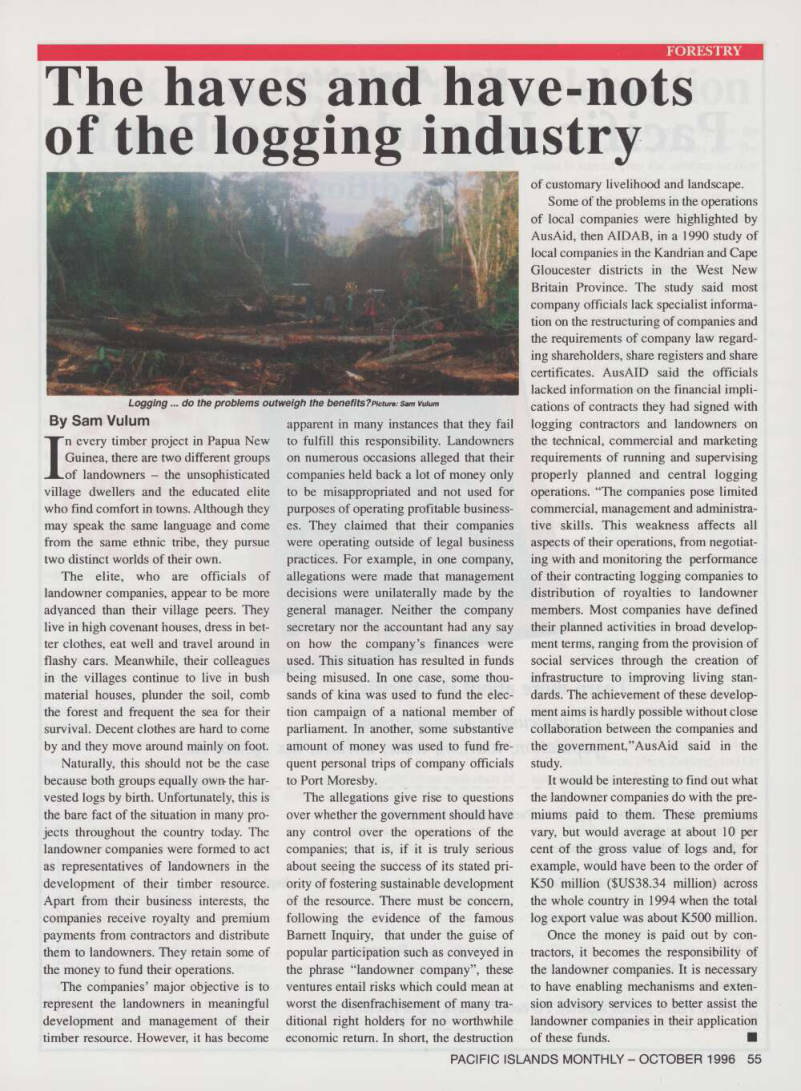
Logging...do the problems outweigh the benefits? Picture: sam vulum