The strong, silent type
pp. 52-53 · Read in the full issue
Annoying the media by keeping too low a profile, Olo Brown makes his mark with his quiet achievements
By Atama Raganivatu
Although one of the most influen tial figures in the world today, 010 Brown has a low profile and that, most definitely, is the way he likes it.
Brown hates the limelight and his reluctance in attending award functions and dogged refusal to grant interviews have become a source of amusement and irritation - in about equal measure - to the sporting media around the world. The Samoan prop forward is very much the quiet achiever and his achievements are magnificent.
Bom in Apia on October 24, 1967 and christened 010 Max Brown soon after wards, he has spent all but the first few months of his life in New Zealand and is a classic example of Samoan raw talent refined through Kiwi rugby’s matchless coaching and development programmes
to become a world beater.
Much of Brown’s life has been spent at Ponsonby, a central Auckland suburb renowned for its rugby club which boasts of producing more All Blacks than any other club in New Zealand.
And it was the “Ponies” Brown joined upon leaving school but he had already given a glimpse of his potential before then. Brown’s sterling and consistent per formances for the Mount Albert Grammar School first XV won him a call up into the New Zealand secondary schools’ team that toured Australia in 1985. Despite his comparatively tender years. Brown imme diately established himself amongst the top props in the tough Auckland senior club competition and, when All Black Steve McDowell left the city in 1989, a successor had already been groomed to take possession of the Auckland provin cial side’s number three jersey.
Brown’s initial full season of first-class rugby ended with Auckland triumphing in both New Zealand’s major domestic com petitions, the Ranfurly Shield and National Championship. His distin guished role was acknowledged by him being named amongst the country’s Five Most Promising Players. 1990 saw Brown become an All Black. On tour with the New Zealand Development team in Canada, he was flown across the Atlantic to join the world’s most prestigious rugby side, which had become depleted through injuries while touring France.
Brown had to wait until 1992 before making his Test debut and from that time he has gained admirers and plaudits in huge numbers. One of New Zealand’s Five Players of the Year in 1992, Brown has - apart from the odd game missed through injury - been an automatic choice for the All Blacks ever since.
A splendid World Cup campaign in
1995 increased the legion of Brown fans and, on the domestic front, his efforts for the still dominant Auckland were reward ed with the First Division Player of the Year award four months after he returned from South Africa. Amongst those appre ciating Brown’s abilities is former Australian national team coach Bob Dwyer, who said: “010 has added a tremendous amount to All Black teams in recent years. He is one New Zealand play er who I would have loved to see playing for my teams, if he had been eligible.”
Laurie Mains, New Zealand’s coach at the World Cup adds; “010 is often devas tating. After he’d established himself on the international scene, I asked him to become more prominent in open play and use his bulk and strength more. He responded in outstanding fashion and came into his own.” In the Northern Hemisphere, too, Brown is recognised as being at the top of his profession. Ex- England captain Bill Beaumont observed: “He is the best prop fielded by New Zealand for many years. Nobody has greater scrummaging power or mobility
than him.”
The strength encompassed within his 1.83-metre-tall and 110-kilogram-heavy frame may well be Brown’s greatest asset on the rugby field. However, he is far from what many perceive to be the archetype prop forward of immense brawn and limited intelligence. Brown gained a degree at Auckland University and is a qualified accountant.
He, then, has no need to fear for his future upon retirement. That, though, should be some time off yet and in the meantime he can look forward to remain ing a cornerstone of an All Black combi nation which threatens to dominate the opening years of international rugby’s
professional era.
The formidable Samoan is scheduled to make his 50th appearance for the All Blacks before they complete their South African tour on August 31 and, if able to match the durability of his compatriot and fellow prop Peter Fatialofa, may eventual ly clock up a century of games.
By the time that is achieved, his actions will have spoken louder than countless thousands of words. ■
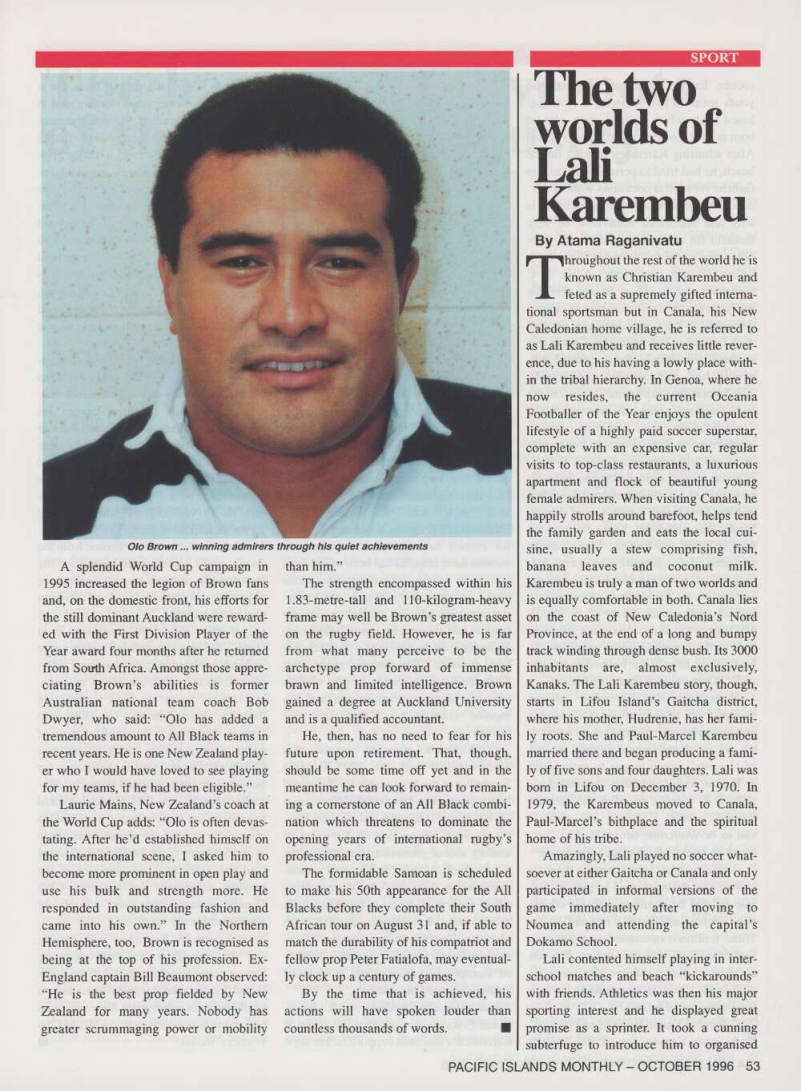
Olo Brown...winning admirers through his quiet achievements