Rugby’s irrepressible Ropati brothers
pp. 50-51 · Read in the full issue
By Atama Raganivatu
The Ropati brothers are unique in rugby league and, almost certain ly, world sport. Six have appeared at international level and, between them, they can claim representative honours with four different countries.
Such a cosmopolitan brood, one would naturally assume, must have an
extraordinary and complex background.
However, Sosene Ropati, the boys’ father and patriarch of his talented family, is
always willing to enlighten those who
quiz him about it.
“As a matai from the village, I am delighted that all my sons regard Lalomanu, in the district of Aleipata, Western Samoa, as their home,” he states proudly. “Many people believe we origi nate from Tokelau because three of the boys have played for it in the Pacific Cup, but this is not so. My father was Tokelauan and, in order to make the tour nament as competitive as possible, they were asked to represent one of the weak er entrants. Actually, none of us have been there!” Surprisingly, Sosene played little sport himself. “Just the odd game of rugby union at St Joseph’s College in Apia,” he chuckles. Nor does the boys’ mother, Margaret, boast any athletic
accomplishments.
Sosene moved to Auckland in 1954 and met Margaret, a New Zealander, four years later. They now have eight children - seven sons and one daughter. Greatly respected through his matai status in Samoa, Sosene was humbled upon dis covering he held a lowly place in the Kiwi class system and resolved that none of his children would become unvalued blue-collar workers like him.
The harsh discipline Sosene imposed while striving to encourage his children to reach the highest standards in both sport and education, though widely accepted in Samoan culture, conflicts with the liberal stance on child rearing currently prevailing in New Zealand soci ety and stimulated much controversy when revealed in Running On Empty, a book recently written by the second-
Sport
youngest son, Iva.
The book recalls the poverty endured by the family and how they were only able to keep their heads above water financially through the heroics of Margaret, who held down part-time facto ry jobs whilst raising eight children.
Sosene and Margaret must now feel that all the sacrifices were worthwhile for, not only did the boys gain success as rugby players, those who have retired are now engaged in responsible positions one a lawyer, two managers and one a company secretary. In addition Nai, their only daughter, is a customs manager.
All of Sosene and Margaret’s male off spring have played rugby league at senior level. The eldest. Feu, made the least impact but was still good enough to tour Australia with an Auckland Colts selec tion. A move to Papua New Guinea, after being offered a position there as quarry manager, ended his chances for further honours.
The first Ropati to make a substantial mark was Joe. Despite being leading points scorer on New Zealand’s tour with
high-profile clubs Warrington (England)
and Manly (Sydney), he is best remem
bered for his spectacular try against Australia in 1983 that clinched the Kiwis’ first Test across the Tasman Sea for 20 years.
Prior to becoming an overseas-based professional, Joe was a member of the Mangere East Club in Auckland. Amongst his team mates were Iva, John, Tea and Peter Ropati. In 1987, all but Iva played for the Auckland provincial XIII against Northern Districts. Never before had four brothers lined up alongside each other in the same representative side. John, Peter, Iva and Tea also appeared together with the New Zealand selection that won the 1986 World Students Cup at Auckland.
Peter can, justifiably, call himself the true globetrotter of the family. As well as appearing for England’s Leigh Club and captaining the Victoria State combination in Australia, he ‘gained’ a place amongst the Papua New Guinea President’s XIII that suffered a record-breaking 106-3 defeat by Queensland when living at Port Moresby in 1983.
Fortunately, Tea’s international experi
ences do not include any such traumas. As a 19-year-old, he wore New Zealand’s colours for the first time while touring Australia and Papua New Guinea (with Joe) in 1986, but his Test debut was delayed until 1992 when caps were gained against PNG and Great Britain. He also played with distinction when facing Australia the following year. 1995 saw him, much to the joy of Sosene, feature in Western Samoa’s inaugural World Cup campaign. He had earlier represented Sefi Samoa at two Pacific Cups, helping them win the 1990 event.
At club level. Tea has served Warrington, Swinton and St Helens of England as well as Newcastle Knights and Auckland Warriors in Australia’s major domestic competition. His sterling efforts during the Saints’ 1992-93 British Premiership triumph were acknowledged with the First Division Player of the Year accolade. He was also voted the Warriors’ best performer in 1995.
Iva too has tasted top-class fare in both Australia and England. After establishing himself as a midfield back of great ability
with English outfits Oldham and Featherstone Rovers, he was called up for the New Zealand touring party which toured Britain and France in 1993, appear ing in three Tests during that expedition.
Then, his career lost momentum when he broke his leg while on loan to Sydney club Parramatta in 1994. The inability to regain full fitness after the fracture healed, a series of unrelated ankle injuries and a personality conflict with Rovers’
Australian coach, Steve Martin, conspired to force him into quitting rugby league and returning to his original profession -
teaching.
However, after 14 months on the side lines, Iva was persuaded to come out of retirement by Auckland Warriors coach John Monie and played so well in 1996 that he gained selection for Western Samoa’s Oceania Tournament squad.
Feu, Joe, John and Peter hung up their boots several years ago, while Tea and Iva, aged 30 and 29 respectively, can’t anticipate many more seasons in the game. The name Ropati, though, seems certain to be around the sporting scene for decades to come.
Romi Ropati played for Tokelau in the 1992 Pacific Cup when only 16, but it is as a rugby union player that he has emerged as one of New Zealand sport’s most exciting prospects. Romi starred in the Kiwi’s national schoolboys XV in 1995, before graduating to their Colts (Under-19) selection early this year and then being drafted into the all-conquering Auckland senior provincial team. Most observers believe that Romi has the abili ty to become an outstanding All Black.
Then there is George Ropati.Tea’s recently bom son will be able, when he can talk, boast of a maternal grandfather (Roger Bailey), who spent nine years in New Zealand’s national rugby league side, as well as his distinguished uncles and father. Moreover, he is named after George Mann - the Tongan international who was a teammate of Tea’s at Newcastle and St Helens.
With a pedigree like that, we can con fidently expect George to spearhead another wave of Ropatis in about 2016. ■
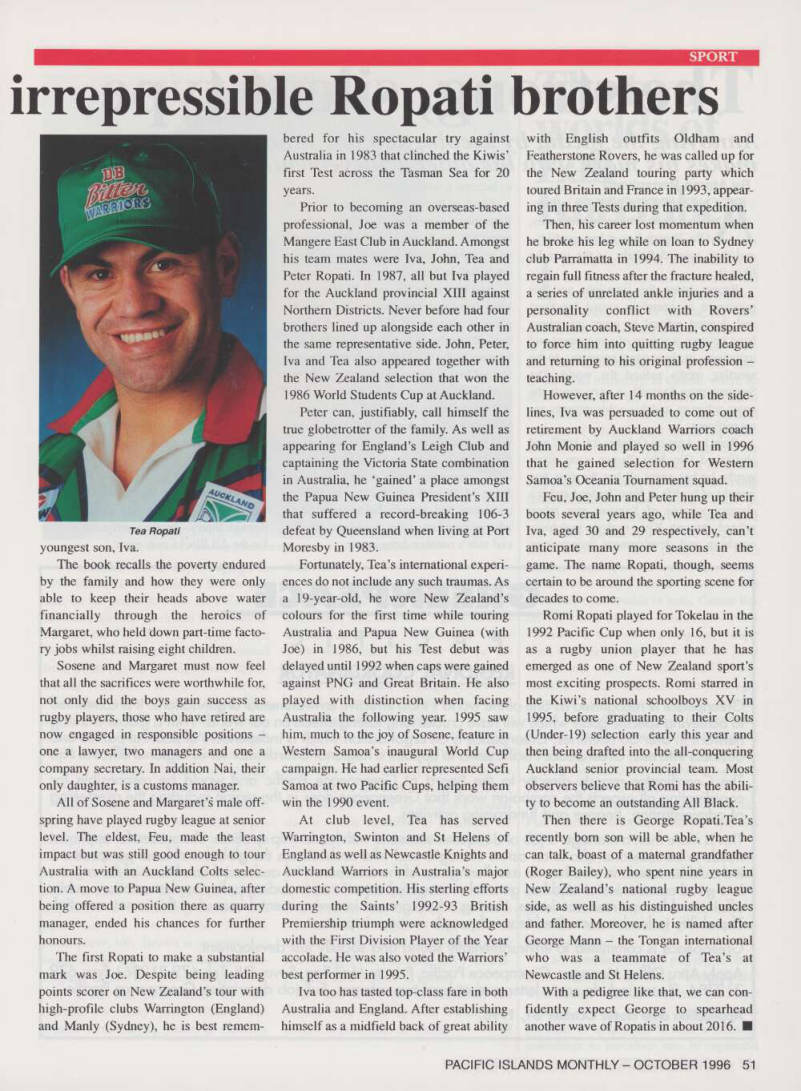
Tea Ropati