P NG's pottery
pp. 49-50 · Read in the full issue
Culture
P NG's pottery traditions
I remember clearly the first time I trav elled along the Sepik River in Papua New Guinea in a tiny dugout canoe. We had turned off the main river and into a beauti ful channel surrounded by long grasses; every now and again white egrets would take you by surprise as they broke from the banks and soared across the lead-grey sky, growing heavy before a storm.
Finally, we pulled the boat onto the muddy banks at Chambri Village and within minutes were surrounded by people.
Walking up amongst the houses all built on stilts, hundreds of animal faces sculpted onto clay stared out from the platforms which were built beneath them. Huge pots used for storing sago, small water pots, clay fireplaces - all were adorned with faces.
Some wore pig tusks, others were birds, a few looked almost human.
Chambri is famous in the Sepik region for its pots which have become a huge tourist attraction. Mostly made by the coiling method, they are baked in open fires and have been used and traded by Chambri villagers for centuries.
Throughout Papua New Guinea a rich pottery tradition exists.
Until recently, little was known about it and the first comprehen sive study was conducted by two women, Patricia May and Margaret Tuckson; they spent eight years travelling around the country photographing and recording various pot-making tech niques and talking to the villagers about their uses, the symbol ism of certain markings and the different ways in which they are made.
Whilst travelling, wherever possible Tuckson collected three of each type of pot she saw - one for the Papua New Guinea Museum, one for the Australian Museum and one for herself.
Their research formed the basis of a superb book. The Traditional Pottery of Papua New Guinea, which remains the most thorough analysis of pot making in PNG today.
Almost every area has its own legend or myth which describes how pots and the art of pot making came to the people.
One particularly interesting story recounted by May and Tuckson is to do with the people of Silosilo Bay in Milne Bay Province: “At Gedigedi Village lived a witch who was the only woman who possessed clay pots and fire to cook with.
“Every day the witch prepared the food for the hunters by placing it in the sun. She also prepared her own food by putting it in a clay pot and cooking it with fires which she took from her
h
anus. In order that the men would not learn her secret, when she finished eating she would put the pot and fire back into her anus.
One day the men discovered some cooked food the witch had mistaken ly left out. They wanted to know how she made it taste different, so one man hid in the comer of her house.
When the man saw what she did he rushed out and grabbed the fire and took it to the other villages. In this way
fire was given to all the villages of Silosilo Bay. The women went to her and threatened to kill her if she didn’t show them her pot and how to make it.
“Then the women went back to their villages, made pots and taught other women. That is why today the people use fire and clay pots for cooking instead of drying their food in the sun as they used to do long ago.”
Most people still use open fires to fire their pots. At one stage a project funded by the United Nations Educational, Scientific and Cultural Organisation attempted to teach the people how to make bricks and build kilns in which they could fire their pots to a higher temperature.
In fact, this higher temperature made the pots slightly more brittle so that when they were used for cooking on an open fire they would often crack. Several years after the project had been established Tuckson could only find one potter who continues to use a kiln on occasion.
Basically, two techniques were used for making traditional pots - coiling and paddle and anvil - and it is these which con tinue to be used today.
The potter’s wheel did not exist although today a few urban potters have learnt to use them. The paddle-and-anvil technique is used exclusively by certain coastal communities and small island groups.
Most of these kinds of pots are made by women and are often of a rounded shape at the base.
The technique involves beating out a lump of clay using a smooth round river stone and a wooden paddle beater with which they build up the sides.
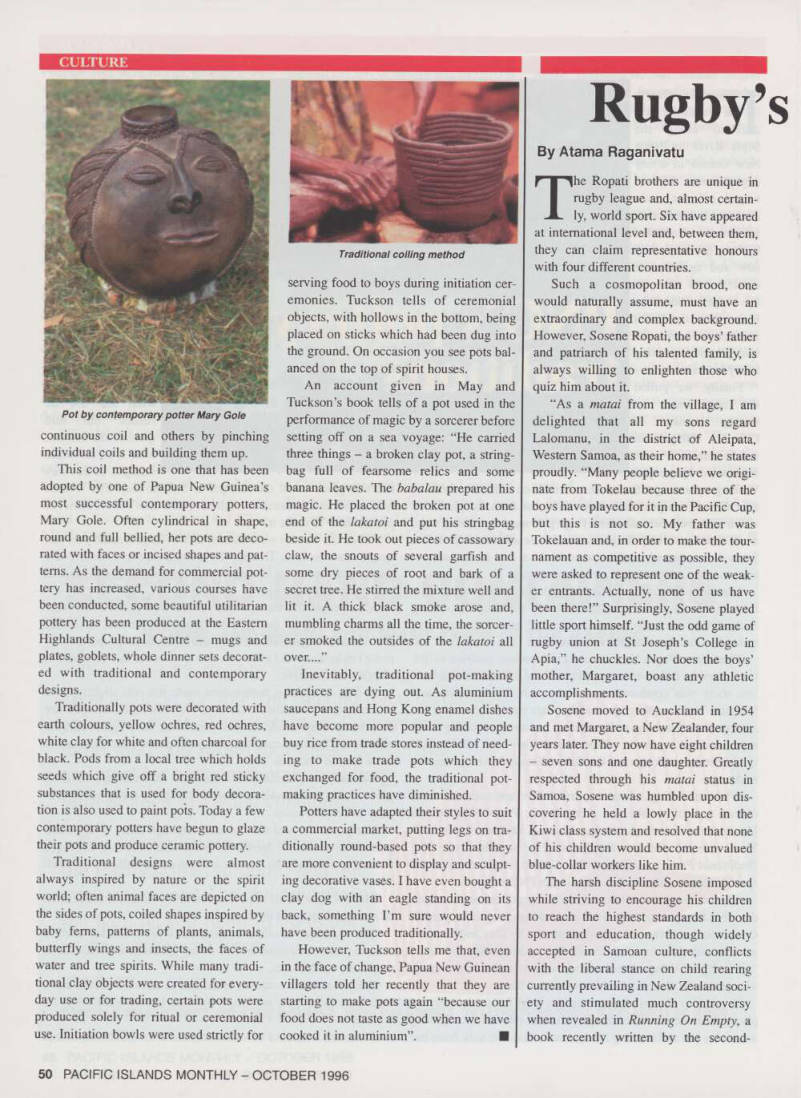
The other most common technique is the coil pot. In most instances, these pots are made by men but in some areas by women.
There are a number of variations; some are made out of one
continuous coil and others by pinching individual coils and building them up.
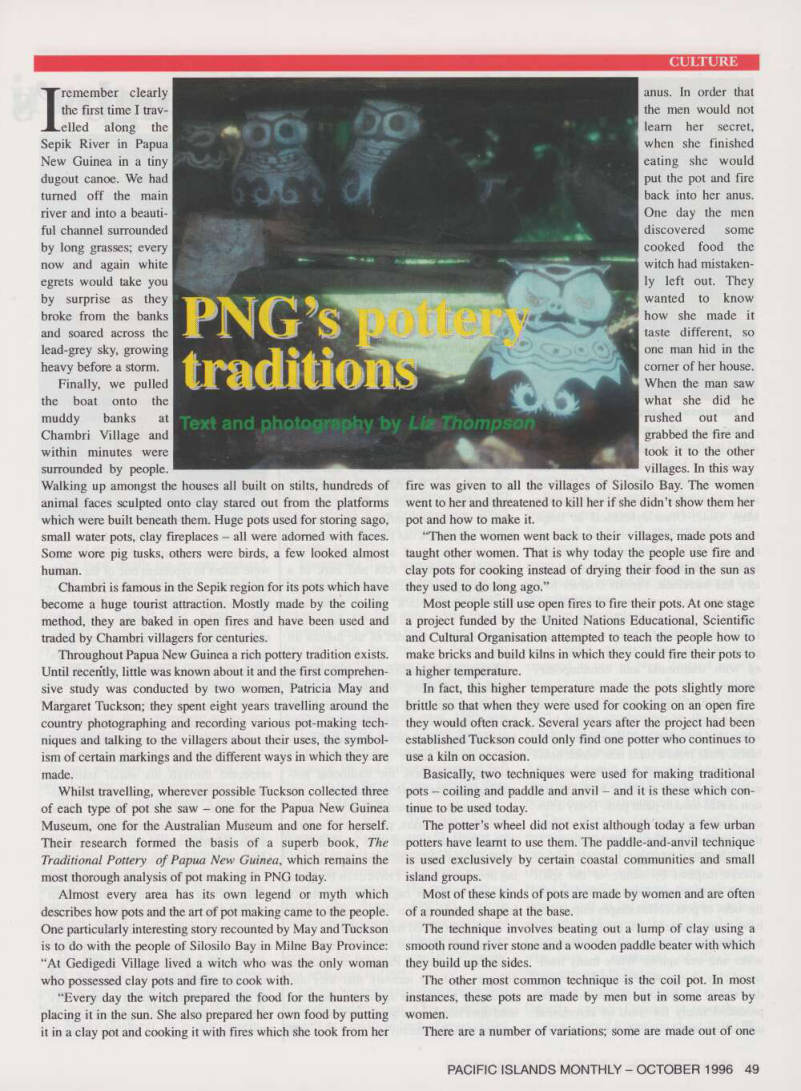
This coil method is one that has been adopted by one of Papua New Guinea’s most successful contemporary potters, Mary Gole. Often cylindrical in shape, round and full bellied, her pots are deco rated with faces or incised shapes and pat terns. As the demand for commercial pot tery has increased, various courses have been conducted, some beautiful utilitarian pottery has been produced at the Eastern Highlands Cultural Centre - mugs and plates, goblets, whole dinner sets decorat ed with traditional and contemporary designs.
Traditionally pots were decorated with earth colours, yellow ochres, red ochres, white clay for white and often charcoal for black. Pods from a local tree which holds seeds which give off a bright red sticky substances that is used for body decora tion is also used to paint pots. Today a few contemporary potters have begun to glaze their pots and produce ceramic pottery.
Traditional designs were almost always inspired by nature or the spirit world; often animal faces are depicted on the sides of pots, coiled shapes inspired by baby ferns, patterns of plants, animals, butterfly wings and insects, the faces of water and tree spirits. While many tradi tional clay objects were created for every day use or for trading, certain pots were produced solely for ritual or ceremonial use. Initiation bowls were used strictly for
serving food to boys during initiation cer emonies. Tuckson tells of ceremonial objects, with hollows in the bottom, being placed on sticks which had been dug into the ground. On occasion you see pots bal anced on the top of spirit houses.
An account given in May and Tuckson’s book tells of a pot used in the performance of magic by a sorcerer before setting off on a sea voyage: “He carried three things - a broken clay pot, a string bag full of fearsome relics and some banana leaves. The babalau prepared his magic. He placed the broken pot at one end of the lakatoi and put his stringbag beside it. He took out pieces of cassowary claw, the snouts of several garfish and some dry pieces of root and bark of a secret tree. He stirred the mixture well and lit it. A thick black smoke arose and, mumbling charms all the time, the sorcer er smoked the outsides of the lakatoi all 0ver...”
Inevitably, traditional pot-making practices are dying out. As aluminium saucepans and Hong Kong enamel dishes have become more popular and people buy rice from trade stores instead of need ing to make trade pots which they exchanged for food, the traditional pot making practices have diminished.
Potters have adapted their styles to suit a commercial market, putting legs on tra ditionally round-based pots so that they are more convenient to display and sculpt ing decorative vases. I have even bought a clay dog with an eagle standing on its back, something I’m sure would never have been produced traditionally.
However, Tuckson tells me that, even in the face of change, Papua New Guinean villagers told her recently that they are starting to make pots again “because our food does not taste as good when we have cooked it in aluminium”. ■
Pot by contemporary potter Mary Gole
Traditional coiling method