Twas not always thus
pp. 47-48 · Read in the full issue
The colonies of profit that were ...
By David North
All the Islands seem to be running
budget deficits, even phosphate
rich Nauru. And to make matters worse, the swindled Cook Islands govern ment has defaulted on its loan from the swindled government of Nauru.
In some cases the imbalance, such as in American Samoa, has been so severe that the government hospital has run out of some types of medicine, because the gov ernment had not paid the suppliers.
Similarly, the government on the American mainland has virtually always run a deficit during my lifetime. First it was a good deficit, under Roosevelt, to fight the Great Depression and, later, World War II; then it was the bad deficit
under Reagan, to reduce taxation on the rich. The Reagan deficit and the interest payments it generates still dominate US government finances.
But it was not ever thus.
Certainly not in the Pacific. Most cer tainly not in the British Pacific.
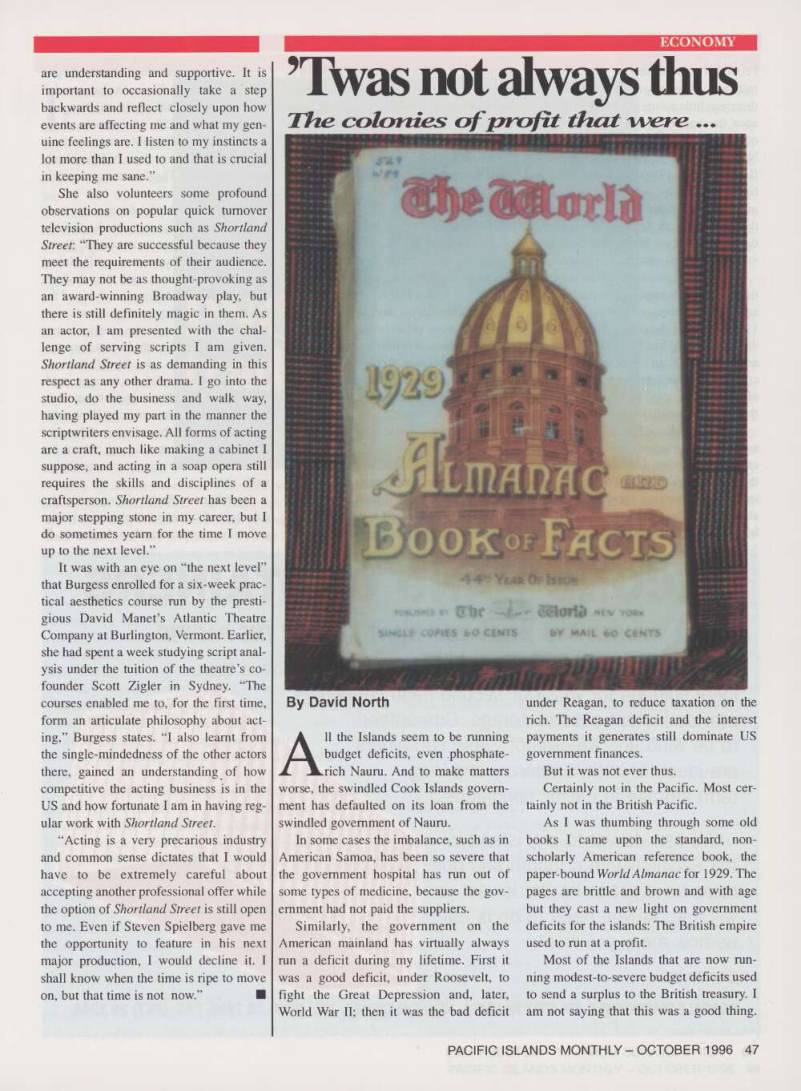
As I was thumbing through some old books I came upon the standard, non scholarly American reference book, the paper-bound World Almanac for 1929. The pages are brittle and brown and with age but they cast a new light on government deficits for the islands: The British empire used to run at a profit.
Most of the Islands that are now run ning modest-to-severe budget deficits used to send a surplus to the British treasury. I am not saying that this was a good thing.
Peoples lives were shorter, education was minimal, streets were not paved, and there was little electricity, but they did bal ance the budget. I had encountered the concept years ago when I read Agnes Newton Keith’s Land Below the Wind (Little Brown, 1939) a sensitive (for the time) memoir by an expatriate woman married to the chief forester in what was then British North Borneo. She noted that the taxes collected in that colony always
the government’s expenditures.
The World Almanac for 1929 indicates that the North Borneo experience was not an isolated phenomenon. For example, in 1926, and using the colonial names of the day: Fiji Islands had £584,515 in revenue and £535,957 in expenditures. The colony’s total debt, built up over a period of years, was only £150,000, less than three months’ worth of taxes.
Tonga Islands, or Friendly Islands, did even better; revenue was £91,696 and expenditures £68,759. Further, in that year, Tonga’s exports (copra and live stock) were running about 10 per cent ahead of its imports. Gilbert and Ellice Islands Colony (now Kiribati and Tuvalu)
showed £51,697 in income and £40,610 in outgo. The Brits were taking out much more in exports, largely phosphate, now exhausted, (£388,157), than they showed in arriving imports (£125,048).
A really big money maker for the colo nial powers was the New Hebrides (Vanuatu) which showed 1925 revenues of 1,420,000 francs versus expenditures of 853,000 francs. Perhaps the most solvent of the jurisdictions in those days was French Polynesia which, according to the World Almanac, had a balanced budget of 11,590,633 francs and a reserve of seven million francs (in the days when the franc was much more valuable than it is now).
Was France subsidising her Islands then as she does now? I could not tell from the old book, but the concept of the Islands being subsidised by the colonial powers was already alive and well. Take the conflicting regional trends in what is now P-NG. In 1926-27 the ex-German Territory of New Guinea was being run at a £35,000-a-year profit under a League of Nations mandate to Britain which was subsequently handed off to Australia.
But the Territory of Papua, long under
Aussie domination, had already begun
deficit financing. Expenditures exeeded
revenues by £56,000 a year and there was a notation of £50,000 subsidy from Australia. Did the subsidy make up most the shortfall? Or was there both a subsidy and a shortfall? The browning pages do not tell us.
Not all the Islands’ finances were as transparent as they were in the British, Australian and French territories. Guam and American Samoa were still United States naval stations, and their budgets were not discussed; nor were those of the then newly Japanese islands in Micronesia. Though the entries were mostly concerned with history, govern ment, and finance, the World Almanac writers apparently did not struggle with the concept of political correctness when they dealt with other matters. Hence this line about one of the colonies: “The peo ple being crude tribes among whom the British are carrying (on) civilising work...”
In addition to the “civilising work” the colonial authorities were also, apparently, collecting more money than they spent. ■