Luisa to stay
pp. 45-47 · Read in the full issue
Profile
Luisa to stay on Street
By Atama Raganivatu
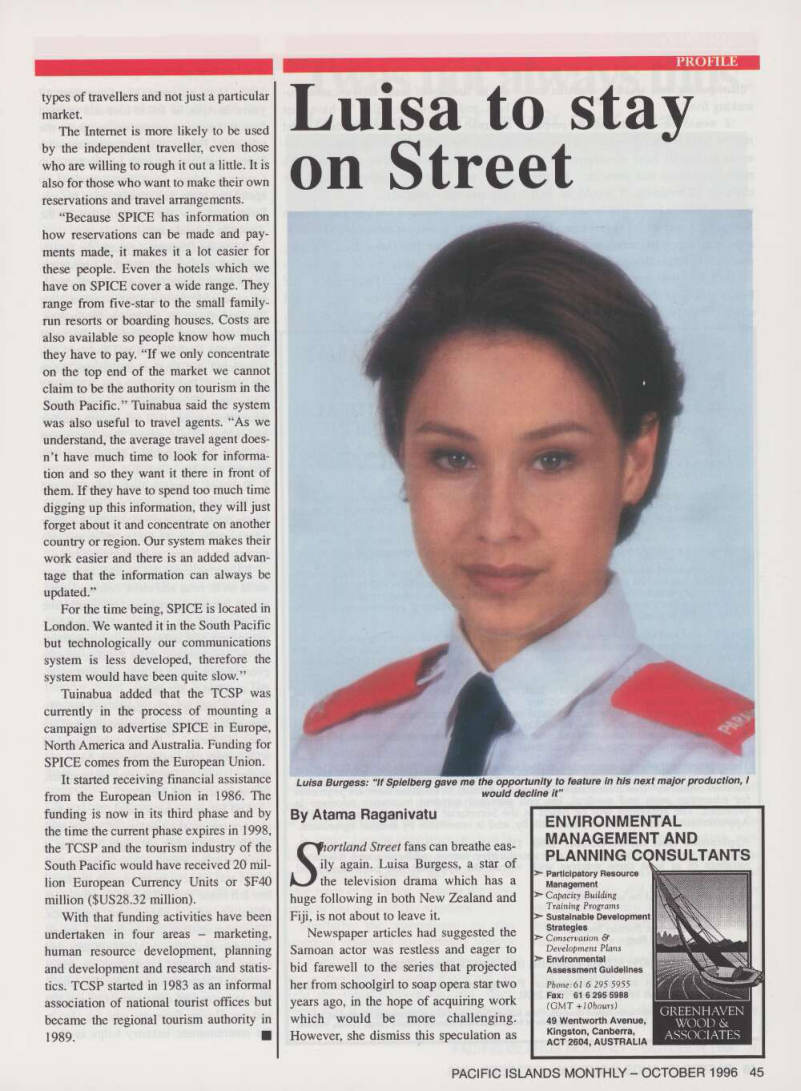
fiortland Street fans can breathe eas ily again. Luisa Burgess, a star of Jk-Jthe television drama which has a huge following in both New Zealand and Fiji, is not about to leave it.
Newspaper articles had suggested the Samoan actor was restless and eager to bid farewell to the series that projected her from schoolgirl to soap opera star two years ago, in the hope of acquiring work which would be more challenging.
However, she dismiss this speculation as
Luisa Burgess: "If Spielberg gave me the opportunity to feature in his next major production, I would decline it”
“them putting two and two together and
making five”.
“I would be foolish not to prepare myself for life after Shortland Street and some journalists have misinterpreted my readiness to face that situation,” Burgess explains. “Obviously, it would be ludi crous to believe I will still be working on Shortland Street in 20 years’ time. I am more than happy to remain with it for the foreseeable future though.”
That is good news for the army of Fijian Shortland Street devotees. The bad news is that she has no plans to follow in
the jet streams of many fellow cast mem bers and journey to Fiji. “I have just returned from six weeks in the United States and will be visiting family mem bers in Samoa later this year, so won’t have any time for further travel,” she explains apologetically, Burgess’ Samoan background, though not widely known, is something she obvi ously cherishes. Her father, Dick Burgess, was posted to Apia as an adviser to Western Samoa’s Department of Agriculture by the New Zealand aid organisation Voluntary Service Abroad in
1968. Here he spent 15 of the next 17 years. In Apia, he fell in love and married Feavai Amosa, a young woman from the village of Falesa. She was pregnant with Luisa when moving with her husband, to Canberra where Dick was required to spend two years as a stipulation of his job.
Luisa first saw the light of day in the Australia federal capital.
After the Canberra sojourn, the family returned to Apia and spent a further six years there before Dick and Feavai decid ed to provide their daughter with a New Zealand education, settling in Wellington.
Luisa gained an interest in drama at Wellington High School and had only just completed her final examinations when the part of Rebecca Frost in Shortland Street was offered. She had actually audi tioned for another role two months earlier and, although not getting that, impressed so much that the persona of Rebecca was created with her in mind.
Rebecca, strong-willed, righteous and resilient yet often naive and vulnerable, shares some characteristics with the actor who portrays her. However, there are also numerous differences between the two.
Rebecca certainly would not wear studs on hr nose and chew coloured gum, as are Burgess’ penchants, nor could she be imagined on a float at Auckland’s annual gay and lesbian parade or present ing prizes during a major fashion awards evening with just a skimpy piece of mate rial attached to her front.
These indulgences apart - and few 20year-olds in the entertainment industry are free of them - Burgess has gained widespread admiration through her com
posure, congeniality, energy, pragmatism,
self-assurance and lucidity.
And Burgess was certainly lucid when elaborating on the burdens of being con stantly in the public spotlight. “At first it was confusing, very confusing, particular ly as I was coming to terms with the fact I had left home and left the things that were affirming who I was,” she confesses.
“Now, my instinct is to stop and regener ate and to cope with the demands required of me. Sometimes I feel that my inno cence has been dismantled by the televi sion industry and often retreat to my flat and cry. Having flatmates who are also in the entertainment industry helps as they
are understanding and supportive. It is important to occasionally take a step backwards and reflect closely upon how events are affecting me and what my gen uine feelings are. I listen to my instincts a lot more than I used to and that is crucial in keeping me sane.”
She also volunteers some profound observations on popular quick turnover television productions such as Shortland Street : “They are successful because they meet the requirements of their audience.
They may not be as thought-provoking as
an award-winning Broadway play, but
there is still definitely magic in them. As an actor, I am presented with the chal lenge of serving scripts I am given.
Shortland Street is as demanding in this respect as any other drama. I go into the studio, do the business and walk way, having played my part in the manner the scriptwriters envisage. All forms of acting are a craft, much like making a cabinet I suppose, and acting in a soap opera still requires the skills and disciplines of a craftsperson. Shortland Street has been a major stepping stone in my career, but I do sometimes yearn for the time I move up to the next level.”
It was with an eye on “the next level” that Burgess enrolled for a six-week prac tical aesthetics course run by the presti gious David Manet’s Atlantic Theatre Company at Burlington, Vermont. Earlier, she had spent a week studying script anal ysis under the tuition of the theatre’s co founder Scott Zigler in Sydney. “The courses enabled me to, for the first time, form an articulate philosophy about act ing,” Burgess states. “I also learnt from the single-mindedness of the other actors there, gained an understanding of how competitive the acting business is in the US and how fortunate I am in having reg ular work with Shortland Street.
“Acting is a very precarious industry and common sense dictates that I would have to be extremely careful about accepting another professional offer while the option of Shortland Street is still open to me. Even if Steven Spielberg gave me the opportunity to feature in his next major production, I would decline it. I shall know when the time is ripe to move on, but that time is not now.” ■