Netting the world
pp. 44-45 · Read in the full issue
Tourism
By Bernadette Hussein
As the rest of the world is linking on to the Internet to take advan tage of the wide publicity, the South Pacific is not far behind.
The Pacific too has discovered the sys tem, realises its importance and feels it is the best way to promote the region to the rest of the world. The organisation which is taking the initiative to promote the Pacific to the rest of the world is the Tourism Council of the South Pacific.
TCSP chief executive Levani Tuinabua said hooking on to the Internet was prob ably the best way to tell the rest of the world what they could find in the Pacific.
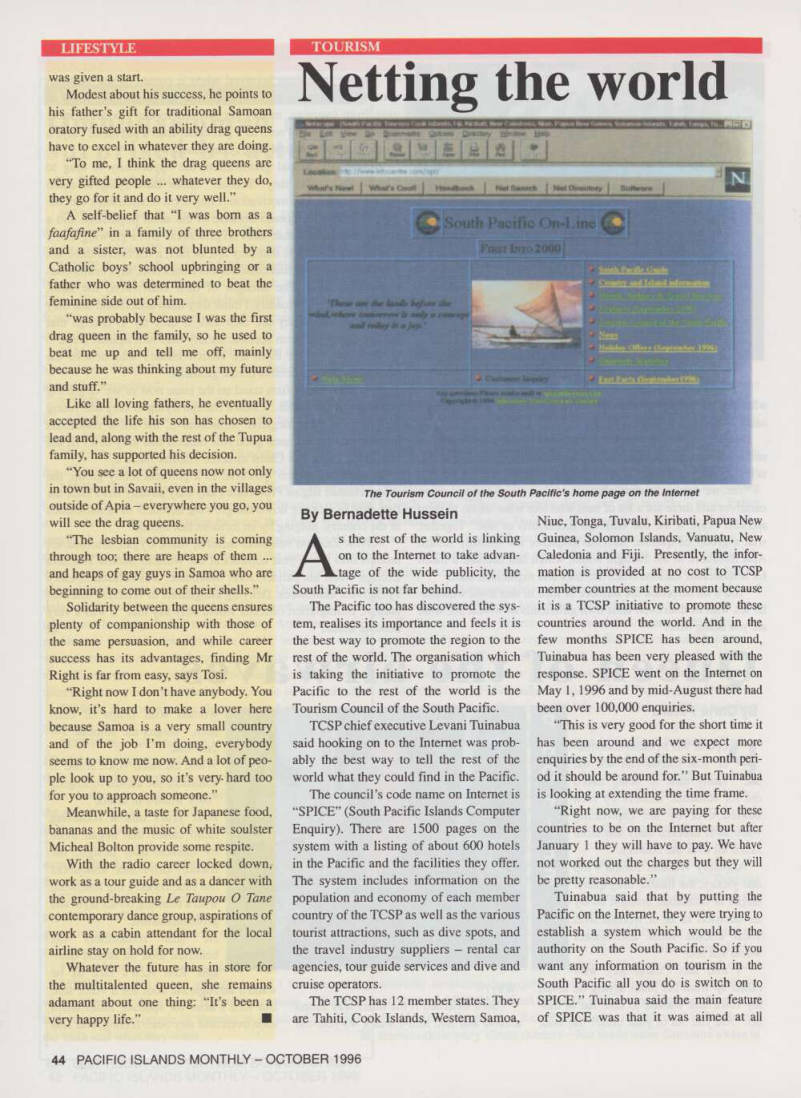
The council’s code name on Internet is “SPICE” (South Pacific Islands Computer Enquiry). There are 1500 pages on the system with a listing of about 600 hotels in the Pacific and the facilities they offer.
The system includes information on the population and economy of each member country of the TCSP as well as the various tourist attractions, such as dive spots, and the travel industry suppliers - rental car agencies, tour guide services and dive and cruise operators.
The TCSP has 12 member states. They are Tahiti, Cook Islands, Western Samoa,
Niue, Tonga, Tuvalu, Kiribati, Papua New Guinea, Solomon Islands, Vanuatu, New Caledonia and Fiji. Presently, the infor mation is provided at no cost to TCSP member countries at the moment because it is a TCSP initiative to promote these countries around the world. And in the few months SPICE has been around, Tuinabua has been very pleased with the response. SPICE went on the Internet on May 1, 1996 and by mid-August there had been over 100,000 enquiries.
“This is very good for the short time it has been around and we expect more enquiries by the end of the six-month peri od it should be around for.” But Tuinabua is looking at extending the time frame.
“Right now, we are paying for these countries to be on the Internet but after January 1 they will have to pay. We have not worked out the charges but they will be pretty reasonable.”
Tuinabua said that by putting the Pacific on the Internet, they were trying to establish a system which would be the authority on the South Pacific. So if you want any information on tourism in the South Pacific all you do is switch on to SPICE.” Tuinabua said the main feature of SPICE was that it was aimed at all
The Tourism Council of the South Pacific’s home page on the Internet
types of travellers and not just a particular market.
The Internet is more likely to be used by the independent traveller, even those who are willing to rough it out a little. It is also for those who want to make their own reservations and travel arrangements.
“Because SPICE has information on how reservations can be made and pay ments made, it makes it a lot easier for these people. Even the hotels which we have on SPICE cover a wide range. They range from five-star to the small family run resorts or boarding houses. Costs are also available so people know how much they have to pay. “If we only concentrate on the top end of the market we cannot claim to be the authority on tourism in the South Pacific.” Tuinabua said the system was also useful to travel agents. “As we understand, the average travel agent does n’t have much time to look for informa tion and so they want it there in front of them. If they have to spend too much time digging up this information, they will just forget about it and concentrate on another country or region. Our system makes their work easier and there is an added advan tage that the information can always be
updated.”
For the time being, SPICE is located in London. We wanted it in the South Pacific but technologically our communications system is less developed, therefore the system would have been quite slow.”
Tuinabua added that the TCSP was currently in the process of mounting a campaign to advertise SPICE in Europe, North America and Australia. Funding for SPICE comes from the European Union.
It started receiving financial assistance from the European Union in 1986. The funding is now in its third phase and by the time the current phase expires in 1998, the TCSP and the tourism industry of the South Pacific would have received 20 mil lion European Currency Units or SF4O million ($U528.32 million).
With that funding activities have been undertaken in four areas - marketing, human resource development, planning and development and research and statis tics. TCSP started in 1983 as an informal association of national tourist offices but became the regional tourism authority in 1989. ■