By Chris Peteru
pp. 24-27 · Read in the full issue

Politics
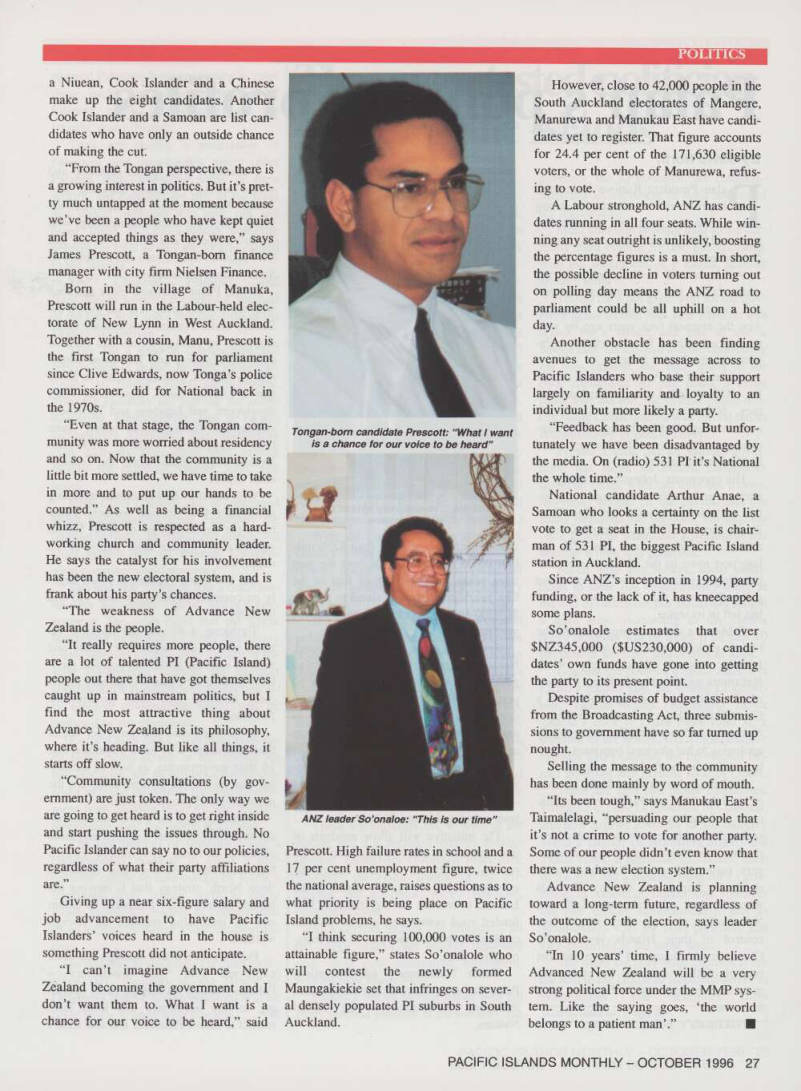
The plated pin on the lapel of Advance New Zealand leader England So’onalole’s navy blue tailored suit says it all. Attitude.
Under the new Mixed Member Proportional voting system being intro duced at the October 12 general elec tions, Advanced New Zealand, built and run by Pacific Islanders, is going all out in a bid for a bigger Pacific Island repre sentation in parliament.
“This party was set up by Pacific Islanders and, because of that, we have to take ownership of problems that our people have. So we are going to look at and implement solutions at parliamen tary level. The days of lobbying are over,” says the witty and articulate So’onalole, who gives seminars on pos itive living.
Currently, the only Pacific Islander member of parliament is Labour’s Tairo Philip Field from Otara, Auckland.
A one time mathematics tutor at Otago University, So’onalole admits Advance New Zealand’s political con victions are a lot easier to calculate than their odds of landing any of their eight candidates in parliament.
For too long, says ANZ, Pacific Islanders have been paid only lip service by National and Labour governments, the latter having enjoyed a solid tradi tion of support from migrant Polynesians since the 19205.
“This is our time. A lot of our people have been consulted at a lower level but we are not involved at the highest level of the decision-making process. And nothing was going to happen until we started a party.”
Immigration, portability of pensions, and setting up a Department of Whanau (Youth) Development are high on the party hit list of issues they are keen to push on behalf of the New Zealand’s Pacific Island community.
“But the only issue right now is to get in. Circumstances in the New Zealand political arena have changed. Under the MMP system this is the golden opportu nity.”
Briefly, this is how MMP works.
There are now 120 seats in the parlia-
Islanders have high hopes of NZ elections
The New Mixed Member Proportional vot ing system may see more Pacific Islanders with a voice in New Zealand parliament .
Chris Peteru meets the Island candidates
ment, an increase of 21 from the old first past-the-post system. Every voter gets two votes. One for their preferred political party and one for their favoured candi date.
Voting for a particular party now means automatic entry for a number of candidates preselected by the party and put on a list. In order for any of the listed candidates to gain a seat, a “threshold”, that is, a percentage of the voters has to be reached.
Before MMP many so-called parties were little more than a name alongside that of an alternative candidate in one
seat. Under the new system, intending parties now have to provide evidence of at least 500 members. Most will end up on every voter’s ballot paper.
While signing up 500 paying members proved “a long hard slog” for ANZ, win ning the party votes of those 500 plus 99,500 others to secure the required threshold will provide the biggest chal lenge.
“On the 1.9 million voter turnout in 1993, about 96,000 votes would be enough to pass the threshold, but given the expectation of a higher MMP turnout, about 100,000 (roughly five per cent) is
seen as a realistic target to get listed can didates into parliament,” says political analyst Sevan Rapson.
The only way of beating the threshold is to win an electorate seat, something more of the small parties are beginning to
pin their hopes on.
Proportional representation was
expected to bring in ‘boutique’ or niche parties such as ANZ, tailored to a much narrower section of the voting population than was possible under the old system.
Another ethnic-based group, the Ethnic Minority Party, believes that com bining the Chinese and Indian vote would lift it over the threshold.
Accusations of political bigotry by the ANZ carry no weight, because the party manifesto benefits all New Zealand, states So’onalole. Instead, the impression is of a party reminiscent of United States presi dential candidate Jesse Jackson’s Rainbow Coalition, the first Afro- American to run for the White House.
“Our political position is a non-issue at the moment. Palagi media who think they are clever are trying to place us on their political spectrum. Left or right. All we are concerned about is taking our voice.”
Although 26 parties have officially
registered, pre-election polls point to
National leader Prime Minister Jim Bolger, Labour (Helen Clark), New Zealand First (Winston Peters) and the Jim Anderson Alliance party as the big four who, between them, will claim most of the seats in parliament, said Rapson.
There is also little evidence to suggest that ethnic votes can be calculated to win seats in the manner ANZ is banking on. On top of that is a drive by the major parties to select list candidates who can also appeal to such communities.
So how does Advance New Zealand stack up? All but one of the electorates they are contesting is in Auckland, home to over 100,000 Polynesians. Support from the Samoan community, who make up the largest number of Islanders in New Zealand, remains splintered between Labour’s Field and National candidate Arthur Anae, who looks a sitter care of high placing on the parties’ list vote.
So’onalole says support from the Tongan community, who have two ANZ candidates, is shoring up. Three Samoans,
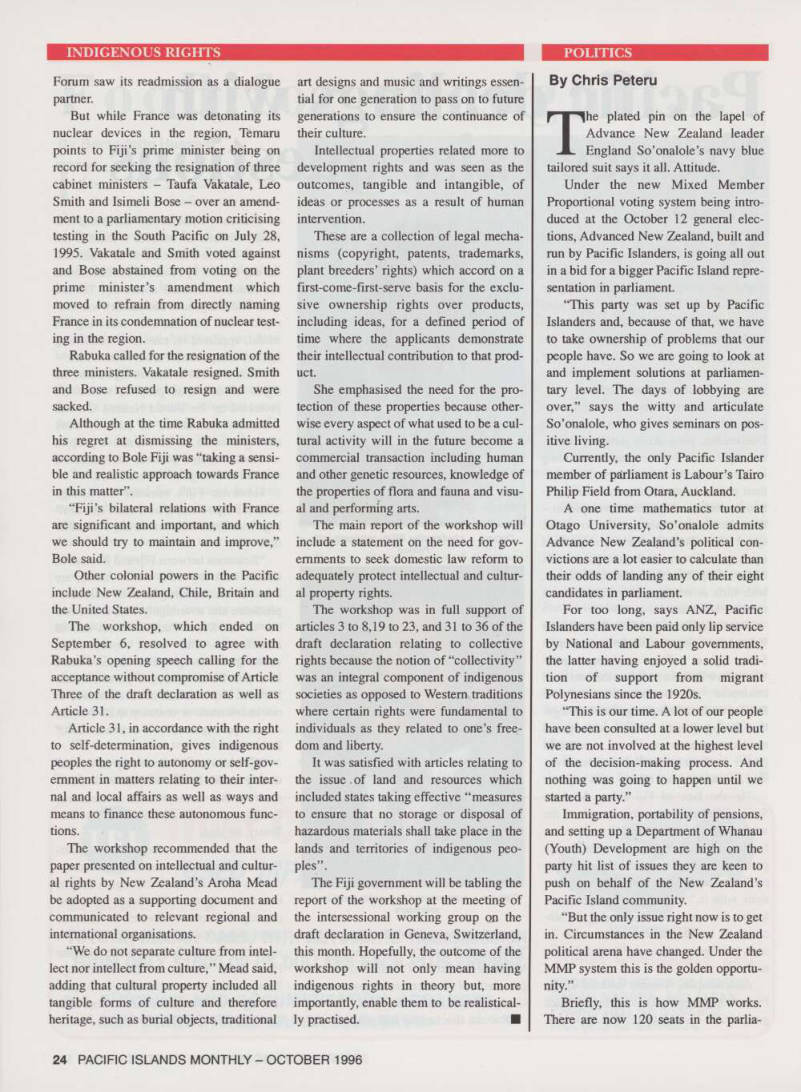
Votes of confidence...new system provides "golden opportunity” Pictures: Chris Peteru
a Niuean, Cook Islander and a Chinese make up the eight candidates. Another Cook Islander and a Samoan are list can didates who have only an outside chance of making the cut.
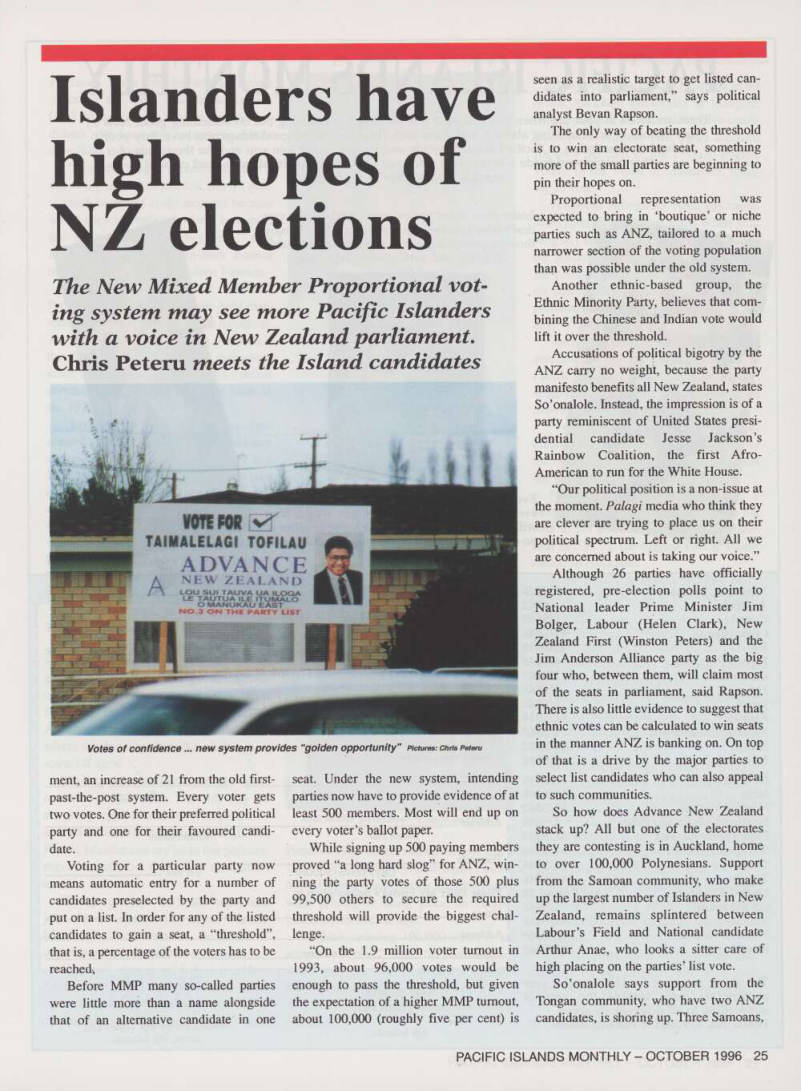
“From the Tongan perspective, there is a growing interest in politics. But it’s pret ty much untapped at the moment because we’ve been a people who have kept quiet and accepted things as they were,” says James Prescott, a Tongan-bom finance manager with city firm Nielsen Finance.
Bom in the village of Manuka, Prescott will run in the Labour-held elec torate of New Lynn in West Auckland.
Together with a cousin, Manu, Prescott is the first Tongan to run for parliament since Clive Edwards, now Tonga’s police commissioner, did for National back in the 19705.
“Even at that stage, the Tongan com munity was more worried about residency and so on. Now that the community is a little bit more settled, we have time to take in more and to put up our hands to be counted.” As well as being a financial whizz, Prescott is respected as a hard working church and community leader.
He says the catalyst for his involvement has been the new electoral system, and is frank about his party’s chances.
“The weakness of Advance New Zealand is the people.
“It really requires more people, there are a lot of talented PI (Pacific Island) people out there that have got themselves caught up in mainstream politics, but I find the most attractive thing about Advance New Zealand is its philosophy, where it’s heading. But like all things, it starts off slow.
“Community consultations (by gov ernment) are just token. The only way we are going to get heard is to get right inside and start pushing the issues through. No Pacific Islander can say no to our policies, regardless of what their party affiliations are.”
Giving up a near six-figure salary and job advancement to have Pacific Islanders’ voices heard in the house is something Prescott did not anticipate.
“I can’t imagine Advance New Zealand becoming the government and I don’t want them to. What I want is a chance for our voice to be heard,” said
Prescott. High failure rates in school and a 17 per cent unemployment figure, twice the national average, raises questions as to what priority is being place on Pacific Island problems, he says.
“I think securing 100,000 votes is an attainable figure,” states So’onalole who will contest the newly formed Maungakiekie set that infringes on sever al densely populated PI suburbs in South Auckland.
However, close to 42,000 people in the South Auckland electorates of Mangere, Manurewa and Manukau East have candi dates yet to register. That figure accounts for 24.4 per cent of the 171,630 eligible voters, or the whole of Manurewa, refus ing to vote.
A Labour stronghold, ANZ has candi dates running in all four seats. While win ning any seat outright is unlikely, boosting the percentage figures is a must. In short, the possible decline in voters turning out on polling day means the ANZ road to parliament could be all uphill on a hot day.
Another obstacle has been finding avenues to get the message across to Pacific Islanders who base their support largely on familiarity and loyalty to an individual but more likely a party.
“Feedback has been good. But unfor tunately we have been disadvantaged by the media. On (radio) 531 PI if s National the whole time.”
National candidate Arthur Anae, a Samoan who looks a certainty on the list vote to get a seat in the House, is chair man of 531 PI, the biggest Pacific Island station in Auckland.
Since ANZ’s inception in 1994, party funding, or the lack of it, has kneecapped
some plans.
So’onalole estimates that over $NZ345,000 ($U5230,000) of candi dates’ own funds have gone into getting the party to its present point.
Despite promises of budget assistance
from the Broadcasting Act, three submis sions to government have so far turned up nought.
Selling the message to the community has been done mainly by word of mouth.
“Its been tough,” says Manukau East’s Taimalelagi, “persuading our people that it’s not a crime to vote for another party.
Some of our people didn’t even know that there was a new election system.”
Advance New Zealand is planning toward a long-term future, regardless of the outcome of the election, says leader So’onalole.
“In 10 years’ time, I firmly believe Advanced New Zealand will be a very strong political force under the MMP sys tem. Like the saying goes, ‘the world belongs to a patient man’.” ■
Tongan-born candidate Prescott: “What I want is a chance for our voice to be heard”
ANZ leader So’onaloe: “This is our time”