Palau’s political profiles
pp. 28-29 · Read in the full issue
By David North
Palau President Kuniwo Nakamura hopes to ride the crest of a strong economic surge and the Islands’ improved living standard to re-election in November.
A 53-year-old businessman/politician
whose family has wide-ranging commer cial interests in the Islands, Nakamura won the election four years ago by sup porting a lucrative free-association com pact with the United States.
As head of the Pacific’s newest repub lic, a US-modelled constitutional democ racy, Nakamura has pursued a ‘look north’ strategy that has brought Palau sig nificant Japanese, Taiwanese, and Philippine investment.
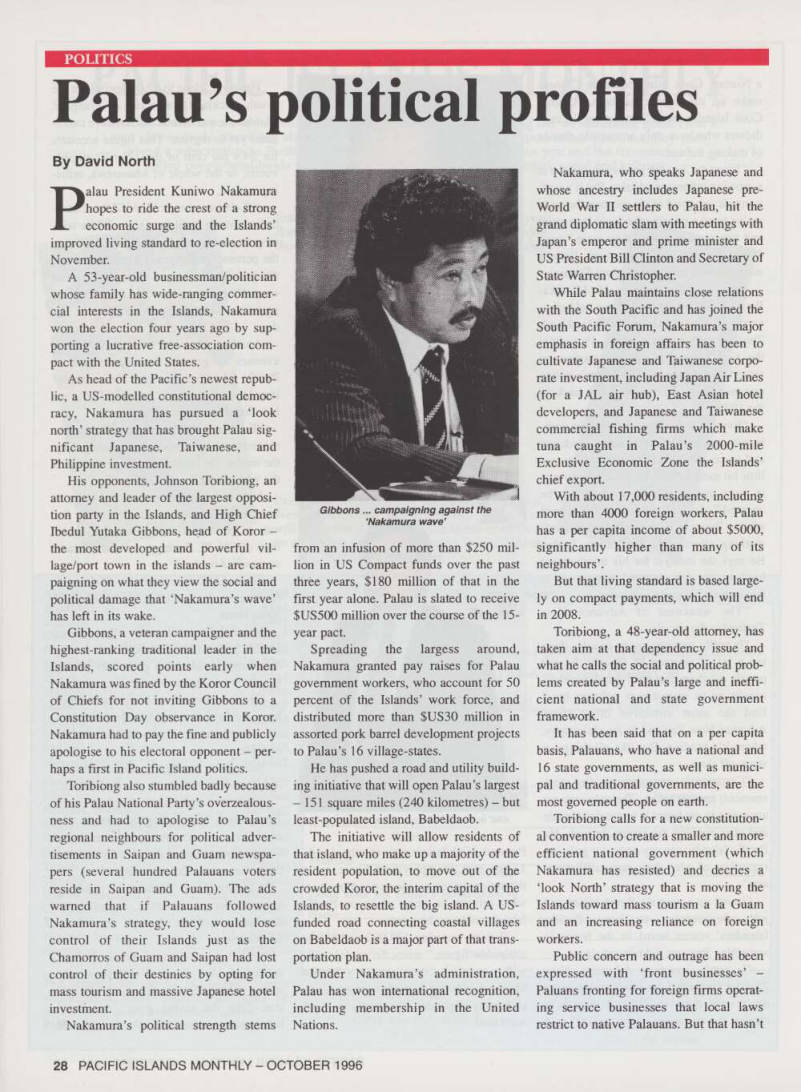
His opponents, Johnson Toribiong, an attorney and leader of the largest opposi tion party in the Islands, and High Chief Ibedul Yutaka Gibbons, head of Koror the most developed and powerful vil lage/port town in the islands - are cam paigning on what they view the social and political damage that ‘Nakamura’s wave’ has left in its wake.
Gibbons, a veteran campaigner and the highest-ranking traditional leader in the Islands, scored points early when Nakamura was fined by the Koror Council of Chiefs for not inviting Gibbons to a Constitution Day observance in Koror.
Nakamura had to pay the fine and publicly apologise to his electoral opponent - per haps a first in Pacific Island politics.
Toribiong also stumbled badly because of his Palau National Party’s overzealous ness and had to apologise to Palau’s
regional neighbours for political adver
tisements in Saipan and Guam newspa pers (several hundred Palauans voters reside in Saipan and Guam). The ads warned that if Palauans followed Nakamura’s strategy, they would lose control of their Islands just as the Chamorros of Guam and Saipan had lost control of their destinies by opting for mass tourism and massive Japanese hotel investment.
Nakamura’s political strength stems
from an infusion of more than $250 mil lion in US Compact funds over the past three years, $lBO million of that in the first year alone. Palau is slated to receive SUSSOO million over the course of the 15year pact.
Spreading the largess around, Nakamura granted pay raises for Palau government workers, who account for 50 percent of the Islands’ work force, and distributed more than SUS3O million in assorted pork barrel development projects to Palau’s 16 village-states.
He has pushed a road and utility build ing initiative that will open Palau’s largest -151 square miles (240 kilometres) - but least-populated island, Babeldaob.
The initiative will allow residents of that island, who make up a majority of the resident population, to move out of the crowded Koror, the interim capital of the Islands, to resettle the big island. A US funded road connecting coastal villages on Babeldaob is a major part of that trans
portation plan.
Under Nakamura’s administration, Palau has won international recognition, including membership in the United Nations.
Nakamura, who speaks Japanese and whose ancestry includes Japanese pre- World War II settlers to Palau, hit the
grand diplomatic slam with meetings with
Japan’s emperor and prime minister and US President Bill Clinton and Secretary of State Warren Christopher.
While Palau maintains close relations with the South Pacific and has joined the South Pacific Forum, Nakamura’s major emphasis in foreign affairs has been to cultivate Japanese and Taiwanese corpo rate investment, including Japan Air Lines (for a JAL air hub). East Asian hotel developers, and Japanese and Taiwanese commercial fishing firms which make tuna caught in Palau’s 2000-mile Exclusive Economic Zone the Islands’ chief export.
With about 17,000 residents, including more than 4000 foreign workers, Palau has a per capita income of about $5OOO, significantly higher than many of its neighbours’.
But that living standard is based large ly on compact payments, which will end in 2008.
Toribiong, a 48-year-old attorney, has taken aim at that dependency issue and what he calls the social and political prob lems created by Palau’s large and ineffi cient national and state government framework.
It has been said that on a per capita basis, Palauans, who have a national and 16 state governments, as well as munici pal and traditional governments, are the most governed people on earth.
Toribiong calls for a new constitution al convention to create a smaller and more efficient national government (which Nakamura has resisted) and decries a ‘look North’ strategy that is moving the Islands toward mass tourism a la Guam and an increasing reliance on foreign workers.
Public concern and outrage has been expressed with ‘front businesses’ - Paluans fronting for foreign firms operat ing service businesses that local laws restrict to native Palauans. But that hasn’t
Gibbons...campaigning against the ‘Nakamura wave’
stopped Palauans from continuing to enter those pacts. An increasing number of Filipina maids are brought into the Islands, many illegally.
They are raising a generation of
Palauans, and occasionally marry older Palauan men, inheriting some of then wealth. Yet Palauans are part of the legal and illegal networks that seek out and bring these SUSIOO-a-month domestic helpers (or DHs as they are locally called) to the Islands.
The Chinese, Filipino, and Bangladeshi workers account for one-half of the paid work force and one-fifth of the
Islands’ population.
They fill a need in construction and service sectors, in part, because Palau con tinues to suffer from outmigration.
Younger Palauans are leaving for better education, higher-paying jobs to escape
increasingly expensive and demanding
clan customs associated with raising money for relatives’ houses, cars, and boats.
High Chief Gibbons also is concerned about traditional customs, especially the conflict between the traditional clan-based chief system and the Islands’ US-mod elled constitutional democracy.
Just last year. Gibbons lost a court bat tle over the organisation of Koror’s gov ernment. The court ruled that the Koror law giving its House of Chiefs (hereditary rulers selected by the clans) control of the state government violated the national constitution’s guarantees of democratical ly elected government which can be replaced by the electorate, Koror’s high clans, who have been the de facto ruling power in the Islands for two centuries, see an insidious democracy and a rich and influential national govern
ment with backing from foreign funding
threatening their traditional hegemony.
The resettlement of Babeldaob and a constitutional mandate to build a new national capital on land owned by Koror’s traditional rival village seem to many Koror traditional leaders as confirmation of an assault on Koror’s historic preroga tives.
In addition to the four-year chief exec utive slot, 16 seats in the House of Delegates and 14 Senate positions will be filled in the Islands-wide election. ■