Pacific dealings with
pp. 23-24 · Read in the full issue
Indigenous Rights
Pacific dealings with France raise questions
By Esita Sogotubu
While the Indigenous Peoples of
the Pacific Workshop on the UN Draft Declaration on the
Rights of Indigenous Peoples and the
annual South Pacific Forum coincided this year and while both purported to work towards securing the interests of the region, there have been claims that, in at least one respect, the meetings proved a direct contradiction of each other.
While the workshop was in full sup port of the United Nations Draft Declaration, particularly Article Three the right to self-determination enabling
indigenous peoples to freely determine
their political status and pursue their eco nomic, social and cultural development there has been concern raised over the speed with which France was readmitted as a post-Forum dialogue partner in Majuro, Republic of the Marshall Islands, with little or no opposition from Forum member countries.
But Oscar Temaru, who led the French Polynesian delegation to the workshop in Suva, Fiji, at a Press conference ques tioned how Rabuka could on the one hand champion self-determination for the Pacific while refusing to grant his delega tion an appointment at the workshop and not exert pressure on France, a colonial power in the region. Rabuka, however, said he was unaware of any such request.
“In the face of Fiji Prime Minister Sitiveni Rabuka’s opening speech at the
workshop promoting self-determination
for indigenous peoples, Fiji should sup
port and fight for us by exerting pressure on France and not continue working rela tions with it,” Tahiti’s pro-independence leader, Temaru, said, challenging the sin cerity of leaders’ rhetoric with what he sees as their blatantly contradictory actions.
As examples, Temaru pointed to the Fiji cabinet’s approval to set up a French government-owned bank, Fiji not boy-
coding last year’s South Pacific games in Tahiti and Rabuka’s acceptance of the Medal of the Order of Tahiti Nui from the president of the territorial government, Gaston Flosse, earlier this year.
Rabuka shocked the indigenous people
of French Polynesia by accepting the
medal on June 29 because it marked the date of France’s annexation of Tahiti and the day chosen by Flosse to commemorate the status of internal autonomy, Temaru said. The indigenous community was out raged when Rabuka, after receiving his medal, appeared on television cautioning against independence from French rule.
“It is a denial of human rights and the rights of colonised peoples, which are protected by the United Nations General Assembly Resolution, to publicly deny the rights of Te Ao Maohi native peoples to decolonisation, political independence and full sovereignty,” Temaru said.
However, Fiji’s minister for foreign affairs, Filipe Bole, denied that Fiji’s deal ings with France illustrated any contradic tion.
“Relations between Fiji and France, as indeed with any other nation states, are based on mutual recognition of their inde pendence and sovereignty. Fiji, as a mem ber of the South Pacific Forum and in association with other independent sovereign states, agreed to readmit France as a post-Forum dialogue partner at the Forum... Fiji’s action in this instance is not inconsistent or contrary to its support of the principle of self-determination,”
Bole said.
Fiji had wanted France stop its nuclear testing in the Pacific and show commit ment to the concept of a nuclear-free Pacific and the Comprehensive Test Ban Treaty, he said.
France was suspended from post- Forum dialogue last year after its resump tion of nuclear tests in the region despite international protest. However, (after det onating six nuclear devices at Mururoa and Fangataufa atolls) France became a signatory to the South Pacific Nuclear Free Zone Treaty, or the Rarotonga Treaty, and was actively engaged in pro moting the Comprehensive Test Ban Treaty, Bole said. The 1996 South Pacific
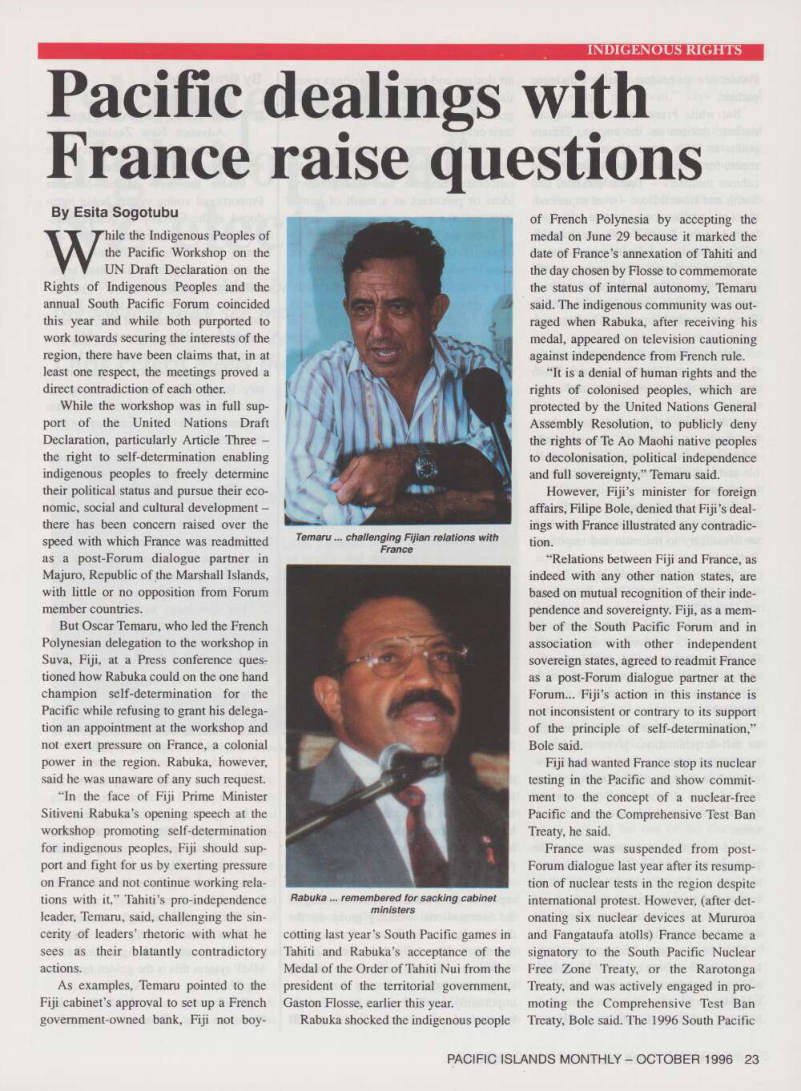
Temaru...challenging Fijian relations with France
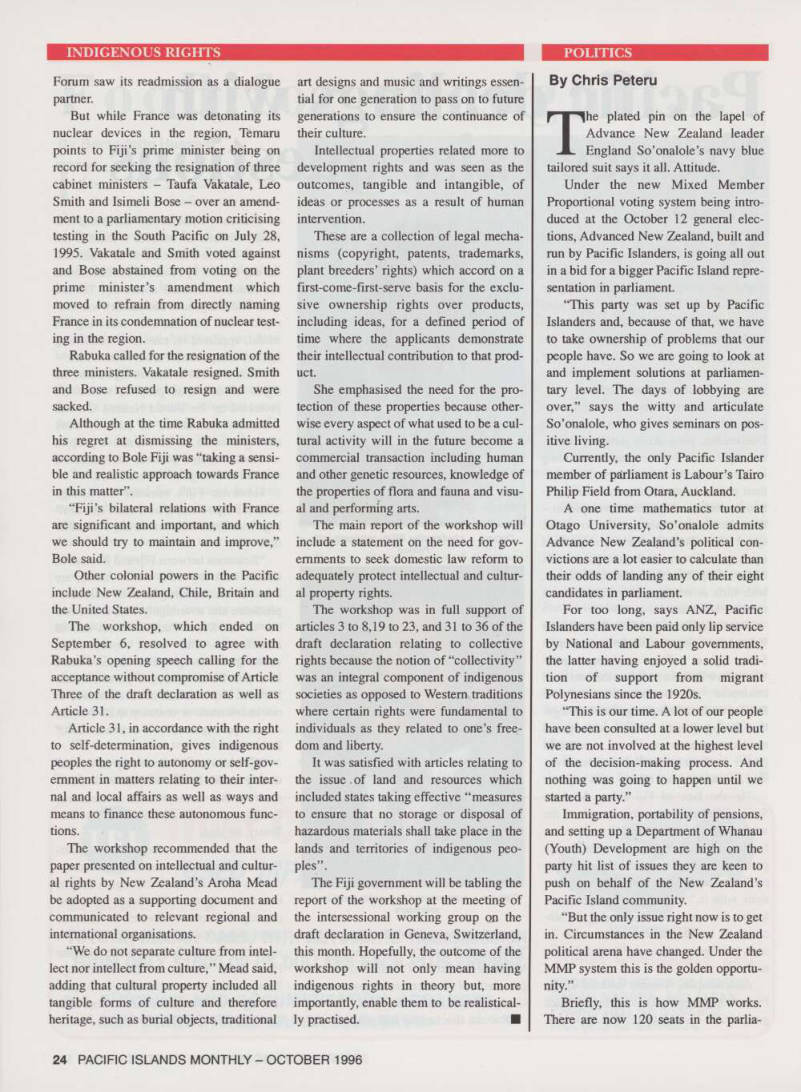
Rabuka ... remembered for sacking cabinet ministers
Forum saw its readmission as a dialogue partner.
But while France was detonating its nuclear devices in the region, Temaru points to Fiji’s prime minister being on record for seeking the resignation of three cabinet ministers - Taufa Vakatale, Leo Smith and Isimeli Bose - over an amend ment to a parliamentary motion criticising testing in the South Pacific on July 28, 1995. Vakatale and Smith voted against and Bose abstained from voting on the prime minister’s amendment which moved to refrain from directly naming France in its condemnation of nuclear test
ing in the region.
Rabuka called for the resignation of the three ministers. Vakatale resigned. Smith and Bose refused to resign and were sacked.
Although at the time Rabuka admitted his regret at dismissing the ministers, according to Bole Fiji was “taking a sensi ble and realistic approach towards France in this matter”.
“Fiji’s bilateral relations with France are significant and important, and which we should try to maintain and improve,”
Bole said.
Other colonial powers in the Pacific include New Zealand, Chile, Britain and the United States.
The workshop, which ended on September 6, resolved to agree with
Rabuka’s opening speech calling for the
acceptance without compromise of Article Three of the draft declaration as well as Article 31.
Article 31, in accordance with the right
to self-determination, gives indigenous
peoples the right to autonomy or self-gov ernment in matters relating to their inter nal and local affairs as well as ways and means to finance these autonomous func tions.
The workshop recommended that the paper presented on intellectual and cultur al rights by New Zealand’s Aroha Mead be adopted as a supporting document and communicated to relevant regional and
international organisations.
“We do not separate culture from intel lect nor intellect from culture,” Mead said, adding that cultural property included all tangible forms of culture and therefore heritage, such as burial objects, traditional
art designs and music and writings essen tial for one generation to pass on to future generations to ensure the continuance of their culture.
Intellectual properties related more to development rights and was seen as the outcomes, tangible and intangible, of ideas or processes as a result of human intervention.
These are a collection of legal mecha nisms (copyright, patents, trademarks, plant breeders’ rights) which accord on a first-come-first-serve basis for the exclu sive ownership rights over products, including ideas, for a defined period of time where the applicants demonstrate their intellectual contribution to that prod uct.
She emphasised the need for the pro tection of these properties because other wise every aspect of what used to be a cul tural activity will in the future become a commercial transaction including human and other genetic resources, knowledge of the properties of flora and fauna and visu al and performing arts.
The main report of the workshop will include a statement on the need for gov ernments to seek domestic law reform to adequately protect intellectual and cultur al property rights.
The workshop was in full support of articles 3 to 8,19 to 23, and 31 to 36 of the draft declaration relating to collective rights because the notion of “collectivity” was an integral component of indigenous societies as opposed to Western traditions where certain rights were fundamental to individuals as they related to one’s free dom and liberty.
It was satisfied with articles relating to the issue .of land and resources which included states taking effective “measures to ensure that no storage or disposal of hazardous materials shall take place in the lands and territories of indigenous peo
ples”.
The Fiji government will be tabling the report of the workshop at the meeting of the intersessional working group on the draft declaration in Geneva, Switzerland, this month. Hopefully, the outcome of the
workshop will not only mean having
indigenous rights in theory but, more
importantly, enable them to be realistical ly practised. ■