On the brink of change
pp. 14-16 · Read in the full issue

Special Report
Nearly a decade after Fiji’s military coups the nation waits with bated breath to see what effect the Constitution Review Commission’s report will have on the nation
By Yunus Rashid
On May 14, 1987, at around 10am the then Lieutenant Colonel Sitiveni Rabuka stormed into Fiji’s parliament, loaded the Fiji Labour Party/National Federation Party Indian dominated government on to the back of a waiting army truck and established a mil itary regime because, he claimed, Fijian sovereignty was under threat. This was done with the powerful M-16 automatic rifles.
Last month, on September 10, the now Prime Minister Sitiveni Rabuka tabled the 1990 Constitution Review Commission’s report in parliament, seeking the support of the nation in implementing its recom mendations in the next 10 months to end
the indigenous dream of “Fiji For Fijians” and establish the democratic rule that existed in pre-coup days. This was done with diplomacy.
The coup left Fiji’s future at the mercy of a military regime headed by Rabuka.
Within a few months of the coup, Fiji had started feeling the pinch of international trade sanctions within a few months of the coup.
In December 1987, Rabuka decided to hand over the reins to Ratu Sir Kamisese Mara - the man who had ruled Fiji for 16 years after its independence.
Fiji’s ties with the Commonwealth and its benefits were severed when it was declared a republic in September, 1987, and the 1970 Constitution was nullified by
means of a decree.
In 1990, Fiji received a constitution which was supposed to bring to reality the aspirations of the indigenous and realise the objectives of the two military coups.
Merely six years after the 1990 Constitution and having to bow to interna tional pressure, Rabuka stood as prime minister and tabled the Constitution Review Commission’s report, which would essentially see the establishment of
a truly democratic society if implemented.
The report provides a formula which would see the indigenous make economic progress at the same pace as the rest of the country and allocates parliamentary seats in a way that would make a government of national unity the most appropriate form
of government. The 1990 Constitution weighed heavily in favour of indigenous Fijians and marginalised the Indians, con demning them to an eternal life in opposi tion. The 1990 Constitution stipulated that Fijians be given 37 seats, Indians 27 seats.
General Electors five seats and Rotumans one seat. It stated that the prime minister must be Fijian and that the president be a nominee of the Great Council of Chiefs.
The commission report recommends that there be 12 Fijians seats, 10 Indian seats, two General Elector seats and one Rotuman seat.
The review commission further says that ethnicity should not be a qualification for prime ministership and that the presi dent be elected by the House of Representatives from a list of nominees submitted by the Great Council of Chiefs.
The recommendations place great
emphasis on the Bill of Rights, thus nulli
fying positive discrimination concepts
and other clauses which might allow for discrimination against any race.
Between May 14, 1987 and September 10, 1996, a lot has happened in the poli tics of Fiji.
The interim government ruled for five years and Rabuka shed his green uniform in favour of civilian clothes to enter poli tics. He became the president of the ruling Soqosoqo ni Vakavulewa ni Taukei Party, which was sponsored by the Great Council of Chiefs. The FLP/NFP coalition prime minister. Doctor Timoci Bavadra, died, and his widow, Adi Kuini Bavadra, took over. After remarrying, Adi Kuini quit the political scene for about two years, returning in 1994. The economy took a severe beating because of interna tional sanctions and the withdrawal of
business by traditional trading partners such as New Zealand and Australia.
Indian business people became peripheral in economic considerations and private investment dwindled. Overseas invest ments came mostly in the form of fly-by night operators who left after making a quick buck at the expense of local Fijian shareholders. A racist constitution cou pled with the uncertainty prevailing over the Agricultural Landlords and Tenants Act (ALTA) did not provide the right combination for an ideal investment opportunity as far as foreign investors were concerned.
Crime blossomed and unemployment thrived. Countless scandals shook the country. But the government maintained its hold.
The marriage of the FLP and NFP, which led to the coup, broke down when
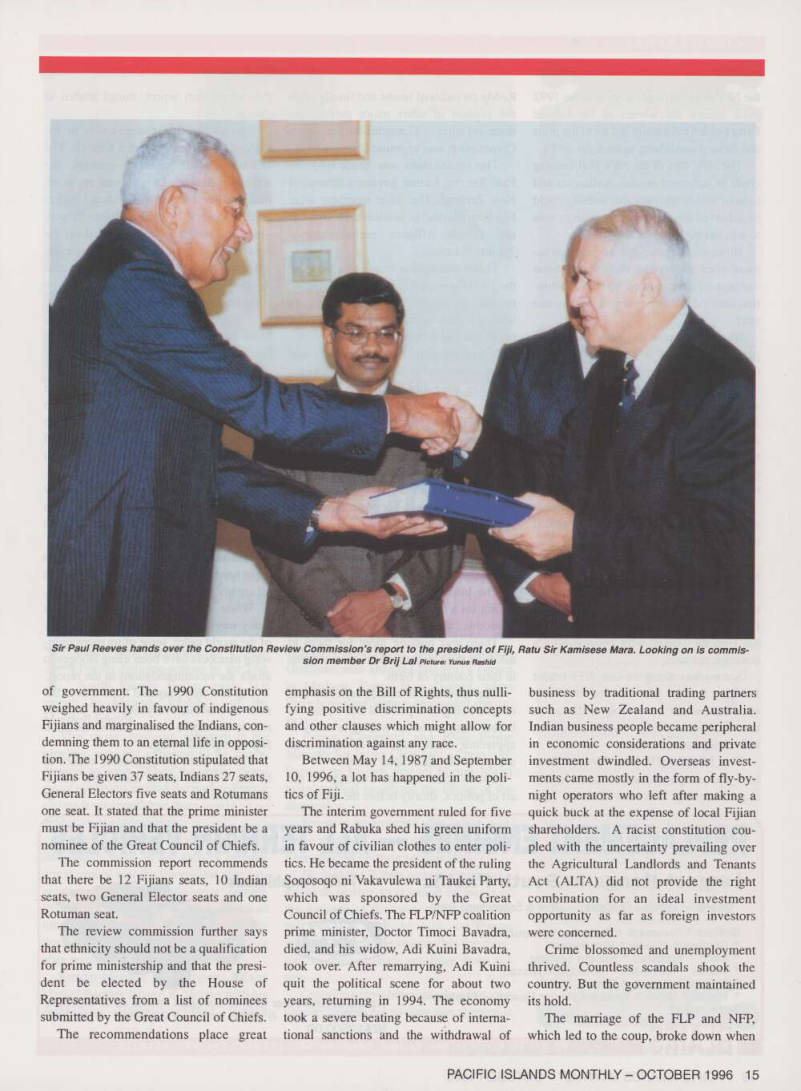
Sir Paul Reeves hands over the Constitution Review Commission’s report to the president of Fiji, Ratu Sir Kamisese Mara. Looking on is commis sion member Dr Brij Lai Picture: Yunus Rashid
the NFP decided to participate in the 1992 polls against the wishes of the Labour Party (which eventually did go to the polls and fielded candidates against the NFP).
The NFP was of the view that nothing could be achieved outside parliament and Labour was of the view that nothing could be achieved inside. Labour’s strategy was to win but boycott parliament.
However, Labour did go into parlia ment after supporting Rabuka as prime minister on the condition that the constitu tion and ALTA be reviewed within one year.
But this support did not last long as patience was not a Labour virtue nor urgency a Rabuka trait.
Eighteen months after Rabuka assumed power, a group of eight people from within the SVT ranks, headed by Josevata Kamikamica, who was aspiring to be prime minister before the general elections, voted against the budget and brought down the government.
But the SVT returned to parliament with a majority win and Rabuka continued as prime minister.
Kamikamica has lost four by-elections since.
During this time, racial biases contin ued in the form of affirmative action for Fijians and Rotumans and, to some extent, the General Voters, who became SVT’s coalition partners.
Somewhere along the line, NFP leader Jai Ram Reddy, who was never overly
optimistic about an overnight change in
the Fijian outlook towards Indians, befriended Rabuka.
This friendship became obvious early last year and continues to date. It saw more meetings between Rabuka and
Reddy on national issues and finally, with the support of other major parties, the three-member Constitution Review Commission was appointed.
The commission was headed by Sir Paul Reeves, former governor-general of New Zealand. The other members were Fiji-born Australian academic Dr Brij Lai and former Alliance parliamentarian Tomasi Vakatora.
Theirs was a clear instruction: Review the 1990 Constitution in line with interna
tionally acceptable democratic principles
while keeping in mind the sovereignty of the Fijian and Rotuman peoples.
When the commission started taking submissions, many radical Fijian groups, including the ruling SVT party, made no bones about wanting complete control.
The SVT was much in favour of the Malaysian Bhumi Putra concept ingrained in their constitution much to the annoy ance of the other races.
The Malaysian influence incited the Fiji Muslims to ask for separate seats four, to be exact.
The submissions reflected, sadly, that some people of Fiji were not ready for
political stability or equality.
The Indians, in general, were merely asking for a fair share of the political and economic cake.
There was nothing more for them to ask from their status as third-class citizens in their country of birth.
The submissions clearly reflected that despite being in a political and economic limbo, many were not willing or ready to appreciate their cultural diversity and accept a truly multiracial society.
But by some strange workings of the art of politics, shortly before the release of
the commission report, things started to
change.
One of the first changes was in the leadership of the Methodist Church. The militant former secretary-general, the Reverend Manasa Lasaro, was replaced, much to the relief of many church elders and the country, by the Rev Ilaitia Tuwere - the man who has clearly spelled out the separation of the church from the ever changing politics of the country and that the holy mission of the church cannot be paralleled with the drudgery of politics.
The second was a closer consultation between Rabuka and Reddy over the report and the resulting positive state ments made by both leaders.
The third was the reformation of the Taukei movement (an indigenous group associated with much violence during the military coups) which said it would counter any civil disobedience as a result of the release of the report.
The fourth was a warning issued by Rabuka that any attempts by radicals to derail the constitution reform process would be met with serious action.
It suddenly began to appear that things were heading back to pre-coup days. But all are not pleased with this turn of events.
While the SVT government has in many ways come to terms with the reality of the world order, some of its more right wing members have been using stooges to attack the recommendations in the report.
Fiji can only pray and hope that in the next 10 months, everybody will come to realise the nation cannot live in isolation
from the global village.
Fiji has been given another chance to be the way the world should be, and it should take it. ■