back, France
pp. 12-13 · Read in the full issue
Welcome back, France
France is back as a post-Forum dia logue partner, following an 11month suspension over its 1995 nuclear testing programme in the Pacific.
Welcome back!
The 27th South Pacific Forum summit in Majuro, Marshall Islands, decided to lift the suspension, having satisfied itself that Paris had made good on a number of fronts on the nuclear issue.
The decision to suspend a post-Forum dialogue partner was unprecedented. It was announced at the United Nations General Assembly in New York on October 2 last year in response to France’s defiance of an ultimatum to stop the nuclear test series or face the rist of hav ing its status as a post-Forum dialogue partner reviewed. It was taken only after all other options were exhausted.
No one argued against lifting the sus pension. But some were taken by surprise with the timing. It was so soon.
Prior to the 1996 South Pacific Forum, a firm consensus on restoring the South Pacific Forum-French connection had emerged. That stand was endorsed by the Forum Officials Committee which rightly agreed to leave the issue to the leaders for a final decision. On September 4 - the day of the Leaders’ Retreat - the spokesman for the 27th South Pacific Forum and prime minister of Papua New Guinea, Sir Julius Chan, announced the decision. The announcement came just two days short of the anniversary of the beginning of France’s controversial nuclear test series conducted at Mururoa and Fangataufa atolls in the South Pacific from September 6 last year.
It was made clear to the French during the post-Forum dialogue in Majuro that the suspension was made on the nuclear testing issue alone. It reflected the outrage with which the Pacific, and indeed the
world, viewed the resumption of nuclear tests. No one should be mistaken about the fact that the region and, indeed the world, viewed with outrage, France’s decision to resume nuclear testing last year. Hence, the suspension of its dia logue-partner status was a significant and effective part of the Pacific’s anti-nuclear testing campaign.
All that said, the South Pacific Forum has accepted that the issue is well and truly behind us. The world moves on. And it is pointless to continue living in the past. It never returns. We only learn from it. There are pros and cons on the decision to readmit France. Critics argue that allowing France back in the post-Forum dialogue this year meant that all the strong words by the Pacific leaders had amount ed to virtually nothing. In this line of argument, timing is the issue.
In their view, allowing France to rejoin the post-Forum dialogue this year meant that Paris had got away with it. Let’s focus for one moment on the response by France to the lifting of the suspension.
Swift was probably an understatement to describe the speed with which the French government machinery reacted on hearing the news on September 4.
By the afternoon of the same day, the South Pacific Forum Secretariat’s tempo rary office in the Capitol Building in Majuro had been informed that France was ready to participate in the dialogue this year.
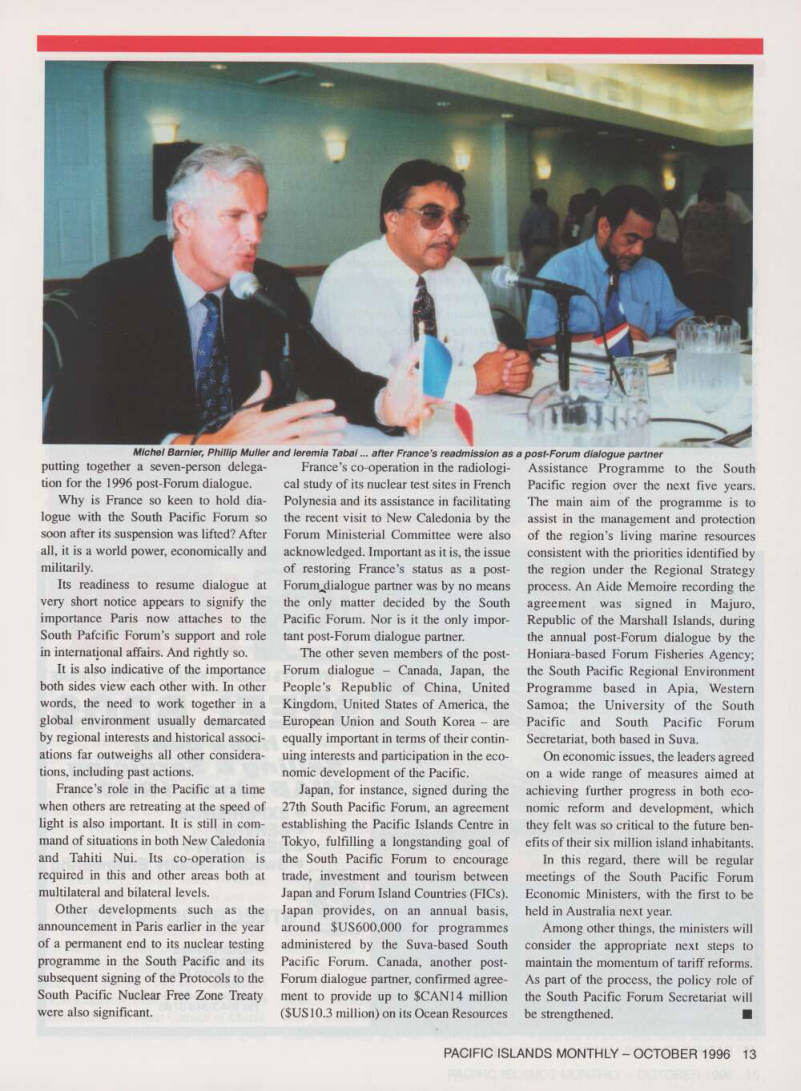
Michel Bamier - the French Minister Delegate in Paris for European Affairs led his country’s delegation. The French response to the South Pacific Forum’s decision was interesting. Putting together a ministerial-level delegation at short notice, especially to attend an internation al Forum half the world away, is not easy.
But France reciprocated the gesture by
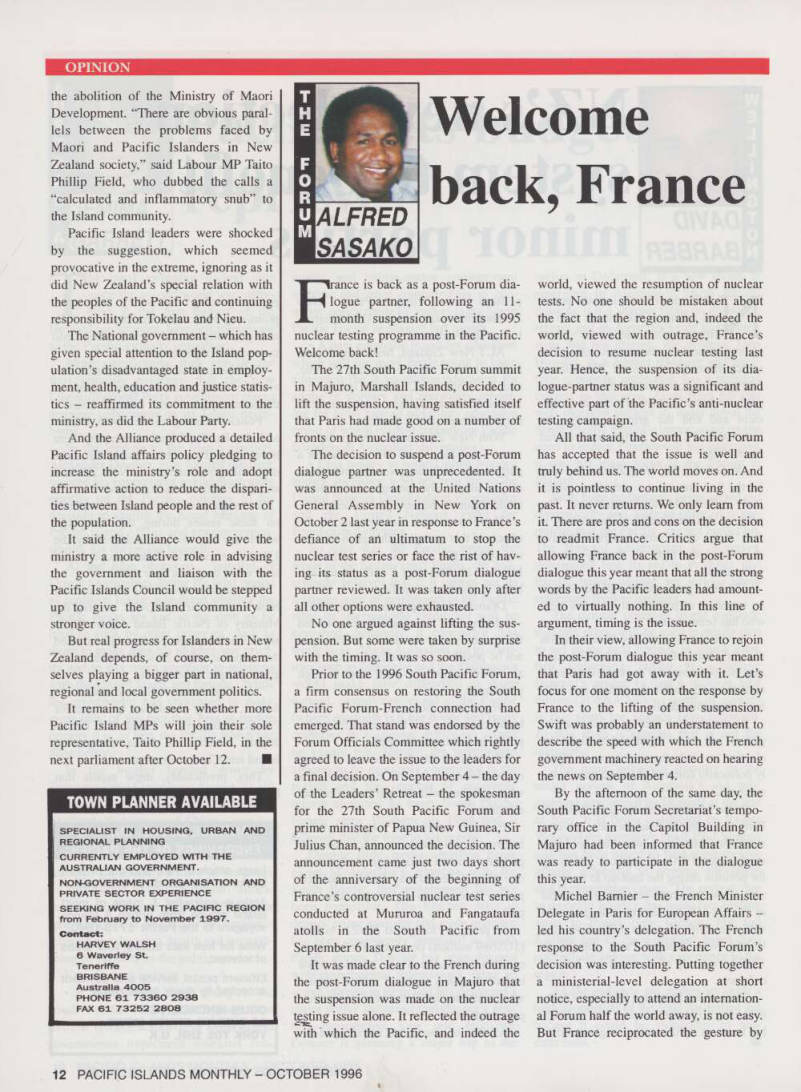
The Forum
Alfred
Sasako
putting together a seven-person delega tion for the 1996 post-Forum dialogue.
Why is France so keen to hold dia logue with the South Pacific Forum so soon after its suspension was lifted? After all, it is a world power, economically and
militarily.
Its readiness to resume dialogue at very short notice appears to signify the importance Paris now attaches to the South Pafcific Forum’s support and role in international affairs. And rightly so.
It is also indicative of the importance both sides view each other with. In other words, the need to work together in a global environment usually demarcated by regional interests and historical associ ations far outweighs all other considera tions, including past actions.
France’s role in the Pacific at a time when others are retreating at the speed of light is also important. It is still in com mand of situations in both New Caledonia and Tahiti Nui. Its co-operation is required in this and other areas both at multilateral and bilateral levels.
Other developments such as the announcement in Paris earlier in the year of a permanent end to its nuclear testing programme in the South Pacific and its subsequent signing of the Protocols to the South Pacific Nuclear Free Zone Treaty were also significant.
France’s co-operation in the radiologi cal study of its nuclear test sites in French Polynesia and its assistance in facilitating the recent visit to New Caledonia by the Forum Ministerial Committee were also acknowledged. Important as it is, the issue of restoring France’s status as a postpartner was by no means the only matter decided by the South Pacific Forum. Nor is it the only impor tant post-Forum dialogue partner.
The other seven members of the post- Forum dialogue - Canada, Japan, the People’s Republic of China, United Kingdom, United States of America, the European Union and South Korea - are equally important in terms of their contin uing interests and participation in the eco nomic development of the Pacific.
Japan, for instance, signed during the
27th South Pacific Forum, an agreement establishing the Pacific Islands Centre in
Tokyo, fulfilling a longstanding goal of
the South Pacific Forum to encourage trade, investment and tourism between Japan and Forum Island Countries (FICs).
Japan provides, on an annual basis, around SUS6OO,OOO for programmes administered by the Suva-based South Pacific Forum. Canada, another post- Forum dialogue partner, confirmed agree ment to provide up to SCANI4 million (SUSIO.3 million) on its Ocean Resources
Assistance Programme to the South Pacific region Over the next five years.
The main aim of the programme is to assist in the management and protection of the region’s living marine resources consistent with the priorities identified by the region under the Regional Strategy process. An Aide Memoire recording the agreement was signed in Majuro, Republic of the Marshall Islands, during
the annual post-Forum dialogue by the
Honiara-based Forum Fisheries Agency; the South Pacific Regional Environment Programme based in Apia, Western Samoa; the University of the South Pacific and South Pacific Forum Secretariat, both based in Suva.
On economic issues, the leaders agreed on a wide range of measures aimed at achieving further progress in both eco nomic reform and development, which they felt was so critical to the future ben efits of their six million island inhabitants.
In this regard, there will be regular meetings of the South Pacific Forum Economic Ministers, with the first to be held in Australia next year.
Among other things, the ministers will consider the appropriate next steps to maintain the momentum of tariff reforms.
As part of the process, the policy role of the South Pacific Forum Secretariat will be strengthened. ■
Michel Barnier, Phillip Muller and leremia Tabai...after France’s readmission as a post-Forum dialogue partner