minor parties
pp. 11-12 · Read in the full issue
NZ’s new election system to benefit minor parties
New Zealand heads into the politi cal unknown this month with its first election under a new system
of proportional representation voting. The
switch from the traditional Westminster first-past-the-post system will give minor parties a better chance of seats in parlia ment and end the grip on power the National and Labour parties have shared since 1938.
On October 12, New Zealanders will for the first time elect a parliament which fairly reflects the total votes cast. The price of this new brand of democracy is that, at the same time, voters will have abandoned the right to directly elect a government.
The new government will be formed by members of parliament once it’s clear who has been elected.
It will almost certainly be a coalition and the shape of the new administration may not be known for days or even weeks after the poll - after the parties and MPs have done their deals.
At the time of writing, more than 20 parties had been registered to fight the election and only the very brave or blind ly politically committed would predict the outcome.
Prime Minister Jim Bolger’s National Party is hoping to head the new govern ment, thus retaining power it has held nar
rowly since 1990. In political jockeying
for position during the lead-up to the elec tion, it lost the single-seat majority it held in the 99-MP parliament and governed with the help of seven MPs from the United New Zealand Party, formed in 1995 by a group of National and Labour defectors.
The Labour Party, led by Helen Clark, is bidding to regain power it lost in 1990, but faces an uphill struggle against com
petition from Winston Peters’ New Zealand First party and the ANZ Alliance, led by Jim Anderton.
ACT New Zealand, headed by former Labour cabinet minister Richard Prebble, and the Christian Coalition, led by ex- National minister Graeme Lee, completes the list of high-profile parties.
With New Zealanders now given two votes - one for a local MP and one for a party - any of these seven organisations, or just about any combination of them, could figure in the next government.
There are two theories about the effects of this sweeping change in the vot ing system that will raise the number of MPs to 120. One says it will enforce sta
bility in government policy.
Dramatic and unpopular - if necessary - reforms like those which restructured the economy over the last 12 years would not be possible if one party does not gain an overall majority to push them through parliament.
Negotiation between parties and a broad consensus will be needed for major policy initiatives to succeed.
The other holds that because of those negotiations, voters will have little idea what policies will be pursued after an election.
If party manifestos meant anything before, they’ll mean even less now. A party that makes a campaign pledge to do one thing if elected may find its coalition partner forces it to do another after the poll.
A promise to spend SNZI billion (SUS6B9 million) on health, for instance, could in political reality be whittled down to half that in a trade-off with a partner who wants to spend the rest on another
policy initiative.
All this, of course, has not stopped the
parties pouring out policy documents
promising to do this, that and the other and generally mould New Zealand into their vision of perfection.
Opinion polls indicate that health ser vices, education and the general state of the economy are voters’ main priorities.
Policies relating to the South Pacific and the Pacific Island community here have rarely, if ever, been issues that make or break governments in New Zealand and this election is no exception.
But some parties have put an emphasis on these issues during this campaign which are sure to be considered by the 170,000 or so Pacific Island people living here when they cast their votes.
The most controversial was a call by New Zealand First and ACT to scrap the Ministry of Pacific Island Affairs. They argue that Island people should be treated the same as other New Zealanders and given no special attention.
“We don’t have a Ministry of Chinese Affairs, so why should we have one for Pacific Islanders?” asked NZ First’s deputy leader, Tau Henare, equating Island and Chinese immigrants.
This, predictably, drew taunts that Henare, a Maori, could equally argue for
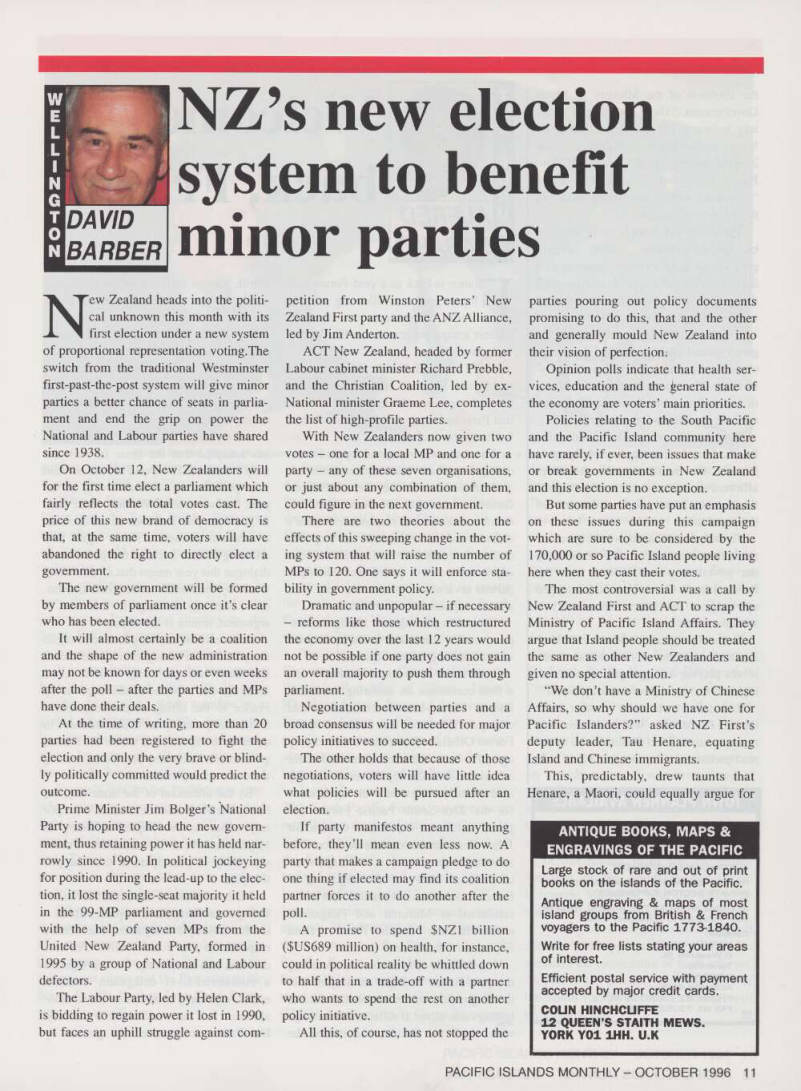
Wellington
David
Barber
the abolition of the Ministry of Maori Development. “There are obvious paral lels between the problems faced by Maori and Pacific Islanders in New Zealand society,” said Labour MP Taito Phillip Field, who dubbed the calls a “calculated and inflammatory snub” to the Island community.
Pacific Island leaders were shocked by the suggestion, which seemed provocative in the extreme, ignoring as it did New Zealand’s special relation with the peoples of the Pacific and continuing responsibility for Tokelau and Nieu.
The National government - which has given special attention to the Island pop ulation’s disadvantaged state in employ ment, health, education and justice statis tics - reaffirmed its commitment to the ministry, as did the Labour Party.
And the Alliance produced a detailed Pacific Island affairs policy pledging to increase the ministry’s role and adopt affirmative action to reduce the dispari ties between Island people and the rest of the population.
It said the Alliance would give the ministry a more active role in advising the government and liaison with the Pacific Islands Council would be stepped up to give the Island community a stronger voice.
But real progress for Islanders in New Zealand depends, of course, on them selves playing a bigger part in national, regional and local government politics.
It remains to be seen whether more Pacific Island MPs will join their sole representative, Taito Phillip Field, in the next parliament after October 12. ■