French fallout
pp. 17-19 · Read in the full issue
Cover Stories
The end of the French fallout
The South Pacific Forum makes up with France after suspending it as a post-Forum dialogue partner less than a year ago
By Bernadette Hussein
France was readmitted as a post- Forum dialogue partner by the 27th South Pacific Forum early last month in Majuro, Republic of the Marshall Islands.
This move, however, although in the pipeline, was not expected to be imple mented so soon. While the move raised many eyebrows around the region, France claims it was confident there would be no delays in its readmission.
French nuclear testing at Mururoa and Fangataufa atolls in the face of interna tional protest saw the Forum last year sus pending France as a dialogue partner.
France, on learning that the Forum had lifted the suspension, did not waste any time and arrived in Majuro just two days after receiving the news.
French Minister for European Affairs Michel Bamier arrived in Majuro with his delegation, which included French
Polynesian President Gaston Flosse and
French Co-operation Minister Jacques
Godfrain, who attended last year’s Forum in Madang, Papua New Guinea, when French nuclear testing dominated discus sion.
Forum Chairman and PNG Prime Minister Sir Julius Chan told a Press con ference in Majuro that all Forum Island members had supported the lifting of the
suspension.
France’s readmission. Sir Julius said, was a means of getting closer to the coun tries affected by their nuclear tests.
He said the Forum wanted France as a dialogue partner so it would be aware of the feelings of countries which fell near the test sites. And, he said, the Forum wanted France to be responsible for dam age to these Islands resulting from the tests.
Questions have been asked as to how a country, which not so long ago showed it
• The Forum called on the Forum Fisheries Committee to continue with urgency its development and comprehensive arrangements for the sustainable management of the region's fisheries and endorsed the Marshall Islands' initiative to hold a meeting to advance this process. • It endorsed a second High Level Multilateral Consultation on the Conservation and Management of Fisheries Resources of the Central West Pacific in early 1997. • The Forum endorsed action to date by member countries to implement the South Pacific Code of Conduct for Logging of Indigenous Forests in selected South Pacific Countries and called for continuing efforts. • The Forum agreed that Forum ministers with appropriate economic portfolios should meet annually prior to the Forum and report to the Forum. • Leaders recognised that tariff reform was critical to achieving sustainable economic development and agreed that tariff policies should be reviewed in the light of national circumstances to liberalise trade in the region, consistent with the global liberalisation focus and supported measures that countries can undertake without compromising other national policy objectives. • The Forum acknowledged the importance of attracting quality investment if members were to achieve sustainable economic development. The next Forum Economic Ministers' Meeting will report to the 1997 Forum on the progress of Forum Island Countries in developing their national investment policies, and advise on efforts to bring these into line with APEC investment principles by the end of 1998. • The Forum welcomed the opening of the South Pacific Economic Exchange Support Centre in Tokyo, Japan and reaffirmed its on-going commitment to SPEESC, including member Island Countries' financial contributions, and further development of trade, investment and tourism links with Japan. • Leaders directed the Forum Secretariat to proceed with work to develop and broaden trade representation in other markets which offered FICs export and investment-sourcing opportunities. • The Forum reiterated the need for further strengthening of APEC/Forum links. It discussed Papua New Guinea's initiative for the establishment of the proposed APEC Centre and invited PNG to develop its proposals further.
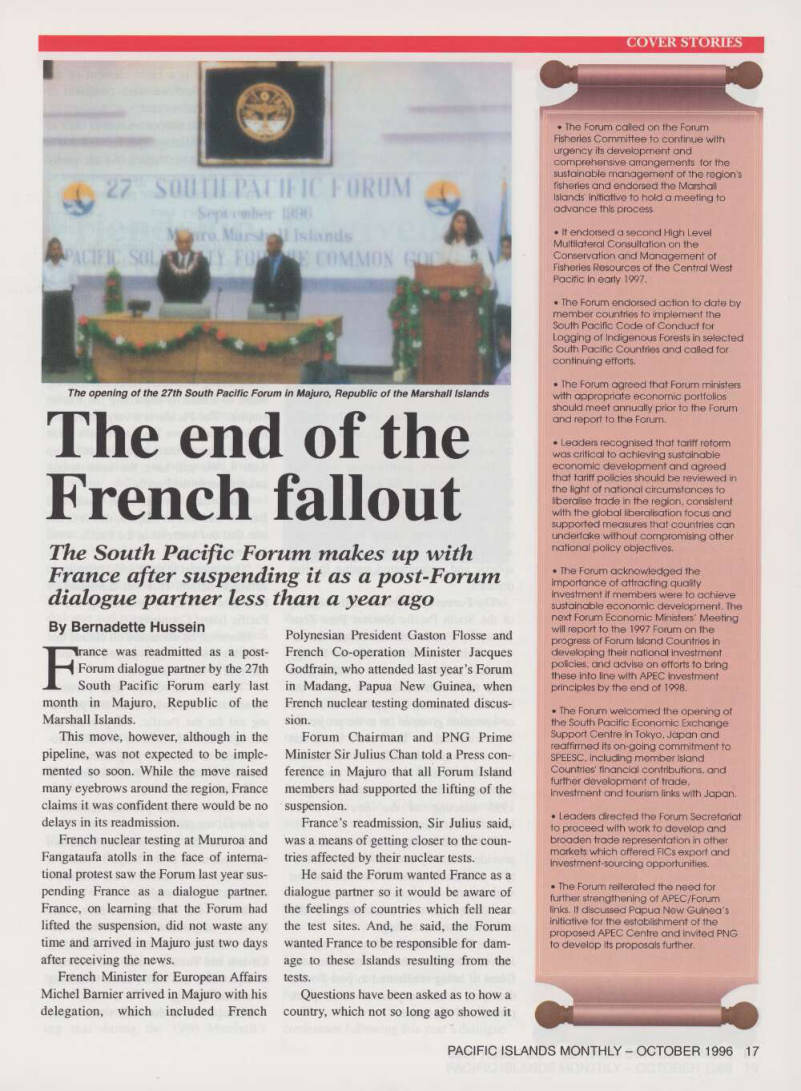
The opening of the 27th South Pacific Forum in Majuro, Republic of the Marshall Islands
• The Forum highlighted its concern that climate change had become a crucial issue and called for urgent action, particularly in view of the Second Assessment Report of the Intergovernmental Panel on Climate Change (IPCC) which stated that the balance of scientific evidence suggested a discernible human influence on the global climate, It called for negotiations on the text of a legally binding protocol to be completed in time for adoption at the Third Session of the Conference of the Parties in order to achieve significant progress towards the goal of lower greenhouse gas emissions. • The Forum called upon the United Nations Development Programme and the Global Environment Facility for the extension of the funding period for the South Pacific Biodiversity Conversation Programme (SPBCP) to provide adequate time for community-based conservation activities to build effective community management groups, • Forum members resolved to continue their support for the Regional Marine Turtle Conservation Programme and to examine further ways of working together to enhance conservation efforts. • The Forum called on member countries and development partners to recognise the Pacific region's 1997 "Year of the Coral Reef" and to encourage participation in its development and implementation. • The five-yearly ministerial meeting of SPREP (November, 1996) will consider and adopt an action plan for regional co-operation In environmental management over the next five years, • Forum leaders called on development partners to support regional efforts to address coastal protection. • The Forum agreed that shipments of plutonium and radioactive wastes through the region posed a continuing concern and that such shipments should be carried out in accordance with the highest international safety and security standards in a manner which satisfactorily addressed all possible contingencies and in consultation with Forum Countries. • The Forum noted that, despite the longstanding regional opposition to the use of the Pacific as a dumping ground for wastes and the adoption of the Waigani Convention, new proposals for creating storage sites for nuclear wastes in the region were emerging. The Forum also reiterated its opposition that Palmyra be used to develop a storage site for spent nuclear fuel and reaffirmed
did not care very much about the Pacific and how its people felt, could be wel comed back.
The Forum’s justification was that France had reduced the number of nucle ar tests from eight to six and that its per manent cessation of testing marked the end to all nuclear testing in the region, which has been subjected to both atmo
spheric and underground testing for five
decades.
The Forum also welcomed the signing of the South Pacific Nuclear Free Zone Treaty by France and the French invita tion to the International Atomic Energy Agency (lAEA) to conduct a radiological study of French nuclear test sites in the Pacific, expressing its appreciation for the co-operation given so far to the project by French authorities. The Forum noted that the invitation to the lAEA was consistent with the desires of Forum countries expressed in the declaration of the August 1995 meeting of the South Pacific Environment Ministers.
The declarataion called on France to provide access by international communi ty to all French scientific data and the test sites themselves to enable an independent and comprehensive assessment of the effects of nuclear testing.
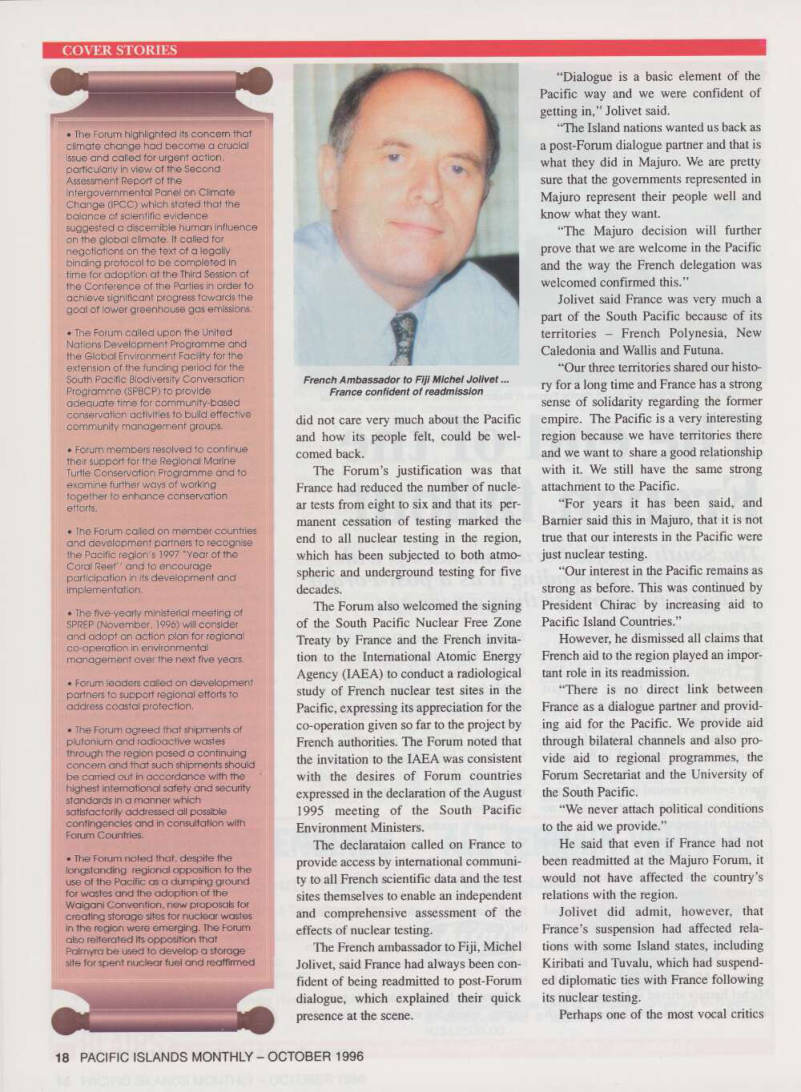
The French ambassador to Fiji, Michel Jolivet, said France had always been con fident of being readmitted to post-Forum
dialogue, which explained their quick
presence at the scene.
“Dialogue is a basic element of the Pacific way and we were confident of getting in,” Jolivet said.
“The Island nations wanted us back as a post-Forum dialogue partner and that is what they did in Majuro. We are pretty sure that the governments represented in Majuro represent their people well and know what they want.
“The Majuro decision will further prove that we are welcome in the Pacific and the way the French delegation was welcomed confirmed this.”
Jolivet said France was very much a part of the South Pacific because of its territories - French Polynesia, New Caledonia and Wallis and Futuna.
“Our three territories shared our histo ry for a long time and France has a strong sense of solidarity regarding the former empire. The Pacific is a very interesting region because we have territories there and we want to share a good relationship with it. We still have the same strong attachment to the Pacific.
“For years it has been said, and Bamier said this in Majuro, that it is not true that our interests in the Pacific were
just nuclear testing.
“Our interest in the Pacific remains as strong as before. This was continued by President Chirac by increasing aid to Pacific Island Countries.”
However, he dismissed all claims that French aid to the region played an impor tant role in its readmission.
“There is no direct link between France as a dialogue partner and provid ing aid for the Pacific. We provide aid through bilateral channels and also pro vide aid to regional programmes, the Forum Secretariat and the University of the South Pacific.
“We never attach political conditions to the aid we provide.”
He said that even if France had not been readmitted at the Majuro Forum, it would not have affected the country’s relations with the region.
Jolivet did admit, however, that France’s suspension had affected rela tions with some Island states, including Kiribati and Tuvalu, which had suspend ed diplomatic ties with France following its nuclear testing.
Perhaps one of the most vocal critics
French Ambassador to Fiji Michel Jolivet...
France confident of readmission
of France’s readmission has been the Greenpeace movement, which claims that though France’s re-entry was never in doubt, it was disappointing that the Forum did not wait at least a year before lifting
the suspension.
“Such a delay would have demonstrat
ed the Forum’s seriousness about France’s indifference to the region’s opposition to nuclear testing. While France’s nuclear testing has ended in the Pacific, the prob lems are not over. The issue of clean-up and compensation has still to be resolved,” Greenpeace said. ■