Bizarre rise to
pp. 56-57 · Read in the full issue
Fuemana’s Bizarre rise to fame and glory
By Atama Raganivatu
The South Pacific has produced a long stream of very talented pop singers, none of whom gained great fame beyond our region.
However, the long-awaited interna tional breakthrough may occur soon through the vocal talents of Pauly Fuemana.
The gifted singer has already topped
the charts in both New Zealand and Australia under the name of O.M.C.
through the exasperatingly hauting tune
How Bizarre. As Pacific Islands Monthly went to press, it was the eighth most pop ular song in Britain and there are legiti mate hopes for similar success in North America, where Australasia’s catchiest ditty is to be released later this year.
If Fuemana does become a celebrity throughout the pop world, he will be a rags-to-riches story of classical propor tions. He readily admits that most of his life has been unhappy and wasteful.
Bom in 1969, four years after his Niuean father, Takiula Tuapassi, had jumped a copra boat in Auckland and three months before his Maori mother ran off to Australia, Fuemana was raised by his grandmother until aged 11. He then joined Takiula’s dysfunctional family in the notoriously grim south Auckland sub urb of Otara.
Speaking only Niuean into his mid teens and suffering from a lisp, his schooldays were spent at the back of the class learning little.
Believing academic qualifications to be beyond him and having little interest in sport, Fuemana devoted many years to gangs, crime, drugs - and music.
“Music was the only legitimate activi ty my family had any involvement in,” he now concedes. “But it never brought in more money than burglary or drug dealing which were part and parcel of the gang scene I was then engaged in.”
Unfortunately, it took considerable time for Fuemana to recognise music as the best option open to him. He had already settled into a life of law breaking, stints in government institutions and unemployment when, at 17, he left home
voluntarily for the first time and moved to Australia.
Across the Tasman Sea, Fuemana con tinued his lifestyle until a chance meeting with a former gang member who owned a vehicle sales resulted in him becoming a reputable car salesmari.
Sadly, this taste of mainstream Australia lasted just two years before he fell back into the drug scene, lost his job and went back to Auckland.
Upon returning, Fuemana found that his elder brother, Phil, and sister, Christine, had formed a pop group enabling them to make both a name for themselves and an honest income.
Without any great enthusiasm, Fuemana assembled some other musi cians from within his neighbourhood and set up the Otara Millionaires Club. The title was a whimsical one - Otara has no millionaires. And they styled themselves upon Black American rap groups such as Public Enemy.
Fuemana and his friends tried to repro duce the anger of Los Angeles ghetto dwellers.
“We were sick of being called ‘dumb coconuts’,” he recollects.
“We continually asked why we were poor and seemingly trapped in Otara. We wanted to kick the establishment through our music.”
Otara Millionaires Club acquired a cult following around south Auckland but few devotees elsewhere. Their capacity for attracting gangs did not endear them to concert promoters.
In 1992, ‘The Millionaires’ were invit ed to just four ‘gigs’ and the last of these ended prematurely when the audience erupted into an all-out brawl which mem bers of the group became involved in.
At this stage, Fuemana concluded he no longer had the stomach to remain a gang associate and spent one year at Bible college attempting to sort himself out.
“I am not a practising Christian as such,” he reflects today. “But I succeeded in getting my values and priorities identi fied at the college, so the time there was invaluble to me.”
After leaving the college, Fuemana, along with 39 other south Auckland
musicians, travelled around New Zealand on what was titled “The Proud Tour”. The sojourn made him little money.
However, it did provide opportunities to mix among his musical peers, meet important figures in the local entertain ment industry and take his act to a wider audience.
On the strength of his performances during the tour, he gained work in Australia where the humour behind the name Otara Millionaires Club was lost on
the natives. So, it was abbreviated to
O.M.C.
O.M.C. was by that time solely Fuemana’s project.
The other original members had drift ed away or, in one case, suffered a myste rious death and it comprised just him and any backing singers and musicians he could muster at any given time. The name change did not bring any immediate change in fortune though.
After the short Australian trip, engage
ments virtually dried up and just last year, Fuemana was considering applying to enroll in an art school when a knight in shining armour called Alan Jansson rode onto the scene.
Jansson, an Auckland record producer who first met Fuemana on the Proud Tour, became the disheartened singer’s mentor.
“Alan told me I had qualities - and nobody had ever said that to me before,” he laughs. The two worked upon a com plete metamorphosis for O.M.C. and the inspiration for ‘their’ eventual guise came in the unlikely form of Fuemana’s father, who died from an illness related to his alcoholism, aged 52, in 1990.
“Dad didn’t like rap,” Fuemana recalls.
“He much preferred more melodic music. Tom Jones, Elvis Presley and Dean Martin were his favourites and he would sing Niuean versions of their songs, accompanying himself on a one string guitar, at Otara hotels and parties.
Remembering him, I realised that it would be more appropriate for me to sing gentler stuff that reflects I’m Niuean liv ing in urban New Zealand and forget try ing to imitate Americans. Also, I have had a change of outlook.
I no longer blame other people for whatever situation I’m in, as I did in the rap days. I realise it is up to me to go out and be a success for myself.”
The first product of the new and tune ful O.M.C. was How Bizarre, a song writ ten by Fuemana and Jansson. Its progress has been staggering. How Bizarre remained in the Kiwi top 10 for three months before becoming the first number one single in Australia by a New Zealand based artist since 1965.
At the 1995 New Zealand Music and Entertainment awards, it was voted Single of the Year. Fuemana captured the Most Promising Male Vocalist Award and must have created something of a record when he accepted the Most Promising Group accolade the same evening.
Now Fuemana is bewitching the British through his song and an assault upon the all-important North American market will be made in conjunction with the release of O.M.C.’s first album in the coming months. It remains to be seen whether or not Fuemana is. a ‘One-Hit Wonder’.
The knowledgeable Rolling Stone magazine discounted such a notion when it observed: “He is an absolute natural - a man who sings and moves with the easy confidence of a young Marvin Gaye.
“It is hard to believe that Pauly Fuemana will not be a huge international star.” Little did Fuemana know when naming his group Otara Millionaires Club that he was making a self-fulfilling prophecy. ■
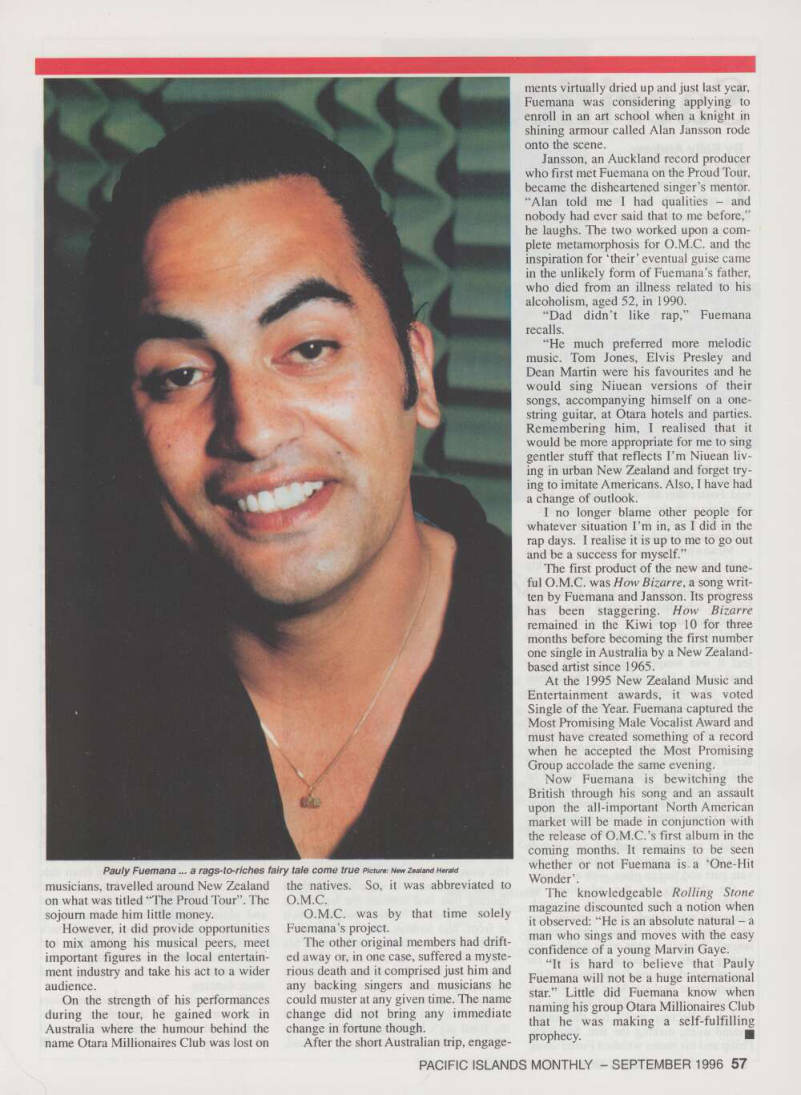
Pauly Fuemana... a rags-to-riches fairy tale come true Picture: New Zealand Herald