Sacrifice of adoption
p. 58 · Read in the full issue
By Sally Andrew
I sat on a rough wooden bench watch ing Rachel move hot stones aside with a split stick. Her ima-kisin (kitchen shed) was smoky, and my eyes watered. It was dark, but the kerosene lantern sitting on the table remained unlit. My eyes adjusted to the blackness and the smoke slowly while Rachel explained how to cook Vanuatu’s national dish, laplap.
Our return to Vanuatu was slated to be a very special one, culminating with our formal adoption into a village in northern Pentecost. In preparation for the celebra tion, kava, taro and yams had to be col lected from the gardens, and a sacrificial pig acquired. Foster joined his ni-Vanuatu father-to-be, Philip, on the trip to the gar den to collect the necessary traditional foods for the feast.
On the way, he prompted; “You must tell me what to do. I am like a young boy.”
So Philip talked about the ceremony and told Foster that he would have to kill a small pig with the tusk just coming out.
In the garden, he helped pull up taro and yams and replanted some shoots.
Meanwhile Rachel decided to make a bush lunch. She grabbed two prickly branches and used them to grate a yam onto a clean leaf. She cut a section of bamboo tube, lined it with a leaf, poured grated yam inside, and lay it in the fire.
Voila! Yam laplap, damu longgo, so hot you could hardly hold the four-layer-thick leaf it was wrapped in. It tasted really good, a little bit smoky, with the consis tency of porridge. Laplap can also be made from plantain, cassava or taro.
At the end of the day, the boys cut branches and vines, and trimmed and tied the taro to long sticks. Everyone shoul dered up their loads and set off. Foster still had one big worry - what would he need to wear for the ceremony? On sever al islands in Vanuatu, namha are the tradi tional formal attire of males participating in custom ceremonies. Namba, I should explain, are penis sheaths - tiny woven mats that are wrapped around a male’s pri vate part and tied in place with a string.
On the day of the adoption, we dinghied ashore at eight o’clock.
Everyone was already busy carrying taro and yams to the nakamal (the meeting house). Several women were peeling and grating roots, and preparing leaves for wrapping and serving foods. Some of the women wove baskets. Men were unload ing kava, cutting lengths of bamboo for laplap, collecting rocks for the under ground oven, making the fire. Suddenly, Philip and his mates whisked Foster away.
His worst fear proved unfounded as they helped him dress. He wore a fancy dyed dancing mat, tied between the legs like a loin cloth with an “apron” hanging down in front, and nothing else - no shirt, no watch, no shoes. It was tied around his waist with a natural coir cord. My new mum-to-be, Rachel, took me off to her hut and wrapped a red mat around my waist, over my lavalava.
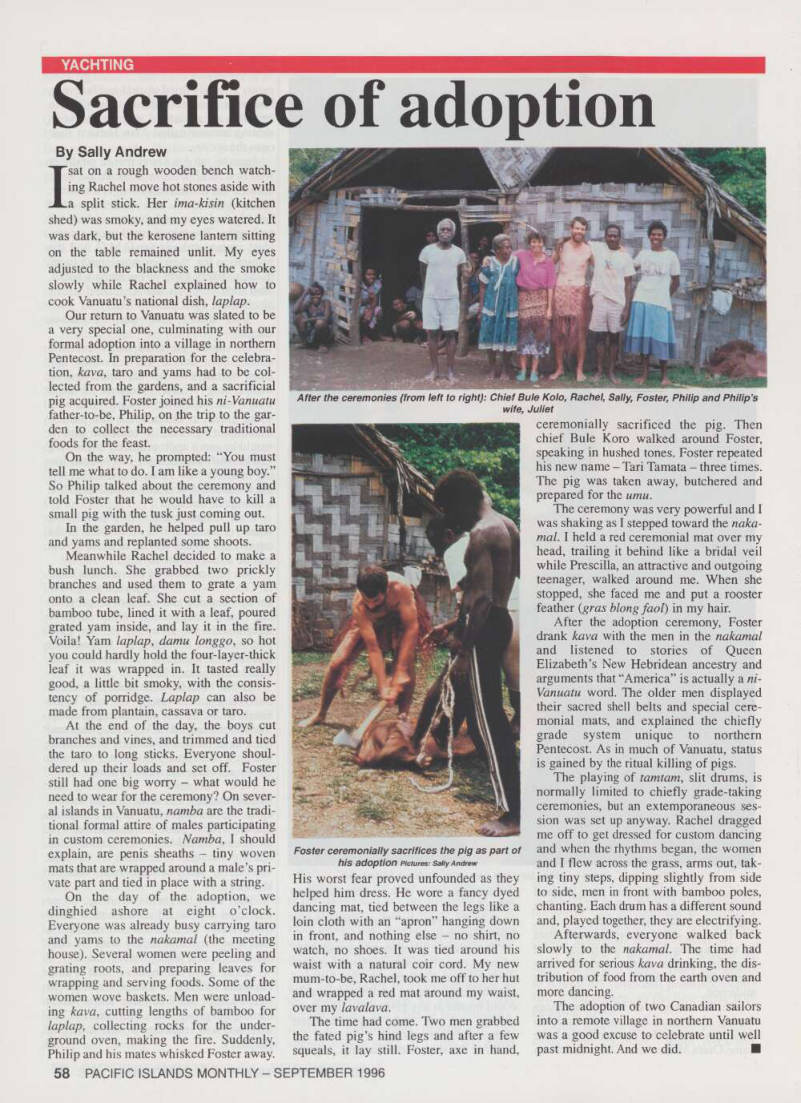
The time had come. Two men grabbed the fated pig’s hind legs and after a few squeals, it lay still. Foster, axe in hand,
ceremonially sacrificed the pig. Then chief Buie Koro walked around Foster, speaking in hushed tones. Foster repeated his new name - Tari Tamata - three times.
The pig was taken away, butchered and prepared for the umu.
The ceremony was very powerful and I was shaking as I stepped toward the naka mal. I held a red ceremonial mat over my head, trailing it behind like a bridal veil while Prescilla, an attractive and outgoing teenager, walked around me. When she stopped, she faced me and put a rooster feather ( gras blong faol ) in my hair.
After the adoption ceremony, Foster drank kava with the men in the nakamal and listened to stories of Queen Elizabeth’s New Hebridean ancestry and arguments that “America” is actually a ni- Vanuatu word. The older men displayed their sacred shell belts and special cere monial mats, and explained the chiefly grade system unique to northern Pentecost. As in much of Vanuatu, status is gained by the ritual killing of pigs.
The playing of tamtam, slit drums, is
normally limited to chiefly grade-taking
ceremonies, but an extemporaneous ses sion was set up anyway. Rachel dragged me off to get dressed for custom dancing and when the rhythms began, the women and I flew across the grass, arms out, tak ing tiny steps, dipping slightly from side to side, men in front with bamboo poles, chanting. Each drum has a different sound and, played together, they are electrifying.
Afterwards, everyone walked back slowly to the nakamal. The time had arrived for serious kava drinking, the dis tribution of food from the earth oven and more dancing.
The adoption of two Canadian sailors into a remote village in northern Vanuatu was a good excuse to celebrate until well past midnight. And we did. ■
After the ceremonies (from left to right): Chief Buie Kolo, Rachel, Sally, Foster, Philip and Philip’s wife, Juliet
Foster ceremonially sacrifices the pig as part of his adoption Pictures: Sally Andrew