Trying times for Manu Samoa
pp. 55-56 · Read in the full issue
Internal bickering and finger-pointing dominate in the wake of the former rugby giant’s sporting failures
By Chris Peteru
It’s been a devastating season for Manu Samoa, who have failed to deliver the outstanding rugby that once labelled them as a team to fear.
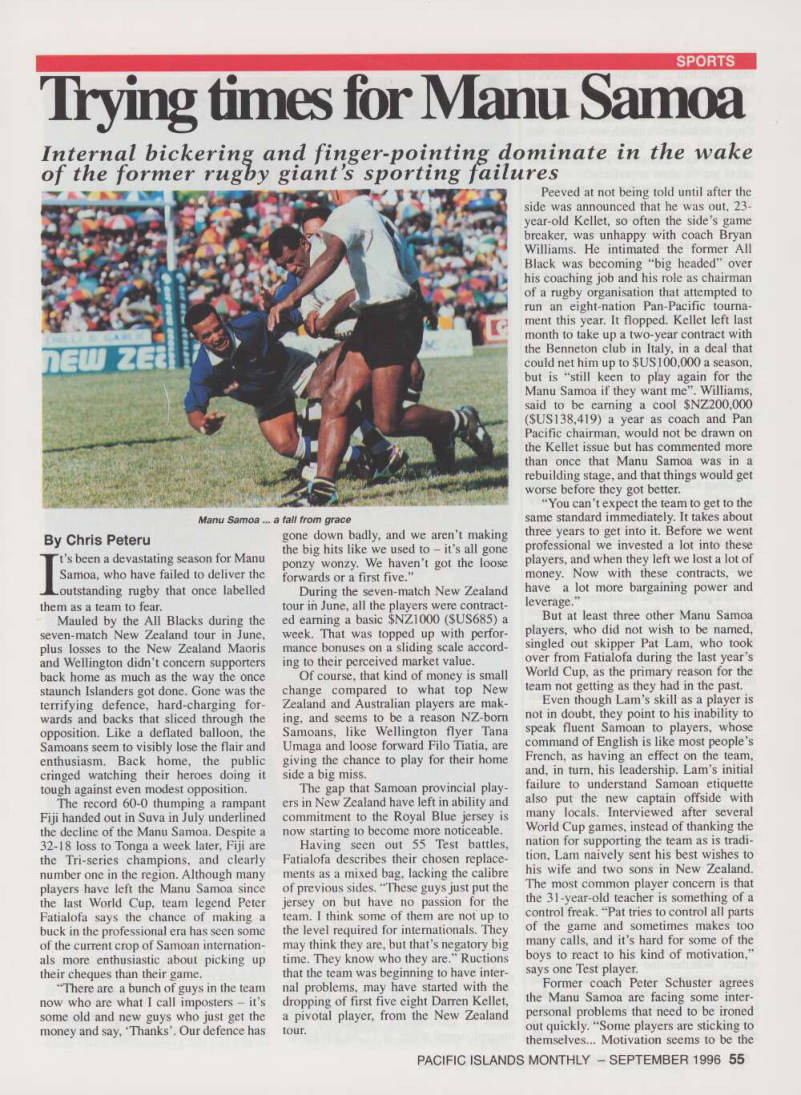
Mauled by the All Blacks during the seven-match New Zealand tour in June, plus losses to the New Zealand Maoris and Wellington didn’t concern supporters back home as much as the way the once staunch Islanders got done. Gone was the
terrifying defence, hard-charging for
wards and backs that sliced through the opposition. Like a deflated balloon, the Samoans seem to visibly lose the flair and enthusiasm. Back home, the public cringed watching their heroes doing it
tough against even modest opposition.
The record 60-0 thumping a rampant Fiji handed out in Suva in July underlined the decline of the Manu Samoa. Despite a 32-18 loss to Tonga a week later, Fiji are the Tri-series champions, and clearly number one in the region. Although many players have left the Manu Samoa since the last World Cup, team legend Peter Fatialofa says the chance of making a buck in the professional era has seen some of the current crop of Samoan internation als more enthusiastic about picking up their cheques than their game.
“There are a bunch of guys in the team now who are what I call imposters - it’s some old and new guys who just get the money and say, ‘Thanks’. Our defence has
gone down badly, and we aren’t making the big hits like we used to - it’s all gone ponzy wonzy. We haven’t got the loose forwards or a first five.”
During the seven-match New Zealand tour in June, all the players were contract ed earning a basic SNZIOOO (SUS6BS) a week. That was topped up with perfor mance bonuses on a sliding scale accord ing to their perceived market value.
Of course, that kind of money is small change compared to what top New Zealand and Australian players are mak ing, and seems to be a reason NZ-bom Samoans, like Wellington flyer Tana Umaga and loose forward Filo Tiatia, are giving the chance to play for their home side a big miss.
The gap that Samoan provincial play ers in New Zealand have left in ability and commitment to the Royal Blue jersey is now starting to become more noticeable.
Having seen out 55 Test battles, Fatialofa describes their chosen replace ments as a mixed bag, lacking the calibre of previous sides. “These guys just put the jersey on but have no passion for the team. I think some of them are not up to the level required for internationals. They may think they are, but that’s negatory big time. They know who they are.” Ructions that the team was beginning to have inter nal problems, may have started with the dropping of first five eight Darren Kellet, a pivotal player, from the New Zealand tour.
Peeved at not being told until after the side was announced that he was out, 23year-old Kellet, so often the side’s game breaker, was unhappy with coach Bryan Williams. He intimated the former All Black was becoming “big headed” over his coaching job and his role as chairman of a rugby organisation that attempted to run an eight-nation Pan-Pacific tourna ment this year. It flopped. Kellet left last month to take up a two-year contract with the Benneton club in Italy, in a deal that could net him up to SUS 100,000 a season, but is “still keen to play again for the Manu Samoa if they want me”. Williams, said to be earning a cool SNZ2OO,OOO (SUS 138,419) a year as coach and Pan Pacific chairman, would not be drawn on the Kellet issue but has commented more than once that Manu Samoa was in a rebuilding stage, and that things would get worse before they got better.
“You can’t expect the team to get to the same standard immediately. It takes about three years to get into it. Before we went professional we invested a lot into these players, and when they left we lost a lot of money. Now with these contracts, we have a lot more bargaining power and leverage.”
But at least three other Manu Samoa players, who did not wish to be named, singled out skipper Pat Lam, who took over from Fatialofa during the last year’s World Cup, as the primary reason for the team not getting as they had in the past.
Even though Lam’s skill as a player is not in doubt, they point to his inability to speak fluent Samoan to players, whose command of English is like most people’s French, as having an effect on the team, and, in turn, his leadership. Lam’s initial failure to understand Samoan etiquette also put the new captain offside with many locals. Interviewed after several World Cup games, instead of thanking the nation for supporting the team as is tradi tion, Lam naively sent his best wishes to his wife and two sons in New Zealand.
The most common player concern is that the 31-year-old teacher is something of a control freak. “Pat tries to control all parts of the game and sometimes makes too many calls, and it’s hard for some of the boys to react to his kind of motivation,” says one Test player.
Former coach Peter Schuster agrees the Manu Samoa are facing some inter personal problems that need to be ironed out quickly. “Some players are sticking to themselves... Motivation seems to be the
Manu Samoa ... a fall from grace
other problem ... the team togetherness is not what it used to be.”
After taking the side to successive quarter-final spots at consecutive World Cups, Schuster empathises with the incumbent coach, Williams’, problems, saying he too “had to eat a lot of humble pie to get the team to perform”.
“It’s a fair comment from (Bryan Williams) that this is a rebuilding phase and there is plenty that has to be done before we can be confident of competing with Fiji next season, and the start of the
World Cup preliminaries.”
Despite the roller-coaster fortunes of the team, the main sponsor, New Zealand based merchant bankers Fay Richwhite, say they are happy with the side so far. ■ Andrew Gaze, the marketing manager of the team’s corporate arm, Manu Samoa Ltd, says that despite the indiferrent results from the New Zealand tour, Michael Fay was satisfied. “From a pub lic-relations point of view, they were very pleased. The Samoan side received more coverage than the All Blacks. The amount of positive publicity Fay Richwhite has gained through its association with Manu Samoa is incredible.”
Going into this year’s Tri-series with Fiji and Tonga, Fay Richwhite had already spent more than SNZI million ($U5692,000) on players’ salaries, equip ment, travel and accomodation, said Gaze.
Michael Fay is not looking for imme diate financial returns, he is seeing it as an investment, said Gaze.
“It’s pretty hard to motivate yourself to go for a roadrun, but the thing is they are being paid for it and they are being paid good money. They have a responsibility both on and off the field.” On top of that, a sponsorship deal with sports shoe manu facturer Reebok that started in March when Mizuno (shoes) and Canterbury (sports apparel) contracts ended, sees the Samoans being given a larger monetary contribution than Wales, who also play under the same brand, and more than the England team get from their boot sponsor Nike.
As Western Samoa concludes a demor alising season, a nearly confirmed tour to Italy and Ireland at the end of the year and more home games next season may have supporters again collapsing with three- Panadol headaches - more so if the Samoans continue playing heart-attack rugby, that is, moments of good football mixed with total chaos. A new logo fea turing a tattooed warrior icon with a rugby ball for a torso was designed to symbolise the tiny country’s strength and pride in its team. Whether the new generation of players has got what it takes to continue the legacy of hard, exciting rugby and a love for the game is the big question.
Judging by the present crisis, that could be a long time coming. ■