industry
p. 37 · Read in the full issue
Tapping
Png’S
tourism industry
By Sam Vulum
The Tourism Promotion Authority (TPA) has undertaken moves to make Papua New Guinea’s tourism industry a high growth area of income and employment.
The industry’s current contribution to the national exchequer is marginal and direct employment generation is just over 7000. Potentials in this area have been
widely recognised by the World Bank,
Tourism Council of the South Pacific (TCSP) and other international institu tions. This recognition is further con firmed by the high levels of satisfaction expressed by visitors on the quality of tourism experience available in PNG.
A survey undertaken by the TCSP in 1991 revealed that 84 per cent of visitors rated their stay in PNG as excellent or better than average. Only two per cent rated it poor, while the remaining 14 per cent rated their stay as average or moder ate.
The TPA has been established to oper-
ate as a stimulus to the private sector by
promoting the country’s tourism image
and by facilitating the growth and devel opment of the industry at home.
Since its inception in 1993, the TPA has been actively engaged in promoting the country’s tourism image in identified markets in a systematic and planned
manner. So far, it has taken part in all major trade and consumer shows in Western Europe and Singapore and has organised and co-ordinated participation of the tourism industry players from PNG in all those programmes. Along with pro motional activities, the TPA is concerned with its responsibility in building a strong sustainable base within the country.
It has organised education and train ing workshops and seminars for various sectors of the industry, such as tour guides, tour operators and accommoda tion units. During the current year of operation, emphasis is being placed on training programmes. A large, very opti mistic tourism-awareness campaign for all sectors of PNG society is likely to be initiated soon.
In the area of promotion, the TPA helps local entrepreneurs with advisory, technical and administrative support.
It regularly takes prefeasibility studies from prima facie viable projects and pro vides direct assistance in the form of design and drawings. The country is not looking for large-scale urban-oriented tourism. Instead, small- and medium sized village-based traditional-style guesthouses and resorts are the type of facilities required.
Conservation of the country’s ecosys tems (land and water) and its traditional culture are the keys for developing its tourism future. The year 1994 was effec tively the first time that the image of PNG had been promoted as an exciting tourism destination in an organised and directional manner in the international market. The domestic tourism industry is also getting attention from the National Tourism Office for the first time. These concerted efforts are likely to yield results in the form of a higher flow of tourist arrivals from next year. ■
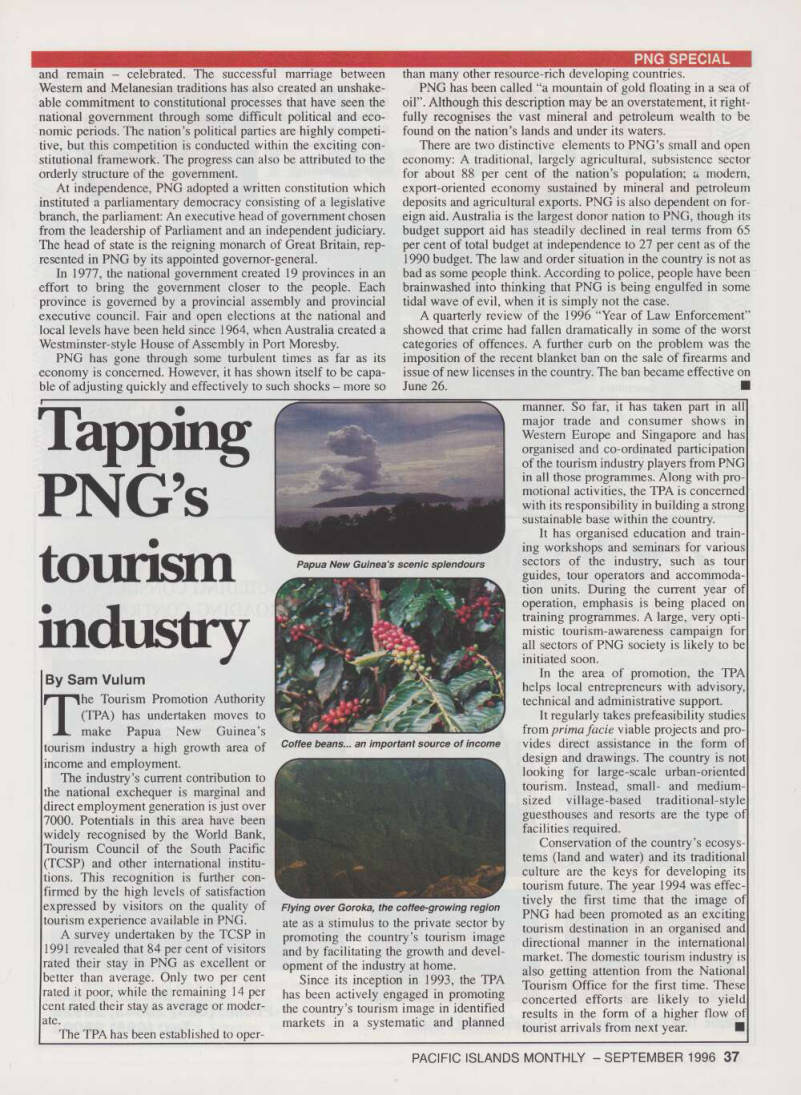
Papua New Guinea’s scenic splendours
Coffee beans... an important source of income
Flying over Goroka, the coffee-growing region