From past to future...
pp. 35-37 · Read in the full issue
By Sam Vulum
Although uneducated and illiter ate, Kondom Aguando, one of Papua New Guinea’s great leaders, clearly saw the way ahead for his country.
The late Aguando, who was ridiculed for his awkward manner while attending a South Pacific Conference in the late 1950 s told the participants: “In my country I am a big man, yet I stand before you as a child.
I’ve been a leader in battle with bow and arrow and spear but today I am a baby feeding at my mother’s breast.
Soon I will die and in a little while my son will come here in my place and speak to you in clear English and write his name. And you will not laugh at him.”
If he had lived to this day, he would be proud to know that his sons and daughters have not only fulfilled what he expected of them, but also became the masters of their own destiny made possible on independence day on September 16, 1975.
Although Aguando’s voice was never heard at independence, his senti ments were clearly spelled out by the distinguished men of the time. In the construction of modern-day Papua New Guinea, many of his hopes became realities.
This was only 30 years ago, which shows how fast the country has devel oped - due entirely to men and women with vision, just like Aguando.
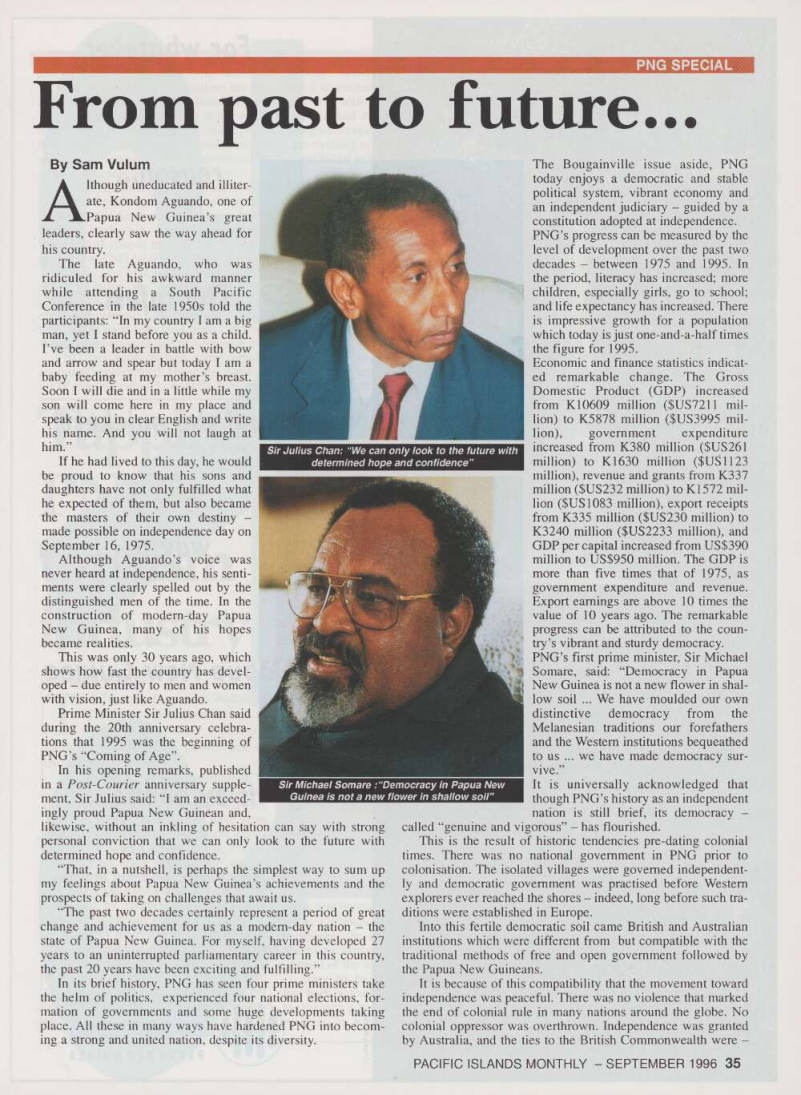
Prime Minister Sir Julius Chan said during the 20th anniversary celebra tions that 1995 was the beginning of PNG’s “Coming of Age”.
In his opening remarks, published in a Post-Courier anniversary supple ment, Sir Julius said: “I am an exceed ingly proud Papua New Guinean and,
likewise, without an inkling of hesitation can say with strong personal conviction that we can only look to the future with determined hope and confidence.
“That, in a nutshell, is perhaps the simplest way to sum up my feelings about Papua New Guinea’s achievements and the prospects of taking on challenges that await us.
“The past two decades certainly represent a period of great change and achievement for us as a modem-day nation - the state of Papua New Guinea. For myself, having developed 27 years to an uninterrupted parliamentary career in this country, the past 20 years have been exciting and fulfilling.”
In its brief history, PNG has seen four prime ministers take the helm of politics, experienced four national elections, for mation of governments and some huge developments taking place. All these in many ways have hardened PNG into becom ing a strong and united nation, despite its diversity.
The Bougainville issue aside, PNG today enjoys a democratic and stable political system, vibrant economy and an independent judiciary - guided by a
constitution adopted at independence.
PNG’s progress can be measured by the level of development over the past two decades - between 1975 and 1995. In the period, literacy has increased; more children, especially girls, go to school; and life expectancy has increased. There
is impressive growth for a population
which today is just one-and-a-half times the figure for 1995.
Economic and finance statistics indicat ed remarkable change. The Gross Domestic Product (GDP) increased from K 10609 million (SUS72II mil lion) to K 5878 million ($U53995 mil lion), government expenditure increased from K3BO million (SUS26I million) to K 1630 million (SUSII23 million), revenue and grants from K 337 million (SUS 232 million) to K 1572 mil lion (SUSIOB3 million), export receipts from K 335 million (SUS23O million) to K 3240 million ($U52233 million), and GDP per capital increased from US$39O million to US$95O million. The GDP is more than five times that of 1975, as government expenditure and revenue.
Export earnings are above 10 times the value of 10 years ago. The remarkable progress can be attributed to the coun
try’s vibrant and sturdy democracy.
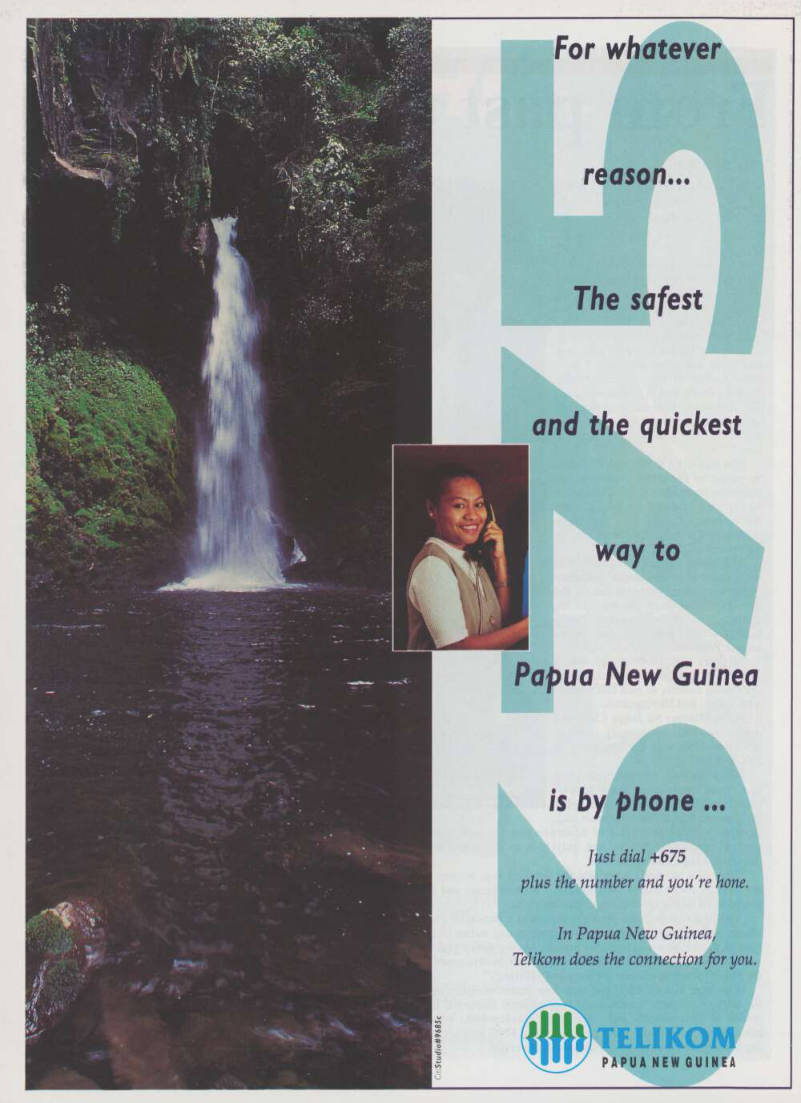
PNG’s first prime minister. Sir Michael Somare, said: “Democracy in Papua New Guinea is not a new flower in shal low soil ... We have moulded our own distinctive democracy from the Melanesian traditions our forefathers and the Western institutions bequeathed to us ... we have made democracy sur vive.”
It is universally acknowledged that
though PNG’s history as an independent
nation is still brief, its democracy -
called “genuine and vigorous” - has flourished.
This is the result of historic tendencies pre-dating colonial times. There was no national government in PNG prior to colonisation. The isolated villages were governed independent ly and democratic government was practised before Western explorers ever reached the shores - indeed, long before such tra ditions were established in Europe.
Into this fertile democratic soil came British and Australian institutions which were different from but compatible with the traditional methods of free and open government followed by the Papua New Guineans.
It is because of this compatibility that the movement toward independence was peaceful. There was no violence that marked the end of colonial rule in many nations around the globe. No colonial oppressor was overthrown. Independence was granted by Australia, and the ties to the British Commonwealth were -
Sir Julius Chan: “We can only look to the future with determined hope and confidence"
Sir Michael Somare:“Democracy in Papua New Guinea is not a new flower in shallow soil”
and remain - celebrated. The successful marriage between Western and Melanesian traditions has also created an unshake able commitment to constitutional processes that have seen the national government through some difficult political and eco nomic periods. The nation’s political parties are highly competi tive, but this competition is conducted within the exciting con stitutional framework. The progress can also be attributed to the orderly structure of the government.
At independence, PNG adopted a written constitution which instituted a parliamentary democracy consisting of a legislative branch, the parliament: An executive head of government chosen from the leadership of Parliament and an independent judiciary.
The head of state is the reigning monarch of Great Britain, rep resented in PNG by its appointed governor-general.
In 1977, the national government created 19 provinces in an effort to bring the government closer to the people. Each province is governed by a provincial assembly and provincial executive council. Fair and open elections at the national and local levels have been held since 1964, when Australia created a Westminster-style House of Assembly in Port Moresby.
PNG has gone through some turbulent times as far as its economy is concerned. However, it has shown itself to be capa ble of adjusting quickly and effectively to such shocks - more so
than many other resource-rich developing countries.
PNG has been called “a mountain of gold floating in a sea of oil”. Although this description may be an overstatement, it right fully recognises the vast mineral and petroleum wealth to be found on the nation’s lands and under its waters.
There are two distinctive elements to PNG’s small and open economy: A traditional, largely agricultural, subsistence sector for about 88 per cent of the nation’s population; a modem, export-oriented economy sustained by mineral and petroleum deposits and agricultural exports. PNG is also dependent on for eign aid. Australia is the largest donor nation to PNG, though its budget support aid has steadily declined in real terms from 65 per cent of total budget at independence to 27 per cent as of the 1990 budget. The law and order situation in the country is not as bad as some people think. According to police, people have been brainwashed into thinking that PNG is being engulfed in some tidal wave of evil, when it is simply not the case.
A quarterly review of the 1996 “Year of Law Enforcement” showed that crime had fallen dramatically in some of the worst categories of offences. A further curb on the problem was the imposition of the recent blanket ban on the sale of firearms and issue of new licenses in the country. The ban became effective on June 26. ■