a nation
p. 33 · Read in the full issue
Png Special
Birth of a nation
Archaeologists
believe that humans arrived on Papua New Guinea some 50,000 years ago, presumably by sea from South-East Asia.
A Spanish naviga tor, Don Jorge de Menesses, credited it “Papua”, a Malay word for the frizzi ness of Melanesia hair. The term “New Guinea” was applied to the island in 1545 by a Spaniard, Ynigo Ortis de Retez, because of a similari ty between the
islands’ indigenous
people and those found on the African Guinea coast.
European traders,
adventurers and gold explorers visited in the 16th and 17th centuries but land claims did not begin until 1828, when the Dutch took control of the western half of New Guinea, now Irian Jaya. Because of the rugged terrain and isolated village com munities, the impact of colonisation varied through the nation.
Prior to World War 11, Papua New Guinea was two sepa rate territories. The territory of Papua was a British colony until 1884, and was later ceded to Australia to administer. New Guinea was part of the pre-World War I German empire but it too was given to
Australia to administer at the end of WWI.
During WWII, Japanese forces occu pied PNG. Following the war and the expulsion of Japanese forces, the two ter ritories were amalgamated and became known as the Territory of Papua New Guinea. Australia focused its efforts on developing PNG’s cash economy and the democratisation of the central govern ment. The Papua and New Guinea Act of 1949 provided for a Legislative Council judicial system, a civil service and a local
government system. A generally protec tionist policy pervaded and characterised Australia’s efforts in the 19505.
In ! 964, the first House of Assembly was established to provide Papua New Guineans a greater role in the country’s political decision-making process.
With domestic and international pres sure f° r independence mounting, prepara dons for political independence began in earnest in the late 1960 s and into the 19705. In 1972, Michael Somare became
chief minister of a
democratically
elected govern ment and in 1973 the country was administratively unified and
renamed Papua
New Guinea.
Independence came to the nation on September 16, 1975.
The 1990 census has it that nearly four million people live in Papua New Guinea. The annu al population growth is about 2.3 per cent. In sharp contrast to its
Asian neighbours,
PNG’s overall pop ulation density is relatively low, about eight persons per square mile.
Indigenous Papua New Guineans vary widely in
physical character
istics, ethnic and cultural types.
Although Papua New Guineans are generally consid ered Melanesians, PNG is the most heterogeneous country in the world.
The people speak over 700 different languages, about one third of the
known languages
of the world.
English is the offi cial language of government and commerce. The majority of the people live in the rural highland val leys - many in iso
lated villages with populations numbering only in the hundreds, Until recent years, some communities located only a few miles from each other were unaware of their neighbours’ exis tence. Fifteen per cent of the population is located in 10 urban centres, including the capital. Port Moresby, which has a rapidly growing population of about 200,000.
About two-thirds of the population is Christian, with the Catholic and Lutheran Churches the largest denominations. ■
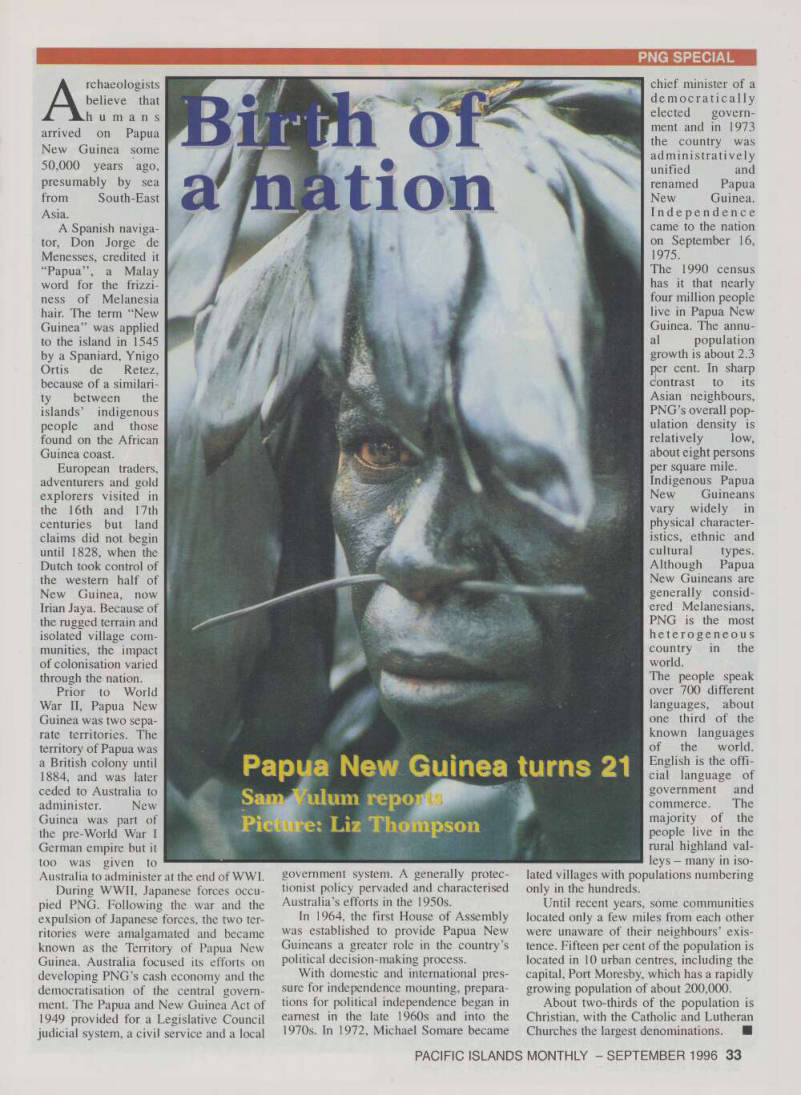
Papua New Guinea turns 21 sam Vulum repots
Pictyre: Liz Thompson