Samoa through
pp. 28-29 · Read in the full issue
History
Samoa through eyes ... the camera can lie
By lan Williams
This summer, visitors to New York’s Metropolitan Museum could see the Samoa of a century ago through the lenses of the photographers who came to record what was, for the rest of the world at least, an exotic tropical
paradise.
“Picturing Paradise: Colonial Photography of Samoa”, displayed pho tographs from mid-Victorian years to 1925. They tell almost as much about the people behind the lenses as their subjects.
In those days of long exposures, the Samoans were posed stiffly in ways that met the expectations of the photographers and their customers, who were usually not locals. In fact, not one local photographer was found to be represented - and the exhibits were culled from across the world, from collections in the all too many countries with colonial entangle ments in the Islands. The two originators were the Rautenstrauch-Joest Museum of enthnography in Cologne, which has a large ethnographic collection dating from Imperial Germany’s possessions in the Pacific, and the South East Museum of
Photography in Daytona Beach, Florida.
Based on their own collections they went looking for more - and found them in plenty. In the United States alone they discovered over 15,000 pictures of Samoa dating back to before 1925.
In fact, that is not so surprising. Before the airlines ironically isolated Samoa again, steamship routes across the Pacific regularly exposed the Islands to the atten tion of thousands of travellers who want ed souvenirs of the exotic Pacific to com memorate voyages between San Francisco and Australia. The exhibition shows how photographs were copied around the world as ready-to-buy trav ellers’ albums, post cards, tokens of impe
rial expansion.
The exhibition of 130 photographs was pulled together from archives across the imperial world. It is perhaps signifi cant that the sources did not include Samoa itself. Although tiny colonial Apia boasted three photo studios, these were not places where local families dropped in for portraits and passport photos. Their product was strictly for export, which is why the exhibits were culled from collec tions in Germany, the US and similar
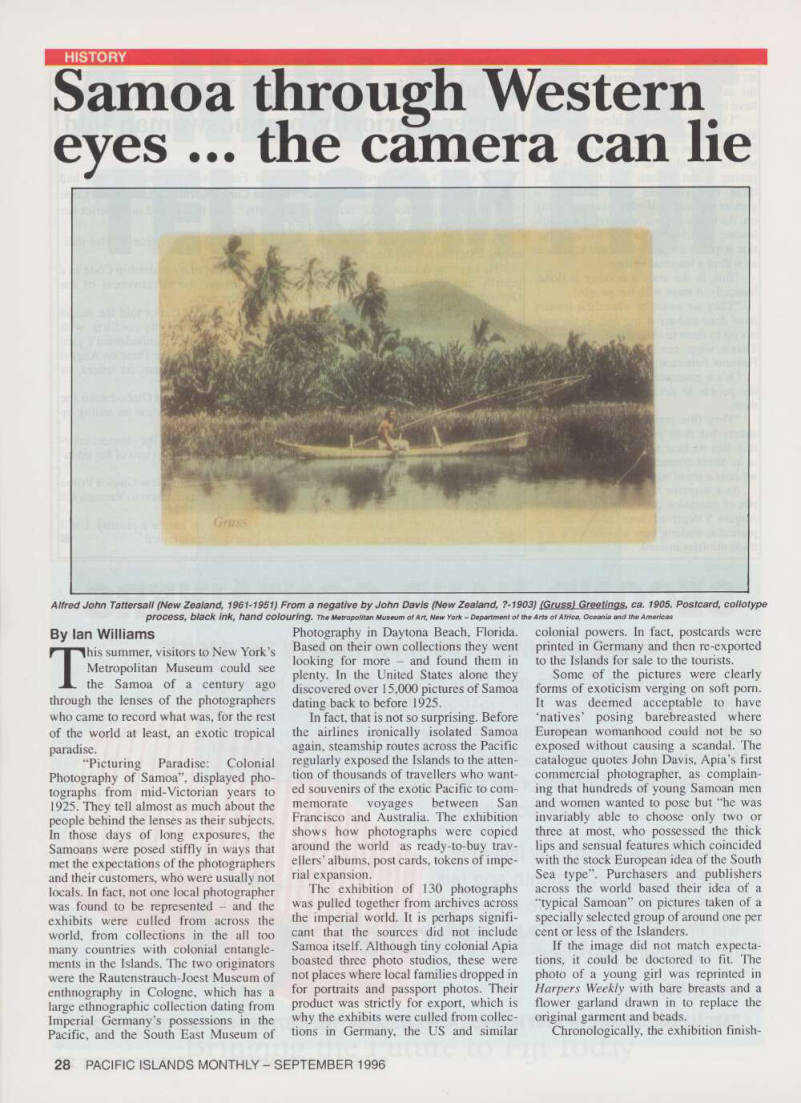
colonial powers. In fact, postcards were printed in Germany and then re-exported to the Islands for sale to the tourists.
Some of the pictures were clearly forms of exoticism verging on soft pom.
It was deemed acceptable to have ‘natives’ posing barebreasted where European womanhood could not be so exposed without causing a scandal. The catalogue quotes John Davis, Apia’s first
commercial photographer, as complain
ing that hundreds of young Samoan men and women wanted to pose but “he was invariably able to choose only two or three at most, who possessed the thick lips and sensual features which coincided with the stock European idea of the South Sea type”. Purchasers and publishers across the world based their idea of a “typical Samoan” on pictures taken of a specially selected group of around one per cent or less of the Islanders.
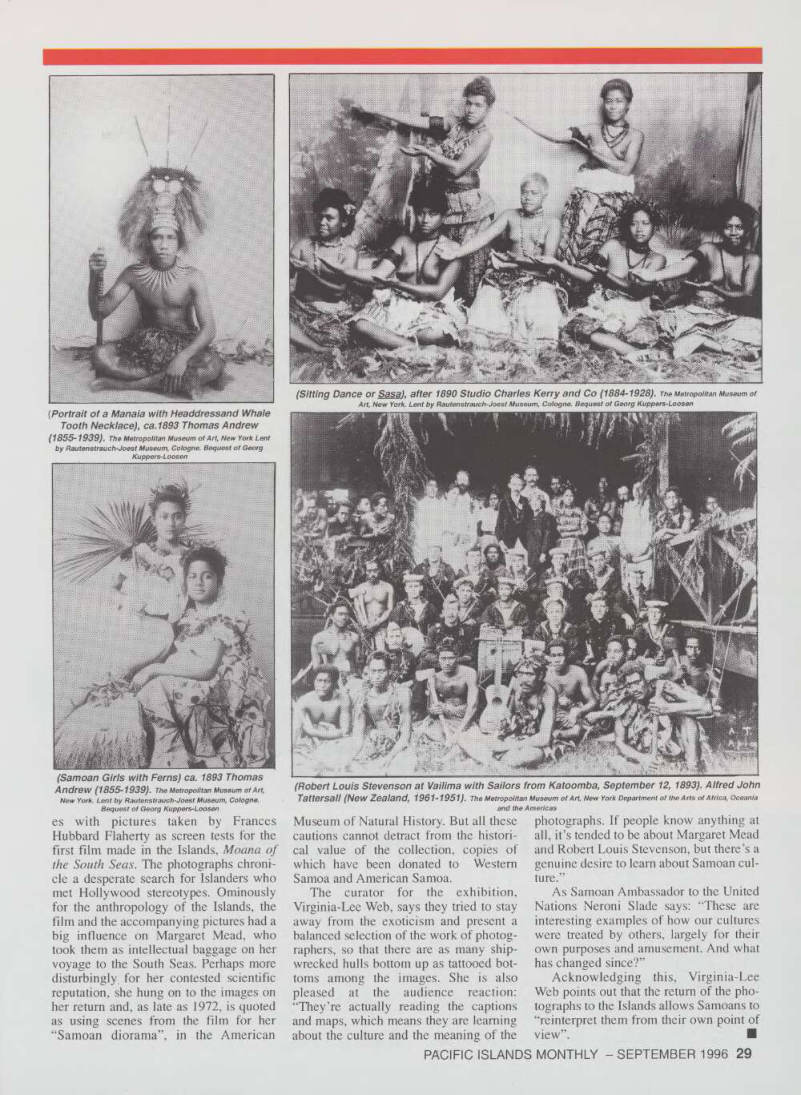
If the image did not match expecta tions, it could be doctored to fit. The photo of a young girl was reprinted in Harpers Weekly with bare breasts and a flower garland drawn in to replace the original garment and beads.
Chronologically, the exhibition finish-
Alfred John Tattersall (New Zealand, 1961-1951) From a negative by John Davis (New Zealand, 7-1903) (Grass) Greetings, ca. 1905. Postcard, collotype process, black ink, hand colouring. The Metropolitan Museum of Art, New York - Department of the Arts of Africa, Oceania and the Americas
es with pictures taken by Frances Hubbard Flaherty as screen tests for the first film made in the Islands, Moana of the South Seas. The photographs chroni cle a desperate search for Islanders who met Hollywood stereotypes. Ominously for the anthropology of the Islands, the film and the accompanying pictures had a big influence on Margaret Mead, who took them as intellectual baggage on her voyage to the South Seas. Perhaps more disturbingly for her contested scientific reputation, she hung on to the images on her return and, as late as 1972, is quoted as using scenes from the film for her “Samoan diorama”, in the American
Museum of Natural History. But all these cautions cannot detract from the histori cal value of the collection, copies of which have been donated to Western Samoa and American Samoa.
The curator for the exhibition, Virginia-Lee Web, says they tried to stay away from the exoticism and present a balanced selection of the work of photog raphers, so that there are as many ship wrecked hulls bottom up as tattooed bot toms among the images. She is also pleased at the audience reaction: “They’re actually reading the captions and maps, which means they are learning about the culture and the meaning of the
photographs. If people know anything at all, it’s tended to be about Margaret Mead and Robert Louis Stevenson, but there’s a genuine desire to learn about Samoan cul ture.”
As Samoan Ambassador to the United Nations Neroni Slade says: “These are interesting examples of how our cultures were treated by others, largely for their own purposes and amusement. And what has changed since?”
Acknowledging this, Virginia-Lee
Web points out that the return of the pho tographs to the Islands allows Samoans to “reinterpret them from their own point of view”. M
(Portrait of a Manaia with Headdressand Whale Tooth Necklace), ca. 1893 Thomas Andrew (1855-1939). The Metropolitan Museum of Art, New York Lent by Rautenstrauch-Joest Museum, Cologne. Bequest of Georg Kuppers-Loosen
(Samoan Girls with Ferns) ca. 1893 Thomas Andrew (1855-1939). The Metropolitan Museum of Art, New York. Lent by RaUtenstrauch-Joest Museum, Cologne.
Bequest of Georg Kuppers-Loosen
(Sitting Dance or Sasa). after 1890 Studio Charles Kerry and Co (1884-1928). The Metropolitan Museum of Art, New York. Lent by Rautenstrauch-Joest Museum, Cologne. Bequest of Georg Kuppers-Loosen
(Robert Louis Stevenson at Vailima with Sailors from Katoomba, September 12, 1893). Alfred John Tattersall (New Zealand, 1961-1951). The Metropolitan Museum of Art, New York Department of the Arts of Africa, Oceania and the Americas