Bareak-Out
pp. 21-22 · Read in the full issue
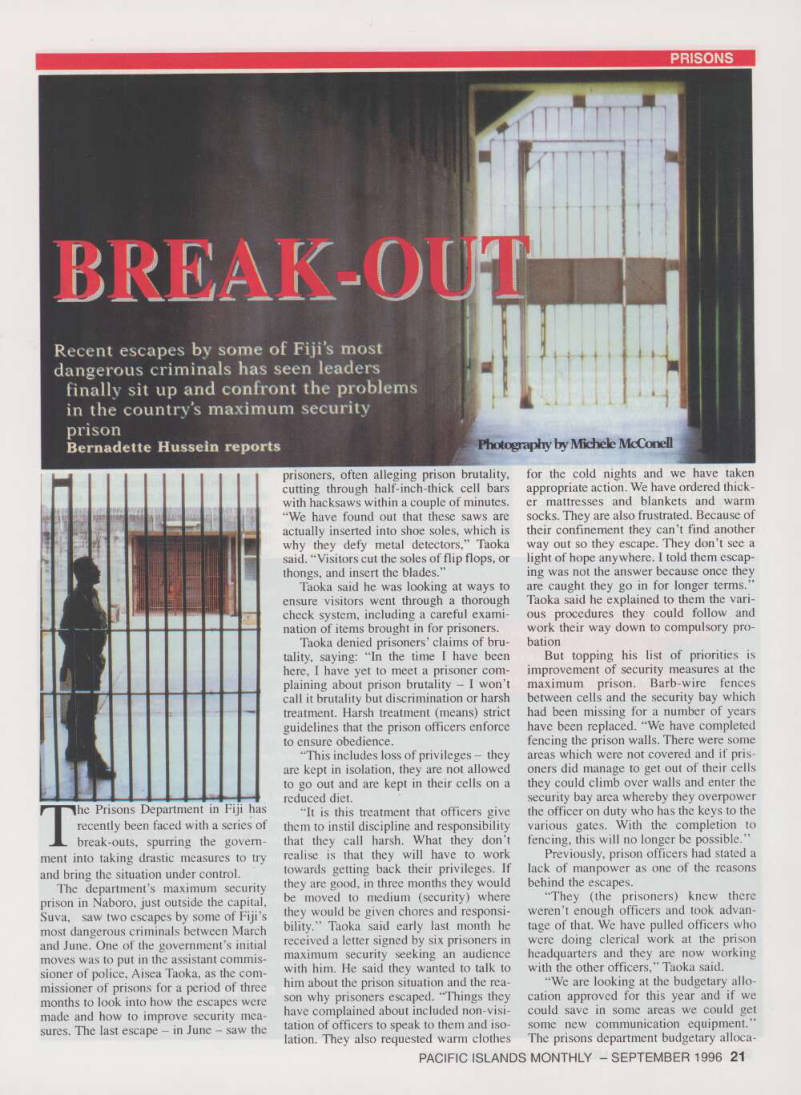
The Prisons Department in Fiji has recently been faced with a series of break-outs, spurring the govern ment into taking drastic measures to try and bring the situation under control.
The department’s maximum security prison in Naboro, just outside the capital, Suva, saw two escapes by some of Fiji’s most dangerous criminals between March and June. One of the government’s initial moves was to put in the assistant commis sioner of police, Aisea Taoka, as the com missioner of prisons for a period of three months to look into how the escapes were made and how to improve security mea sures. The last escape - in June - saw the
prisoners, often alleging prison brutality, cutting through half-inch-thick cell bars with hacksaws within a couple of minutes.
“We have found out that these saws are actually inserted into shoe soles, which is why they defy metal detectors,” Taoka said. “Visitors cut the soles of flip flops, or thongs, and insert the blades.”
Taoka said he was looking at ways to ensure visitors went through a thorough check system, including a careful exami nation of items brought in for prisoners.
Taoka denied prisoners’ claims of bru tality, saying: “In the time I have been here, I have yet to meet a prisoner com plaining about prison brutality - I won’t call it brutality but discrimination or harsh treatment. Harsh treatment (means) strict guidelines that the prison officers enforce to ensure obedience.
“This includes loss of privileges - they are kept in isolation, they are not allowed to go out and are kept in their cells on a reduced diet.
“It is this treatment that officers give them to instil discipline and responsibility that they call harsh. What they don’t realise is that they will have to work towards getting back their privileges. If they are good, in three months they would be moved to medium (security) where they would be given chores and responsi bility.” Taoka said early last month he received a letter signed by six prisoners in maximum security seeking an audience with him. He said they wanted to talk to him about the prison situation and the rea son why prisoners escaped. “Things they have complained about included non-visi tation of officers to speak to them and iso lation. They also requested warm clothes
for the cold nights and we have taken appropriate action. We have ordered thick er mattresses and blankets and warm socks. They are also frustrated. Because of their confinement they can’t find another way out so they escape. They don’t see a light of hope anywhere. I told them escap ing was not the answer because once they are caught they go in for longer terms.”
Taoka said he explained to them the vari ous procedures they could follow and work their way down to compulsory pro bation But topping his list of priorities is improvement of security measures at the maximum prison. Barb-wire fences between cells and the security bay which had been missing for a number of years have been replaced. “We have completed fencing the prison walls. There were some areas which were not covered and if pris oners did manage to get out of their cells they could climb over walls and enter the security bay area whereby they overpower the officer on duty who has the keys to the various gates. With the completion to fencing, this will no longer be possible.”
Previously, prison officers had stated a lack of manpower as one of the reasons behind the escapes.
“They (the prisoners) knew there weren’t enough officers and took advan tage of that. We have pulled officers who were doing clerical work at the prison headquarters and they are now working with the other officers,” Taoka said.
“We are looking at the budgetary allo cation approved for this year and if we could save in some areas we could get some new communication equipment.”
The prisons department budgetary alloca-
Recent escapes by some of Fiji's most dangerous criminals has seen leaders finally sit up and confront the problems in the country's maximum security prison Bernadette Hussein reports
Photography by Michele McConell
tion for this year is $F5.5 million (US3.B million). He said because of the distance between compartments, duty officers on one side could not communicate effec tively with officers in other areas.
“Prison officers are always taking pris
oners out of the complex in work parties.
They don’t have any equipment whatso ever to report back to base should they encounter problems with the prisoners.
“By the time they do get in touch with
the base station, it is too late because the prisoner has already taken off.”
But the maximum security prison was not always under-equipped. When it was built in 1972, it came complete with a centrally controlled security system.
There were buzzers in patrol areas which were a fast and effective way of inform ing the control room of problems. As a result, Taoka added, there were very few break-outs. But with a lack of proper
maintenance the system deteriorated over the years. “It’s a pity because such a sys tem can make it very easy to monitor the
happenings around the prison complex,”
he said. The department is looking at replacing this system and has been assured of the government’s commitment to installing an electronic surveillance system.
“Because they notice the laxity, pris oners have a psychological advantage over their wardens.” Taoka said shortage of manpower and lack of equipment was affecting the morale of prison officers.“ People should realise that the work of prison officers is different from other occupations because during their working hours they are confined within the four walls of the prisons.
“Of course, they get their leave and days off but when they return it is the same thing. Their work is intensive in the sense that they have to be on their toes all the time - they are responsible for some notorious criminals.” He said the sad thing about this was they were becoming
short-tempered and forgetful. “They
become so engrossed in their work they don’t see beyond that.”
But Taoka is optimistic. “I am confi dent that at the end of the three months most of the work I have been asked to do will be complete. I want to see an end to this problem.” ■
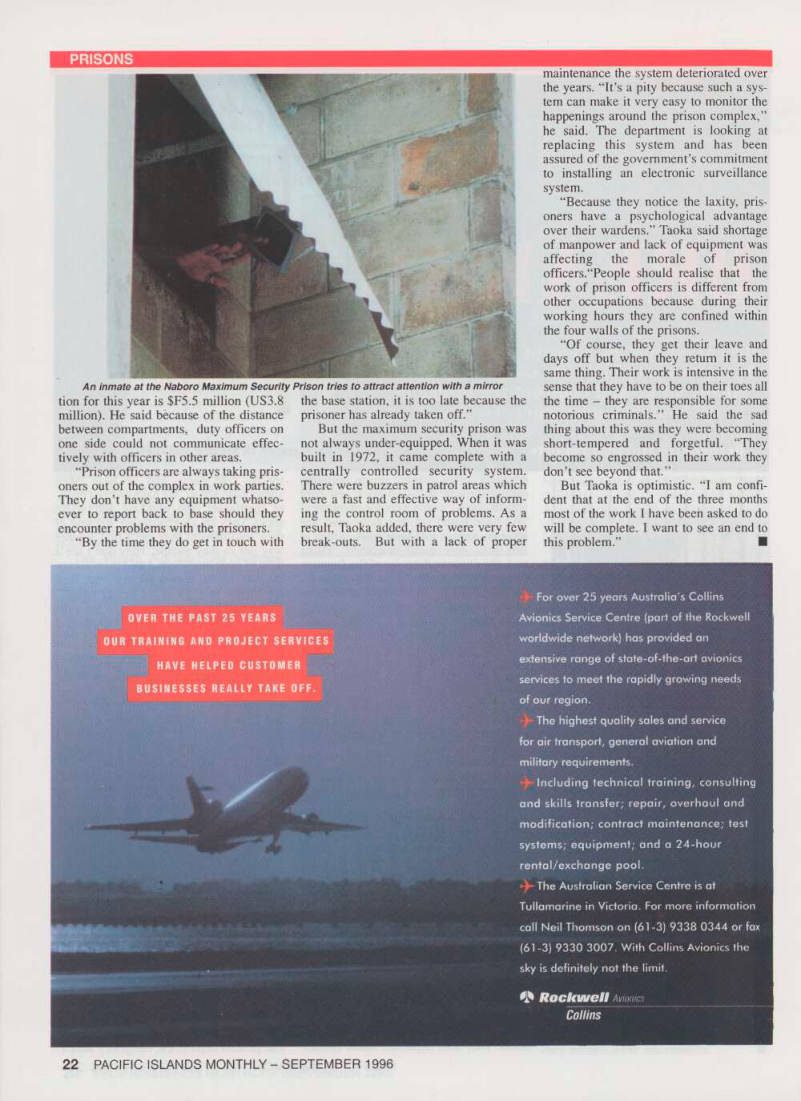
An inmate at the Naboro Maximum Security Prison tries to attract attention with a mirror