Wave of financial ‘seams’
pp. 23-25 · Read in the full issue
Cover Stories
Wave of financial ‘seams’ strikes Island countries
Will the Pacific wise up to these shady dealings or will it continue to he duped by ‘international conmen’ circling the region?
By David North
Will the Islands’ finance minis ters ever learn? The fourth in a series of high-stakes interna tional alleged financial scams has now struck the Republic of the Marshall Islands - in the wake of the previous scan dal in Vanuatu and earlier ones in the Cook Islands and Nauru.
RMI - which briefly had SUSI billion at risk - has probably escaped with little financial loss, but the series of scandals has sullied the reputations of the Islands for fiscal integrity, as well as raising ques tions about the street smarts of the finan cial managers of the four governments involved.
These scandals have had real impacts on the Islands. In Naum, the reports of millions in losses to “conmen” (as well as a failed investment in a London musical and other financial extravagances) led the voters to overthrow the president, Bernard Dowiyogo, and to install a new (and long overdue) fiscal austerity.
Naum’s belt-tightening, however, was just a notch or two compared to the dev astation to the Cook Islands caused by the near total collapse of its finances, follow ing the revelation that international “con men” had allegedly swindled the Island; nation, an event that brought a decade’s worth of government financial excesses into sharp focus.
The embattled, but strangely surviv ing, Cooks prime minister. Sir Geoffrey Henry, had to announce that he was laying off about half of the country’s huge gov ernmental workforce (an astonishing 3500 in a country with 20,000 people), and was cutting the wages of the rest. Sir Geoffrey kept his government in power because of a lopsided majority in the legislature and because of party solidarity. (His party, however, lost a by-election thunderously, an indication of what would happen if his party faced a national election anytime soon, which it will not.) “These things happen all over the world when there is the
right combination of greed,
need and stupidity”
Given the Cook and Nauru disasters, how could Vanuatu and the Marshalls pos-
sibly fall for similar ploys? The short hand answer, in US bank regulation cir cles, is not kind. “These things happen all over the world when there is the right combination of greed, need and stupidi ty,” I was told.
But there is another powerful factor which plays a major role in the Islands.
“Too many of the ministers live and thrive in an atmosphere of secrecy,” one seasoned observer said. “So when some one tells them of secret opportunities for making a bundle, like prime bank notes or letters of guarantee, they fall for it like a ton of bricks.”
The schemes are tailored to the individual situation How do these “scams” work?
The people who know best are not talking since they are either the conmen or the conned men, but we were able to pick up some of the patterns through various sources. First, the schemes are tailored to the individual situation. Conmen treat Nauru - which has money in the bank differently from the Cooks, with its sub stantial debt.
Second, the conmen look for situations in which there are a handful of decision makers and few traditions of public accounting for public funds. Conmen, for
example, have yet to swindle New Zealand’s City of Wellington, or the State of Wisconsin, to cite a couple of places where I have lived.
Third, the matter of financial despera tion is a vital factor; the Cooks are hugely in debt; Nauru is about to run out of phos phate.
Fourth, these arrangements seem to be devised by non-islanders. (Not all fiscal problems are home-grown.) But, what do the conmen do, and how do they profit from the operation?
In the Nauru case, the fraudsters received the money and ran; it was as simple as that In the case of Nauru, since it had major investments (not always sound ones), it was relatively simple. The fraudsters probably said, in effect: “Look, you are getting five to 10 per cent on the coun try’s money. If you buy Prime Bank Notes from us, we will see to it that you get 50 per cent or more a year.” Further, Nauru was assured that if it asked about the “Prime Bank Notes” everyone in banking would lie to them, because these instru ments were a part of a secret conspiracy known only to the very rich.
Nauru nibbled with a million or two, got a handsome return after six months (its own money recycled, in all likelihood) and then plunged heavily, probably to the extent of US$5O million or so. (Naum scored a legal victory over an Australian law firm with a settlement of over SUS6O million for misappropriated finances, the Nauru Bulletin reported in August. A for mer partner in the law firm’s London office, Adrian Powles, was alleged to have mishandled the funds.) In the Nauru case, the fraudsters received the money and ran; it was as sim ple as that.
Defrauding a nation without much in the way of liquid assets is more compli cated, which leads us to letters of guaran tee (LOG in the trade).
While there is no such thing in legiti mate banking as “Prime Bank Notes”, LOGs and related schemes are well accepted. The World Bank, for example, in order to encourage private-sector lend ing to risky Third World Projects, will guarantee the loans, but not make the
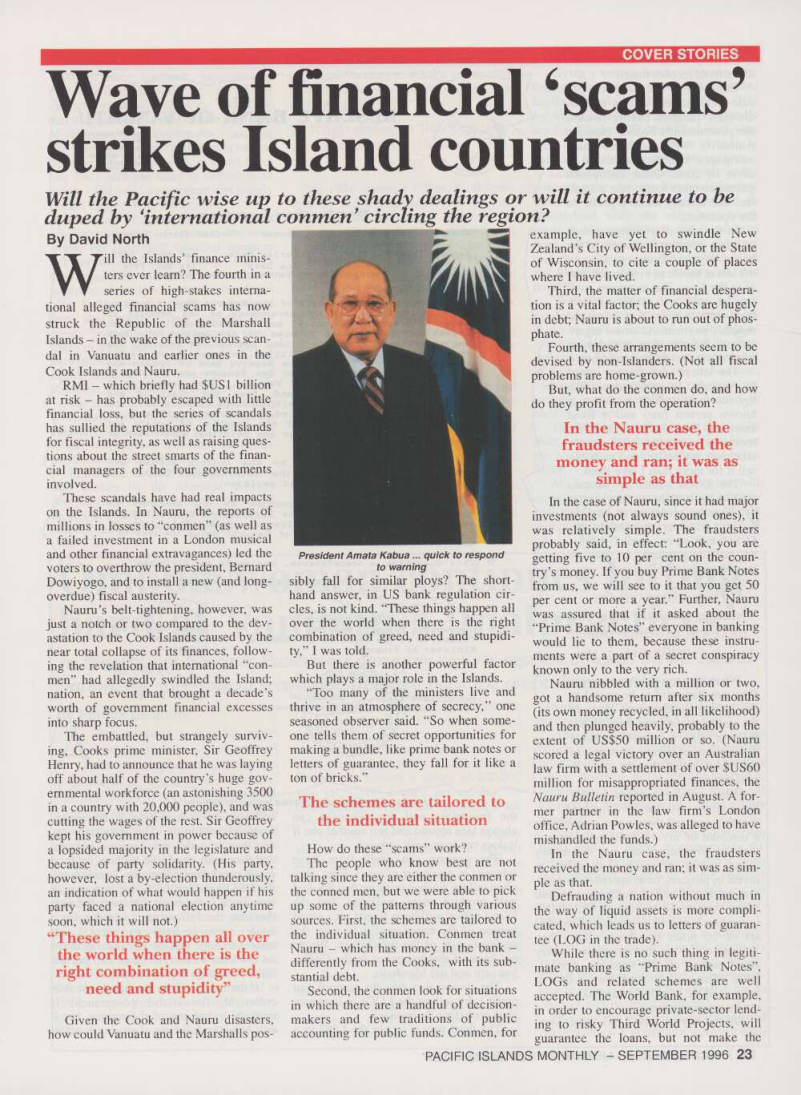
President Amata Kabua ... quick to respond to warning
loans from its own funds.
In the US, to encourage the pri vate sector to lend money to mid dle-class families buying houses, the government’s Federal Housing Authority will guarantee such mortgages, keeping a small fee to cover its costs. Other institutions guarantee other loans, take a small fee, and usually make a profit on
the operation.
In the case of a mortgage such as mine, however, the name of the house buyer is known to all, and the house stands as visible collater al to the loan. The mortgage itself can be sold and resold. (I find, from time to time, that I owe the monthly payments to a new organ isation; the rate does not change, just the names of the institutions.) The letters of guarantee issued by Vanuatu, however, aren’t like my mortgage, which relates to a known person (me) and a fixed asset (my house). If I default, the mortgage company will simply take over my house, and probably sell it for more than I owe them.
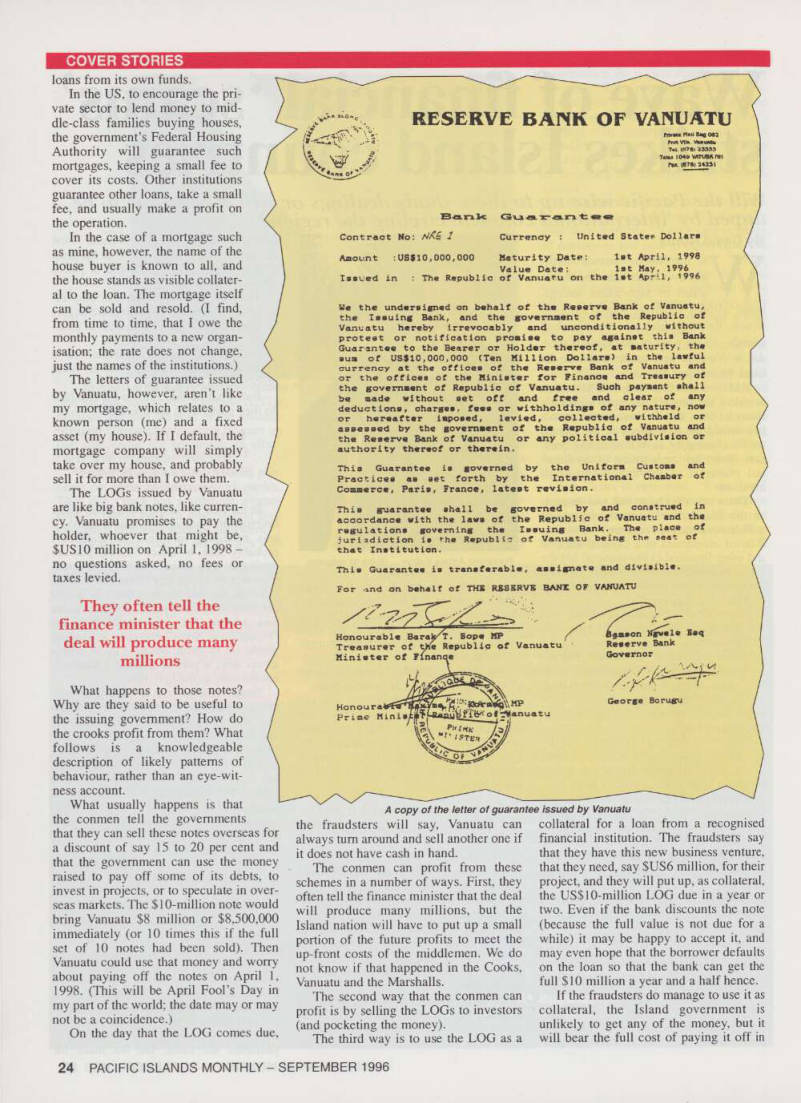
The LOGs issued by Vanuatu are like big bank notes, like curren cy. Vanuatu promises to pay the holder, whoever that might be, SUSIO million on April 1, 1998 no questions asked, no fees or taxes levied.
They often tell the finance minister that the deal will produce many millions What happens to those notes?
Why are they said to be useful to the issuing government? How do the crooks profit from them? What follows is a knowledgeable description of likely patterns of behaviour, rather than an eye-wit ness account.
What usually happens is that
the conmen tell the governments that they can sell these notes overseas for a discount of say 15 to 20 per cent and that the government can use the money raised to pay off some of its debts, to invest in projects, or to speculate in over seas markets. The $ 10-million note would bring Vanuatu $8 million or $8,500,000 immediately (or 10 times this if the full set of 10 notes had been sold). Then Vanuatu could use that money and worry about paying off the notes on April 1, 1998. (This will be April Fool’s Day in my part of the world; the date may or may not be a coincidence.) On the day that the LOG comes due,
the fraudsters will say, Vanuatu can always turn around and sell another one if it does not have cash in hand.
The conmen can profit from these schemes in a number of ways. First, they often tell the finance minister that the deal will produce many millions, but the Island nation will have to put up a small portion of the future profits to meet the up-front costs of the middlemen. We do not know if that happened in the Cooks, Vanuatu and the Marshalls.
The second way that the conmen can profit is by selling the LOGs to investors (and pocketing the money).
The third way is to use the LOG as a
collateral for a loan from a recognised financial institution. The fraudsters say that they have this new business venture, that they need, say SUS 6 million, for their project, and they will put up, as collateral, the US$lO-million LOG due in a year or two. Even if the bank discounts the note (because the full value is not due for a while) it may be happy to accept it, and may even hope that the borrower defaults on the loan so that the bank can get the full $lO million a year and a half hence.
If the fraudsters do manage to use it as collateral, the Island government is unlikely to get any of the money, but it will bear the full cost of paying it off in
A copy of the letter of guarantee issued by Vanuatu
1998. Another approach, suggested to Pacific Islands Monthly by one of the overseas banking regulators, would be that the fraudsters would tell the ministers of finance: “Sign these notes - no one will ever try to collect them. What we can do is to sell the notes to investors for a fee. They will use them as collateral on loans - and your government can simply pocket the fee. Everybody wins!”
These are the motives of the Island governments and the conmen, but why would the individual financial manager risk his career in such a setting? The US bank regulators wonder if another factor might be at work - maybe the fraudsters offer kickbacks to the officials (perhaps from the country’s own up-front pay ment). They say that this happens some times in some places but have no idea as to whether this happened in any of the Island nations. They make no accusa tions, but they do ask the question.
The reactions of the two governments - Vanuatu and the Marshalls - to the exposure of these frauds were quite dif ferent, but neither government volun teered information about it.
In the case of the Marshalls, the story was broken by the Marshall Islands Journal in its July 12 issue; the paper had received, it said, “by mysterious hand” a copy of the letter from US Treasury offi
cial John Shockey to RMl’s ambassador to the US, Banny deßrum, warning him about the fraud.
Borogu defends the Vanuatu government’s action as “not a scam”
As PIM reported (“Borugu defends ministry action” August, 1996) the first secretary of Vanuatu’s Ministry of Finance, George Borugu, defends his government’s action as “not a scam”.
Despite Borugu’s defence of the prac tice in the interview earlier in July, on July 26 the Reserve Bank of Vanuatu issued a Press release revoking the bank guarantees, saying that they were worth less (but not discussing why they had been issued in the first place or why they were being dishonoured).
In contrast, once the leadership of the Marshalls government realised what had happened, they quickly issued an order killing the LOGs without denial or blus ter. We gather, third hand, that RMI President Amata Kabua and the US Treasury’s Shockey know each other, and Kabua was quick to respond to his warn ing. This account should not be read as a story that involved only the conmen.
Island governments, and the United States.
Giving a helping hand to exposing the frauds were Barclay’s Bank in London, Scotland Yard (which seized the LOGs for Vanuatu) and the Bank of England’s ace fraud fighter, Richard Chalmers, who spent a considerable amount of time in Vanuatu, helping straighten out matters.
London played another key role as the setting for the conmen. Vanuatu’s finance minister journeyed to London and to Switzerland while the offer was being made to his government and its reserve bank. Similarly, an American observer said this in answer to the question “Did the Marshalls lose any money on this fraud?”
“Well, in addition to getting a black eye for foolishness, the Marshalls paid for a trip by half a dozen of its officials to London.” He went on to say that the orig inals of the LOGs had been recovered, but in this case, as with the one in Vanuatu, “who knows whether or not genuine looking copies were floating around in banking circles”.
The Marshalls probably got away with little damage, but the next government or the next finance minister may not be so lucky.
My bet, sadly, is that PIM readers will encounter at least one other story of inter national fraud perpetrated on the Islands within the next two years. We’ll see. ■