A Christmas to remember
p. 20 · Read in the full issue
Forty years after they were exposed to radiation from British nuclear testing on Christmas Island\ the former soldiers are demanding compensation
By Mere Momoivalu
Nuclear tests have always been an issue close to the hearts of the people of the South Pacific. Its horrific and tragic effects on the people of the Marshall Islands and the recent con troversial testing in Tahiti have left its scars on the region and have been reason enough for continuing concern.
For Fiji, which has often been in the frontline of the campaign against tests in the region, the issue was brought home recently when British military veterans claimed that Fijian soldiers who served alongside them on Christmas Island about 40 years ago may have, like them, been exposed to nuclear radiation. British vet erans who served on Christmas Island suffered from radiogenic illnesses, leuki maeas related to radiation exposure, can cers, genetic defects among their chil dren, stillbirths among wives of veterans and a whole range of health problems as a result of the exposure.
The British Nuclear Test Veterans Association (BNTVA) has, on behalf of the veterans, waged a series of legal bat tles to obtain pension, compensation and damages from the British government.
BNTVA’s efforts were unsuccessful because it did not have access to military medical records which showed that their members were treated after detonations for such things as radiation bums, diar rhoea and nausea.
The veterans also tried to sue the British government in a case they brought against their defence minister. It failed because of a lack of documentation of the levels of radiation on Christmas Island.
Having exhausted all avenues in Britain, the BNTVA has taken its case to an international arena and is pinning its hope on three cases it has pending before the European Commission of Human Rights in Strasbourg, France, and has been encouraging the Fijian veterans to
similarly seek compensation.
Fijian soldiers were among about 20,000 troops who served under the British on Christmas Island where the then colonial administration was testing its nuclear weapons. Very little was reportedly known about the nature of their engagement there - whether they were allocated to the clean-up operation and whether they had adequate protec tion. It is also unclear whether the Fijian soldiers were even aware of the dangers
they had placed themselves in.
The claim by the British veterans has been documented by them in a series of articles in the association’s journal.
Their belief is also based on reports from some of the veterans following vis its they made to Fiji. Among them was Andy Anderson who reported that nearly 80 per cent of the Fijian contigent “were now sadly dead - the main problem being cancers, heart and respiratory disease and some with stomach problems”.
BNTVA’s defence lawyer, New York based international human rights advo cate lan Anderson, pointed out that an 80 per cent death rate was very high - high er than the British rate. Anderson said it was important for the Fijian veterans to initiate a medical study on the incidence of cancers among them.
The significance of such an epidimio logical study could allow the Fijians to participate in the BNTVA European Commission cases as an intervention by a third party in an ongoing application fded in 1993 and which is now into its third year.
In the absence of data on radiation lev els, statistics showing high incidence of cancers among veterans is in itself a sig nificant factor. “Nowadays there are
many sophisticated means of ascertaining residual radiation levels in the body 20, 30 or 40 years after exposure. It would be weighty evidence. The veterans have had
independent studies proving this,”
Anderson said.
The BNTVA has constantly come up against obstacles in its bid for recognition of the plight of the veterans.
In 1988 and in 1993 the British gov ernment ordered a survey to show the lev els of leukaemia among veterans, using two groups - one of veterans who partic ipated and a “control group” which did not.
The study came up with the bizarre conclusion that radiation levels in veter ans were negligible based on the low lev els found in the control group.
The studies were carried out by the National Radiological Protection Board (NRPB) - a British government agency.
Although the British government relies on the report, it has been widely criticised in Britain and abroad.
Among its international critics was the October 1995 Advisory Committee to United States President Bill Clinton which produced a report on US human
radiation experimentation.
The committee said of the NRPB 1988 report that they did not know what to make of the findings because they were inconclusive and could show “method ological bias”. The US committee com prised 14 eminent epidemiologists, medi cal and radiation experts such as Harvard
assistant professor of radiology Maryann
Stevenson and John Hopkins University professor in the Department of International Health Philp Russel.
Will Britain continue to ignore its nuclear test veterans? BNTVA’s lawyer, Anderson, said: “It’s a legacy of Britain’s nuclear testing. For these veterans I repre sent who have these horrendous health and financial problems because they can’t work - they basically want an apology because they were used.”
And what of the Fijian veterans?
BNTVA’s vice-president, Peter Fletcher, had initially verbally asked the British War Pensions Directorate whether the Fijians were covered for by the. British pension system if they had contracted
radiogenic illnesses.
The answer was “no” but asked further to put that in writing, a 1994 letter from the directorate had a different response stating they were assessing it and that they needed more information. ■
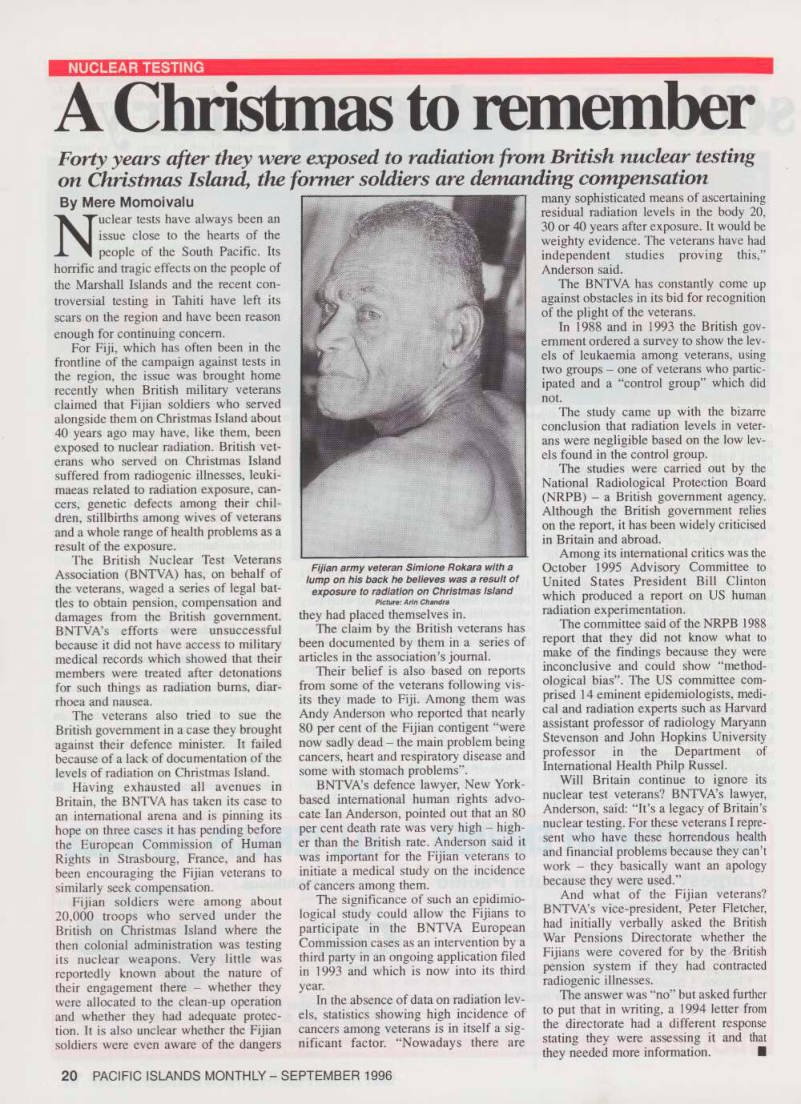
Fijian army veteran Simione Rokara with a lump on his back he believes was a result of exposure to radiation on Christmas Island Picture: Arin Chandra