Pacific
pp. 18-19 · Read in the full issue
By lan Williams
If right was might then the Pacific would almost be a superpower. On July 8, the International Court of Justice in the Hague ruled overwhelming ly that, in almost any conceivable circum stances, the use or threat to use nuclear weapons is against international law.
As Ambassador Neroni Slade of Samoa told Pacific Islands Monthly, “I think it’s one of the most important deci sions to come out of the court in its histo ry-”
The case was the culmination of a long and tortuous process by a coalition of non government organisations and govern ments to have the issue taken up by the court. In a telling example of the powers of NGOs, an umbrella project, the World Court Project, got the World Health Organisation in 1993 to ask the World Court to rule, “In view of the health and environmental effects, would the use of nuclear weapons by a state in war or other armed conflict be a breach of its obliga tion under international law, including the WHO Constitution?”
Then, in December 1994, the coalition persuaded the United Nations General Assembly to ask the court, as it is entitled to under the UN Charter, for an opinion on the question, “Is the threat or use of nucle ar weapons in any circumstances permit ted under international law?” The Pacific was well represented in the hearings, which went ahead in the teeth of opposi tion from the nuclear states. In fact, the Island states mounted a joint prosecution of the case with Samoa, the Solomons, and the Marshalls joined by a wide range of sympathetic states.
In claiming victory from the tangle of judgments, Slade glossed: “Firstly, the judges could have declined to answer the
question, but they rejected arguments
from the nuclear powers that it was politi cal. And then the court ruled that the threat to use nuclear weapons was contrary to international law, and the only exception they mentioned was in the extreme case of self-defence in which the very survival of the state was at stake.” And although the minority of the judges from the nuclear states disagreed, on the main issue, they joined everyone else in a unanimous deci sion that “there exists an obligation to pur sue in good faith and bring to a conclusion negation leading to nuclear disarmament in all its aspects under strict and effective international control”.
“That’s almost as the same as the Non- Proliferation Treaty’s article VI, and calls
for disarmament in all its aspects,” com ments Slade. “By our count, 10 out of 14 judges were in favour of a finding of gen eral illegality. We in SOPAC had taken an absolutist position, and we got three of the judges to back us.
The other seven went a long way towards us,” he assessed.
On the face of it, the decision was not so clear cut since the 15-judge panel split at least three ways. To begin with, 11 out of 13 judges said that the WHO was going beyond its powers by asking for an opin ion on legality. However, they had no such scruples about accepting a reference from the UN General Assembly, and then took the opportunity to make legal music for Pacific ears.
Although 11 judges said that International Law made no references to nukes in themselves, they went on unani mously to say that any use of them would have to be compatible with existing laws
of warfare - presumably including prohi
bitions against targeting civilians, harming neutrals and so on. The Pacific, which has suffered more than any other region from
“collateral damage” from testing, obvious ly has a strong interest in this aspect.
From this premise, three judges said that nuclear weapons were illegal under all circumstances, while seven more thought that they were “generally” illegal but that they were unsure whether this could be said in “an extreme circumstance of self defence, in which the very survival of a state would be at risk”.
Professor Roger Clark of Rutgers University, who has been in the Hague on behalf of Samoa, suggested that what they were making allowances for was extreme circumstances. “It is almost impossible to think of a real or hypothetical case where you could make this work legally.”
He guessed - wildly, as he admitted that if a crazed dictator was about to use some pernicious and awesome form of germ warfare and the only feasible means of preventing him or her would be a nucle ar strike, then this might possibly fit the bill.
Almost as interesting was the correla tion of the judges’ origins with their opin ions. The judges from Russia, Britain and
France, all nuclear powers, were joined by the Japanese judge in opposing their col leagues. Indeed, amazingly. Judge Oda from Japan, the only country to have suf fered a nuclear attack was the hardest against the court accepting the case at all,
even though the Foreign Ministry in
Tokyo immediately protested the
Hiroshima bomb in 1945 as against the Hague conventions.
However, this is a court with no cops.
What effect does the decision have?
Politically, it is a significant moral victory for anti-nuclear campaigners and a signif icant snub to the major powers who usual ly gloss their own actions against weaker countries in the language of legality but have proven much less eager to see it applied to themselves.
An optimistic Slade says: “It lays the ground for a good future effort to get on with the disarmament talks. So this does point the way to a conclusion to nuclear testings, or to nuclear disarmament.”
But there is a lot more work yet before right really becomes might. ■
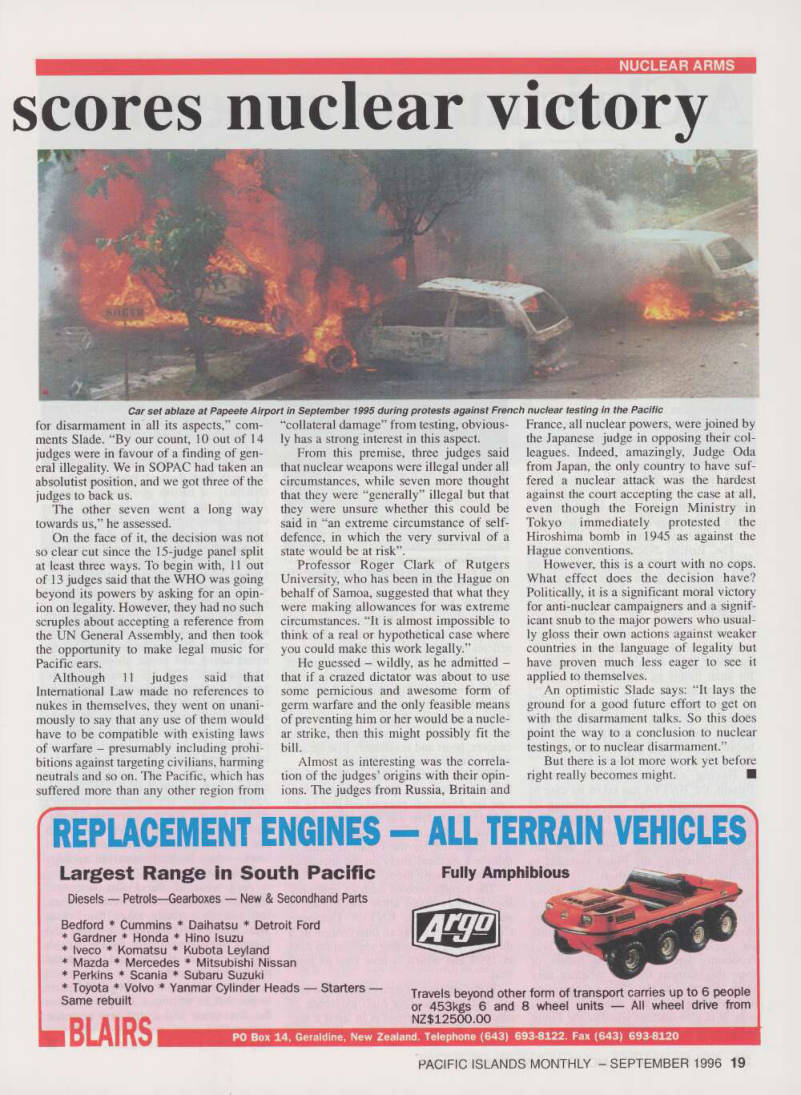
Car set ablaze at Papeete Airport in September 1995 during protests against French nuclear testing in the Pacific