An American legacy ...scores nuclear victory
pp. 17-18 · Read in the full issue
On June 18, the Marshall Islands lost a daughter to the effects of nuclear testing in the South Pacific. But Darlene Keju-Johns on’s spirit lives on and her fight for justice continues
By Bernadette Hussein
For Darlene Keju-Johnson, life was all about trying to get justice fighting for her rights and those of her people - and educating the youth.
She brought to the attention of the world the medical conditions suffered by the people of the Marshall Islands as a result of exposure to radiation from American nuclear tests carried out on the Islands from 1946 to 1958.
A legacy of those nuclear tests was Darlene’s (and other family members’) death through cancer. Darlene, a life-long campaigner for the rights and welfare of the people of the Marshall Islands died on June 18 aged 45.
Bom on Ebeye Island, she was raised on the island of Wotje, a northern atoll in the Marshall Islands downwind of Bikini and Enewetak atolls, the sites of American nuclear tests.
At 15, Darlene went to Hawaii to con tinue studies and went on to become one of the first Marshallese to obtain an advanced degree - a Masters Degree in Public Health. It was during this time that she became involved in the movement for a nuclear-free Pacific, where she met and later married journalist Giff Johnson, an
American raised in Hawaii.
She honed her speaking skills as an activist in the nuclear-free Pacific move ment in the early 1980 s, travelling sever al times to the United States and speaking about Marshallese bomb victims.
Her work eventually took her to the World Council of Churches in Vancouver, Canada, in 1983 where she addressed 10,000 religious leaders and hundreds of media representatives from all around the globe, informing them of the high rate of miscarriages, birth defects and heretofore unheard of conditions such as ‘jelly-fish babies’. She told the conference that the US restricted its care to just two atolls and ignored the pressing needs of many other Marshallese.
The speech made an impact on many including the German Evangelisches Missionswerk, the Association of Protestant Churches and Missions in Germany, who in a letter to Darlene’s
husband after her death, acknowledged that “the consciousness of people in Europe concerning the Pacific only really began to awaken after that speech” and that 1984 saw the beginning of a network in Germany that endeavoured to bring these issues to the attention of concerned Christians, the churches, the public, the Press and politicians.
It supported this move by issuing a German translation of Darlene’s speech and other material on the Pacific to churches and other interested groups free of charge. The links between Europe and the Pacific that Darlene helped to forge existed and had grown stronger, the letter stated.
The US, however, accused her of issu ing bizarre propaganda. At the time, Darlene received no support from Marshallese leaders who were in the midst of negotiating their independence from the US. Now, 12 years later, the
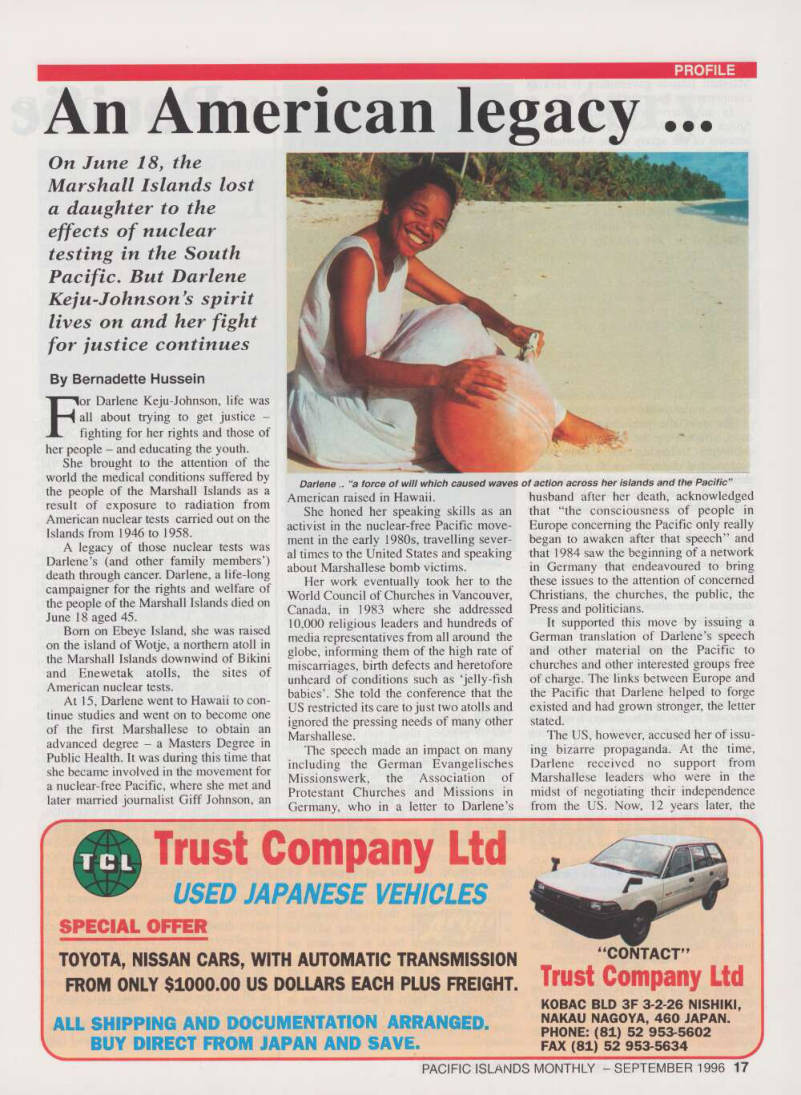
Darlene.. “a force of will which caused waves of action across her islands and the Pacific”
Marshall Islands government is seeking compensation from the US.
In an interview in Pacific Women Speak in 1987, she gave a detailed account of the agony of the Marshallese.
Before the testing started, the people of Bikini Atoll had not been told that they would never see their home again. She told the magazine the people of Bikini had been relocated three times.
Today, Bikini is off-limits for 30,000 years. And, in 1984, when the US explod ed a hydrogen bomb, codenamed BRAVO, the people were never informed - they just experienced a sudden white fallout, with the southern area 'of the
islands turning yellow, bouts of vomitting
and children suffering skin bums while out at play.
“The United States knew that the wind was blowing towards the islands where people lived, but they went ahead and tested anyway. It was not a mistake,”
Darlene maintained.
She told the publication that those most affected by the increase in health problems following the testing were women and children - with a high inci dence of cancer and birth defects. The jel lyfish babies were the most colourful and ugliest things you had ever seen - they had no eyes, heads, arms, or legs and were not shaped like human babies at all, Darlene explained. Some of these babies were able to breathe but lived only a few hours.
The deformities were so extreme that mothers were often not permitted to see the babies because of the traumatic effects this might have.
But the consequences of the nuclear tests were more than just physical. The possible effects of radiation on pregnant women frightened many into not having children. Darlene, who had two tumours removed in the 1980 s, always lived with the fear that if she had children they would be deformed. She never had chil dren.
According to Darlene, jelly-fish babies were being born not only on the radioac tive islands but throughout the 35 atolls and five islands in the Marshall.
In 1984, she became the director of family planning in a country that had one of the highest rates of population growth in the world at the time, with the birth rate dropping over the next five years.
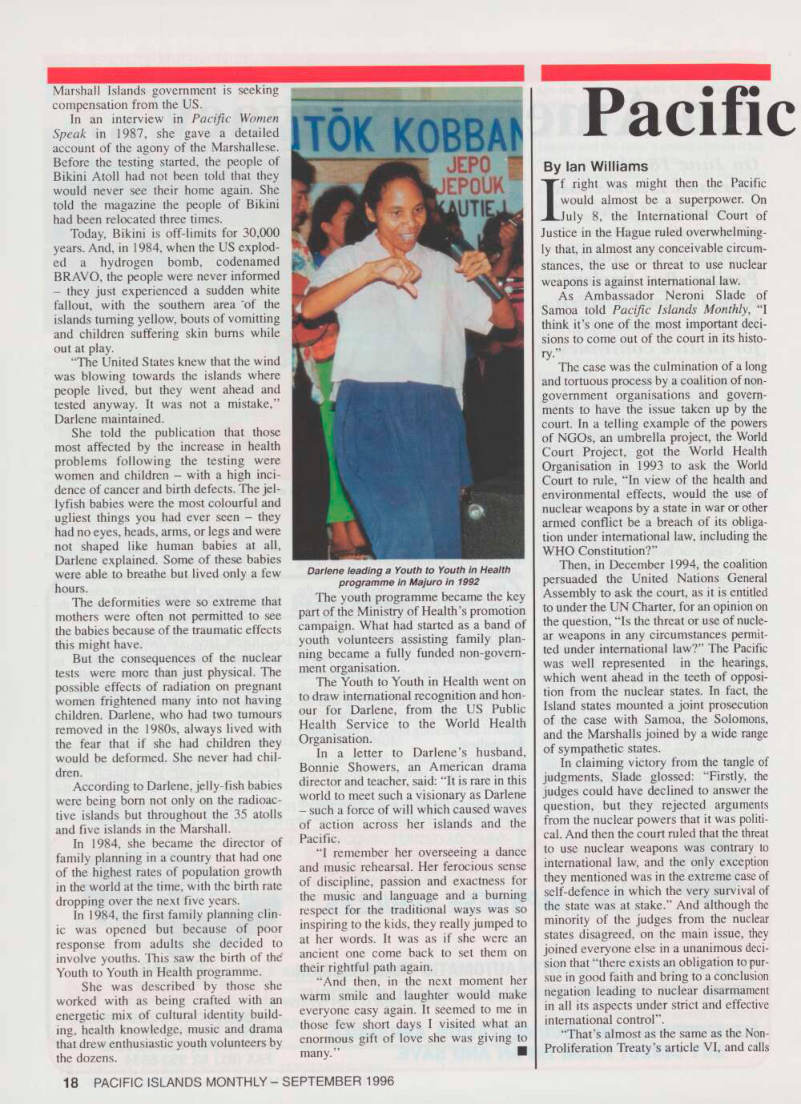
In 1984, the first family planning clin ic was opened but because of poor response from adults she decided to involve youths. This saw the birth of the Youth to Youth in Health programme.
She was described by those she worked with as being crafted with an energetic mix of cultural identity build ing, health knowledge, music and drama that drew enthusiastic youth volunteers by the dozens.
The youth programme became the key part of the Ministry of Health’s promotion campaign. What had started as a band of youth volunteers assisting family plan ning became a fully funded non-govern
ment organisation.
The Youth to Youth in Health went on to draw international recognition and hon our for Darlene, from the US Public Health Service to the World Health
Organisation.
In a letter to Darlene’s husband, Bonnie Showers, an American drama director and teacher, said: “It is rare in this world to meet such a visionary as Darlene - such a force of will which caused waves of action across her islands and the Pacific.
“I remember her overseeing a dance and music rehearsal. Her ferocious sense of discipline, passion and exactness for the music and language and a burning respect for the traditional ways was so inspiring to the kids, they really jumped to at her words. It was as if she were an ancient one come back to set them on
their rightful path again.
“And then, in the next moment her warm smile and laughter would make everyone easy again. It seemed to me in those few short days I visited what an enormous gift of love she was giving to many.” ■
Darlene leading a Youth to Youth in Health programme in Majuro in 1992