Pacific rugby?
pp. 50-51 · Read in the full issue
Sports
Where to now for South Pacific rugby?
With the sudden postponement of the Pan Pacific series and its dubious future, officials must put their heads together and make die best of the limited
options available
By Atama Raganivatu
With the advantage of hindsight, the Pan Pacific Rugby Series postponement was no surprise.
The proposed series, which was to involve the national selections of Fiji, Tonga, Western Samoa, the United States, Canada, Argentina, Hong Kong and Japan, always appeared suspiciously unviable when viewed soberly. What would be little more than international rugby’s third divi sion featured three true “rugby nations” with, in world terms, minute economies plus five countries where the game has tra
ditionally experienced immense problems
in attracting interest from either the public or corporate sponsors. Moreover, it required massive funding to send the par ticipants to farflung comers of the globe for the 31 matches scheduled over three months.
To become a reality, the competition needed the enthusiastic support of major sponsors and international broadcasting concerns. With the marketing personnel of many huge sporting extravaganzas always paying court to both elements, the Pan Pacific Series looked like a plain girl try ing to attract judges’ votes at a Miss
Universe pageant.
And yet the series organisers, Carnegie Sports International, were sO positive in their statements right up to announcing the postponement, that one had to assume it would come to fruition.
In November last year, Carnegie direc
tor Lindsay Singleton assured me that he was “95 per cent certain that the Series will proceed” and on January 25 he “con firmed” the competition’s commencement in a Press release peppered with “wills” and “haves” and containing not a single “perhaps”, “might” or “but”.
Carnegie’s inability to unveil either a
significant sponsorship or meaningful
telecasting deal during the media launch in Hong Kong should have set alarm bells ringing. It didn’t due to those attending being informed the Series was “now up and running”, “a dream realised” and “a great new development for the game of rugby”. Was it, we must now ask, a mere coincidence that those utterances were made on April Fool’s Day?
Less than a month later and one week prior to the planned first games, Carnegie pronounced that they were withdrawing their pledge to underwrite the series which had, consequently, been curtailed until 1997. It is highly unlikely that Carnegie’s actions have any sinister overtones.
Unfortunately, their history does include some failures - notably in soccer, basket ball and netball. There is a definite possi bility the Pan Pacific Series will be added to these in 12 months, when lucrative sponsorship and television contracts will, almost certainly, be just as difficult to secure as they are now. In Tonga, Fiji and Western Samoa, the Pan Pacific was viewed as a lifeline after South Africa, New Zealand and Australia made it clear that there was little scope for the South Pacific trio in their vision of professional rugby. None of the Southern Hemisphere’s rugby triumvirate have plans to include any Pacific Island team in their tremen
dously successful Super 12 championship
and endeavours to add the New Zealand .Maori XV to the annual South Pacific tri series were given the cold shoulder by the New Zealand Rugby Football Union, although Maori rugby administrators are known to be keen on the idea.
As Kiwi, Aussie and Springbok rugby officials strive to generate the money nec essary to finance their elite players’
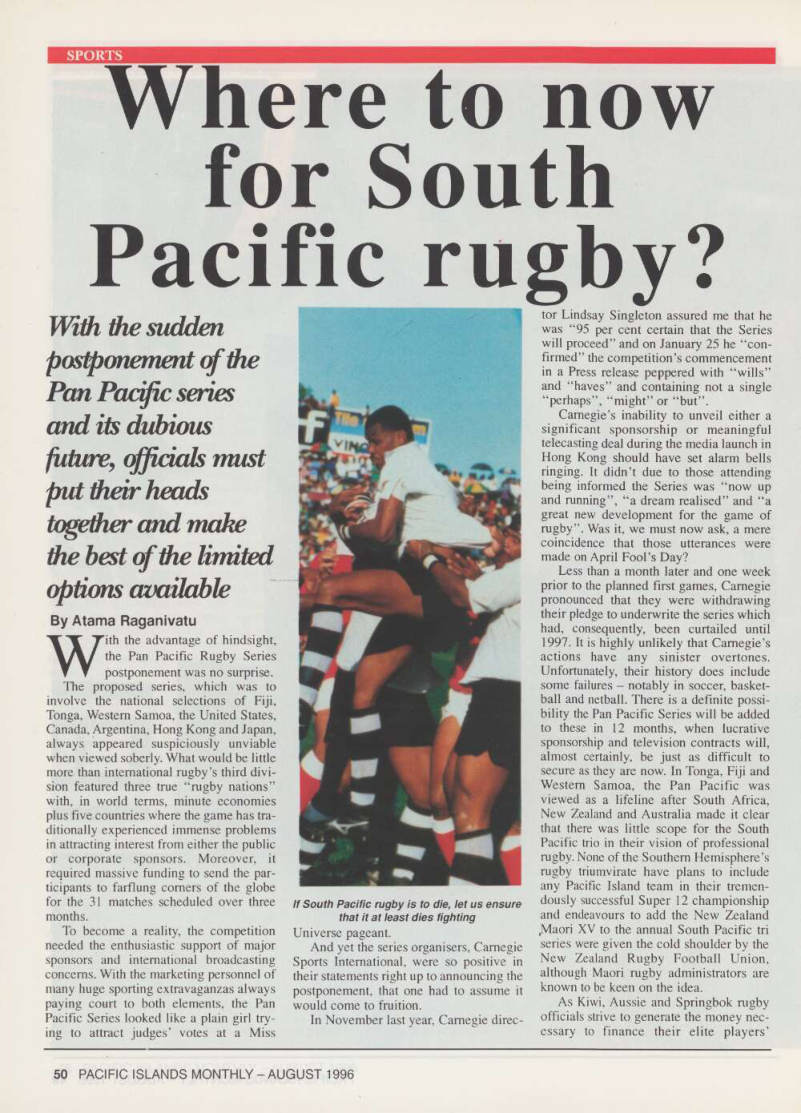
If South Pacific rugby is to die, let us ensure that it at least dies fighting
SUS 150,000-plus salaries, contacts with poor relations will inevitably become even less than they are today. In the meantime, we can expect the plunder of our stars by overseas teams to continue unabated while Fiji, Western Samoa and Tonga slip down the international rankings.
So, what can our rugby officials possi bly do to turn the tide should the Pan Pacific not proceed next year? Sadly, they have few options open to them but must be brave, visionary and adventurous if the region’s rugby is to face the future with any confidence. My own preference is for
/Fijian, Tongan and Western Samoan rugby union executives to get their heads togeth er and create a commercial company whose aim it would be to assemble and administer a composite team to be fielded at Test level. Moreover, instead of com plaining at the injustices inflicted upon them by the new professional era they should exploit it fully and gain the inside running on our international rivals.
Upon its formation, the company should issue five million shares. Each national union would retain a million of these with the remainder being offered to
financial institutions and lovers of South Pacific rugby around the world (of which there are very many) at SUS 2 per share.
Once a reservoir of shareholders’ funds has been created, the first task of the com pany would be to secure the services of players eligible to represent Tonga, Fiji or Western Samoa but who, for financial rea sons, are committed to other countries. No fewer than eight members of the Auckland Blues squad that recently won the Super 12 fall into this category.
Add to them the handful of other prominent Australian- and New Zealand based players with similar circumstances and the seven or eight top-class performers already appearing for our sides and a formidable team would have taken shape.
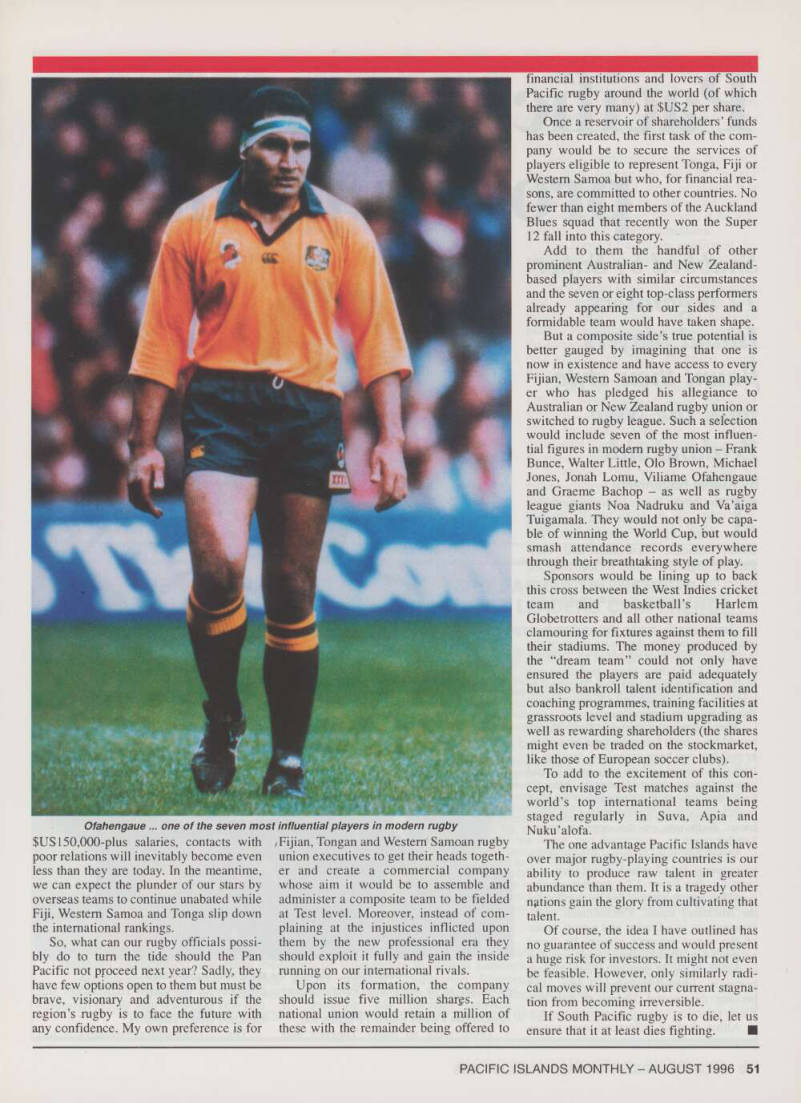
But a composite side’s true potential is better gauged by imagining that one is now in existence and have access to every Fijian, Western Samoan and Tongan play er who has pledged his allegiance to Australian or New Zealand rugby union or switched to rugby league. Such a selection would include seven of the most influen tial figures in modem rugby union - Frank Bunce, Walter Little, 010 Brown, Michael Jones, Jonah Lomu, Viliame Ofahengaue and Graeme Bachop - as well as rugby
league giants Noa Nadruku and Va’aiga
Tuigamala. They would not only be capa ble of winning the World Cup, but would smash attendance records everywhere through their breathtaking style of play.
Sponsors would be lining up to back this cross between the West Indies cricket team and basketball’s Harlem Globetrotters and all other national teams clamouring for fixtures against them to fill their stadiums. The money produced by the “dream team” could not only have ensured the players are paid adequately but also bankroll talent identification and coaching programmes, training facilities at grassroots level and stadium upgrading as well as rewarding shareholders (the shares might even be traded on the stockmarket, like those of European soccer clubs).
To add to the excitement of this con cept, envisage Test matches against the world’s top international teams being staged regularly in Suva, Apia and Nuku’alofa.
The one advantage Pacific Islands have over major rugby-playing countries is our ability to produce raw talent in greater abundance than them. It is a tragedy other nations gain the glory from cultivating that talent.
Of course, the idea I have outlined has no guarantee of success and would present a huge risk for investors. It might not even be feasible. However, only similarly radi cal moves will prevent our current stagna tion from becoming irreversible.
If South Pacific rugby is to die, let us ensure that it at least dies fighting. ■
Ofahengaue...one of the seven most influential players in modern rugby