Pacific gatecrashers
pp. 52-53 · Read in the full issue
prove a point
Snubbed by Super 12 organisers, Island players flaunt their style with the New Zealand side
By Atama Raganivatu
The Rugby Super 12 was intended to be a tournament that discarded South Pacific participation. The South African, Australian and New Zealand organisers made it clear from the outset that no place existed for Fiji, Tonga and Western Samoa in their professional extravaganza.
Our region’s rugby fans, therefore, must appreciate the delicious irony of the Auckland Blues beating Natal 45-21 in the Super 12 final with a lineup including one Fijian, five Samoans and three Tongans. In addition, one Samoan and a Fijian were on the Blues’ replacement bench.
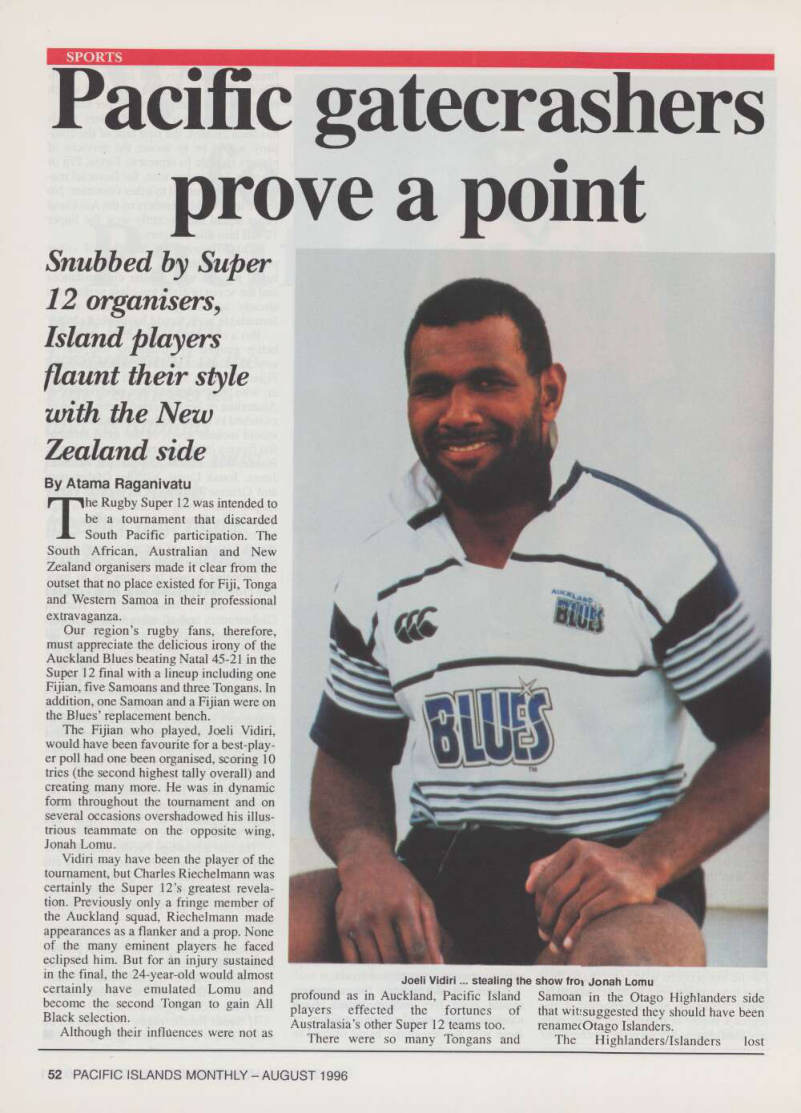
The Fijian who played, Joeli Vidiri, would have been favourite for a best-play er poll had one been organised, scoring 10 tries (the second highest tally overall) and creating many more. He was in dynamic form throughout the tournament and on several occasions overshadowed his illus trious teammate on the opposite wing, Jonah Lomu.
Vidiri may have been the player of the tournament, but Charles Riechelmann was certainly the Super 12’s greatest revela tion. Previously only a fringe member of the Auckland squad, Riechelmann made appearances as a flanker and a prop. None of the many eminent players he faced eclipsed him. But for an injury sustained in the final, the 24-year-old would almost certainly have emulated Lomu and become the second Tongan to gain All Black selection.
Although their influences were not as
profound as in Auckland, Pacific Island players effected the fortunes of Australasia’s other Super 12 teams too.
There were so many Tongans and
Samoan in the Otago Highlanders side that widsuggested they should have been renamecOtago Islanders.
The Highlanders/Islanders lost
Joeli Vidiri...stealing the show fro[?] Jonah Lomu
momentum after a wonderful start and failed to qualify for the semi-finals. Even so, they provided the Super 12 with many thrilling moments and, in Brian Lima and Kupu Vanisi, two of its most exciting per sonalities.
Lima, despite being only 24, had already played over 50 games for Western Samoa and appeared in two World Cups at the beginning of the season.
However, questions remained unan swered about his ability to compete amongst rugby’s elite. He dispelled those doubts in the Super 12 and must today be acknowledged as a winger of the highest calibre.
In contrast to Lima, Kupus Vanisi had played but a handful of first-class matches before 1996. The dreadlocked Tongan is a familiar and respected figure throughout Southern Hemisphere rugby now though and, if able to add a little more determina tion to his game, should reach the very top.
Like Otago, Wellington Hurricanes
experienced a patchy Super 12 campaign.
Samoans Alex Telea and Alama leremia were amongst their better performers.
Waikato Chiefs proved equally erratic.
An injury to Fijian maestro Walter Little did not help their cause, even if his mid field partner, 34-year-old Niuean Frank Bunce, continues to defy time.
Fiji’s national team captain Joeli
Veitayaki enhanced a steadily growing
reputation while on chief’s duty and, typi cal of a prop, seems to be approaching his peak at 29.
Canterbury Crusaders struggled off the field because of an administration woeful
ly ill-prepared for professionalism and on
the field due to a lack of playing depth.
Had Fijians Phillipe Rayasi and Tabai
Matson and Manu Samoa captain Pat Lam been free from the injuries which rendered their inputs negligible, the Crusaders would have fared better. Nevertheless, Tongan fullback Pita Alatini gave them much-needed bite after being drafted.
Across the Tasman Sea, Queensland Reds introduced several Pacific Island players but none could establish himself in the team.
Magnificent Fijian Manasa Bari
arrived in Brisbane too late to make his presence felt, but is expected to be a key man for the Bananabenders next year.
Fitful form cost New South Wales a place in the semi-finals as Fijian Sam Domoni and the Tongan pair of Daniel Manu and Viliame Ofahengaue all flitted in and out of the side.
Manu did sufficient to retain his Australian Test jersey but many fear that
Ofahengaue’s distinguished international
career is now over.
Australian Capital Territory were the
Super 12’s surprise packets.
The universal choice for wooden spoonists before the competition com menced, they very nearly snatched a semi final spot.
Nobody contributed more to their suc
cess than Tongan World Cup player
Ipolito Fenukitau. I have no doubt that Fenukitau will now be proclaimed one of the world’s best loose forwards if he rep
resented higher profile selections.
The Super 12 certainly confirmed the abundance of talent produced by the South Pacific.
But it seems likely that the tournament will continue to provide us with only reflected glory. There are no plans to include Western Samoa, Fiji and Tonga in the foreseeable future ((despite the organis ers-’ excuses for their exclusion being banal).
To add salt to the wound. Super 12 officials were reported to be regarding Victoria - an Australian state where rugby union has meagre support - as a likelier participant than any teams from our region should the competition expand.
It appears that we are expected to remain content with crumbs from the rich men’s table and be placated by the exploits of our boys in the colours of Australian and New Zealand teams. ■