Stephen-worth Nauru’s weight in gold
pp. 46-49 · Read in the full issue
By Atama Raganivatu
A n Olympic medal long seemed an impossible dream for Pacific X athletes. Lack of worth while competition through isolation and inadequate training facilities were handi caps our competitors found impossible to overcome in the past. However, thanks to . ... .. .. the enhanced financial aid now available to all elite representatives, they are making a bigger impact than even before.
The individual to have made the great est impression in an Olympic sport is Nauruan weightlifter Marcus Stephen and he presents the South Pacific with its best hope for glory at Atlanta ‘96.
Stephen’s story is the stuff of Hollywood features. When he left his remote island to attend St Bede’s College in Melbourne as a 15-year-old, he had lit tie knowledge of organised sport.
His only exposure to it previously had been through the video tapes of Australian rules football matches which were flown to Nauru each week and played over and over again by that game’s many followers there. Active sport in Nauru has tradition ally been the preserve of guest workers
engaged in phosphate mining. The locals’ interests were once confined to spectating or pretending to be motor-racing aces while speeding around the road encircling the island. Stephen changed that.
Aussie rules was the sport Stephen firsts tried in Melbourne upon becoming ex P ose d to the Australians love of partici- P s P°rts.
He proved himself inept at it. Nor did the Nauruan teenager achieve much during a brief flirtation with boxing. Then, aged 16, Stephen turned to weightlifting, That was the first major milestone of his sporting life. The second occurred when meeting Paul Coffa.
Coffa had been the Australian weightlifting coach since 1978 and was in the process of elevating Australia from non-entity in the sport to a major power, He succeeded. Dean Lucan’s super-heavyweight gold medal at the 1984 Olympics is probably the most quoted testimony to his ability, but the Island continent’s haul of 17 Commonwealth Games medals 10 years later better reflects Coffa’s achievement.
Coffa adopted Stephen as an honorary member of the Australian squad in 1985, thanks to federal government sponsorship,
and he has been his guiding light ever since.
The 1987 Commonwealth and Oceania championships in Canberra provided Stephen with the first taste of intemation al competition. The Oceania Championships at Tahiti the following year produced his initial international suc ('ess - 1988 , als ° saw bim become Australian national champion.
Fortunately, Stephen stayed in Melbourne after leaving St Bede’s - osten sibly to attend the city’s Royal Institute of Technology - and remained under Coffa’s wing.
Nauru’s sole entrant at the 1990 Commonwealth Games, Stephen won one gold and two silver medals in his section the 60-kilogramme class (older fans still refer to it as the featherweight division), The sight of Coffa dancing in delight as his charge clinched provided the Auckland festival with one of its most memorable moments, Amazingly, Stephen was very nearly deprived of the chance to compete, Nauru being admitted into the Commonwealth Games Federation just two days before competition got under way. The 1991 South Pacific Games in Port Moresby.
Papua New Guinea, yielded three more gold medals and, internationally, Stephen was featuring in the top 10 rankings.
During that same year, he finished ninth and eighth respectively in the World Championships and World Cup.
These placings would normally have guaranteed Stephen an opportunity to compete at the 1992 Olympics. However, as Nauru had not yet acquired International Olympic Committee mem bership, his involvement briefly became a matter of contention and when he did take the stage in Barcelona it was as a Western Samoan representative. Stephen finished ninth. He had no peers at the 1994 Commonwealth Games and claimed all the gold medals at stake in the 60kg class - for clean and jerk, snatch and combined.
Upon the cleansweep being completed, it
was revealed that he participated despite having badly injured both his hands dur ing a training accident just two days earli er. “This is absolutely incredible,” Coffa exclaimed at the time. “It’s a miracle that Marcus can even grasp the bar, let alone lift the weights!” Coffa ended his associ ation with Australian weightlifting at the end of the Victoria Games.
Frustrated by the federal government’s reluctance to provide the funding which, he believed, would enable him to make 'Australia the dominant force in the sport, Coffa quit to become Nauru’s director of sport. The new position gave him access to almost unlimited financial backing and more time to concentrate on Stephen’s training. Coffa also assumed responsibili ty for developing a variety of other sports
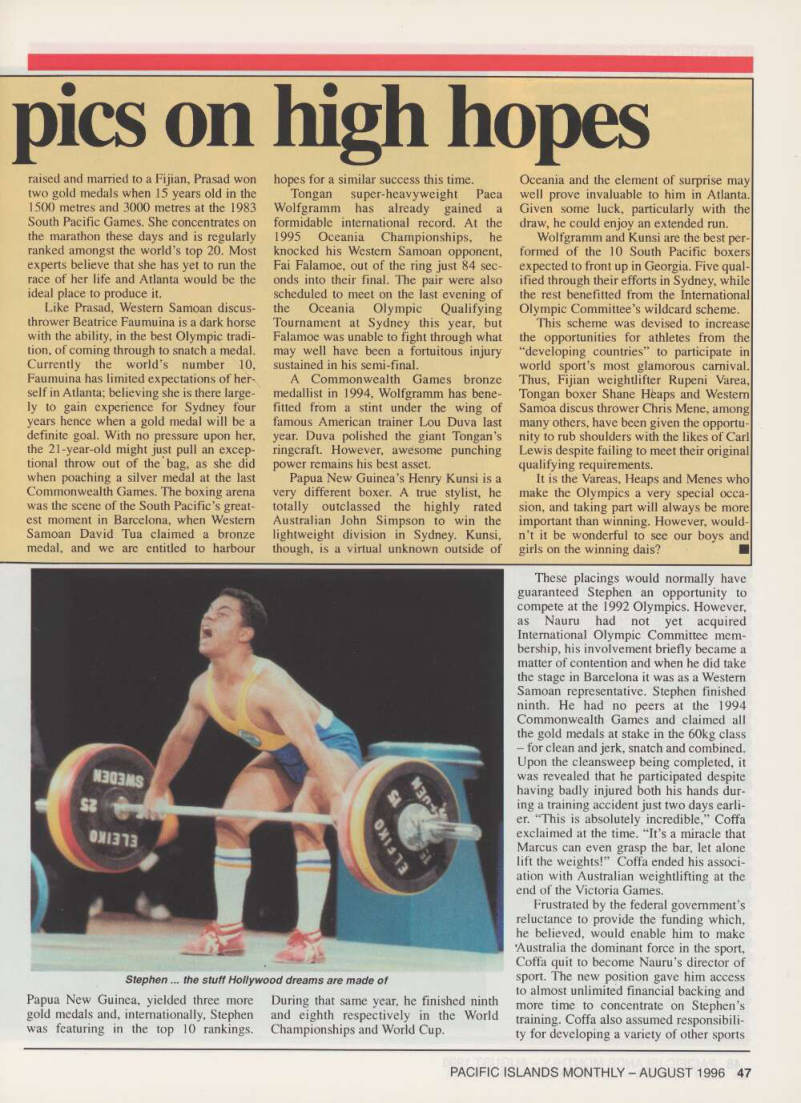
Stephen ... the stuff Hollywood dreams are made of
in the tiny republic - notably boxing, wrestling, Australian rules football and cycling. However, weightlifting is his main priority as, due to Stephen’s feats, it has become the national passion.
Both Coffa and Stephen, whose official
job description is “financial manager”,
now reside on the Island. It is Coffa who ensures that Stephen maintains a rigid training routine, which requires 36 hours working with weights each week, and oversees a strict diet consisting of coconut cream, steak, rice, vitamin supplements and raw fish in exactly the right quantities.
“It is essential that Marcus eats, drinks and breathes weightlifting,” Coffa insists.
“All his rivals for medals in Atlanta are just as dedicated. Only by being utterly single minded will he succeed there.”
Having Coffa’s expertise on tap has
already proved immensely beneficial to
Stephen. Last year, he began to challenge
Eastern Europe’s long-standing domi
nance of his division. During preparations for the World Championships in China, he equalled the world record for the clean and jerk by lifting 170 kgs - approximately three times his body weight. In Auckland five years earlier, he had managed just 142.5 kgs. The difference gives a fair indi cation of his progress in the interim.
Failure to reproduce the record equalling lift in China probably robbed him of a medal. However, fifth placing proved he is improving quickly and must be regarded as a genuine contender for the dais at Atlanta. Stephen’s exploits have made him a national hero and the role model for nearly every young Nauruan male. Virtually all the Island’s youth wish to emulate “The Pocket Battleship”, as he is known throughout the weightlifting world.
Coffa today has over 60 weightlifters in his stable, each eager to become the next Marcus Stephen. One, Rudin Thoma, is, the Australian declares confidently, “going to be the greatest athlete the Pacific has ever seen”. It is hard to dispute that claim as Thoma exceeded the South Pacific Games record last year - when only 16 years old. However, the spotlight will be on Stephen until the Atlanta Games are completed and, much to his delight, it was Nauru’s flag which he marched under at the opening ceremony, for the republic became the 192nd member of the International Olympic Committee last year. Stephen already has more than 40 titles to his name, won at Victorian, Australian, Micronesian Games, Mini South Pacific Games, Oceania, Commonwealth Games and Samoa Games
championships.
Hopefully, the biggest prize of them all will be added in Atlanta. ■
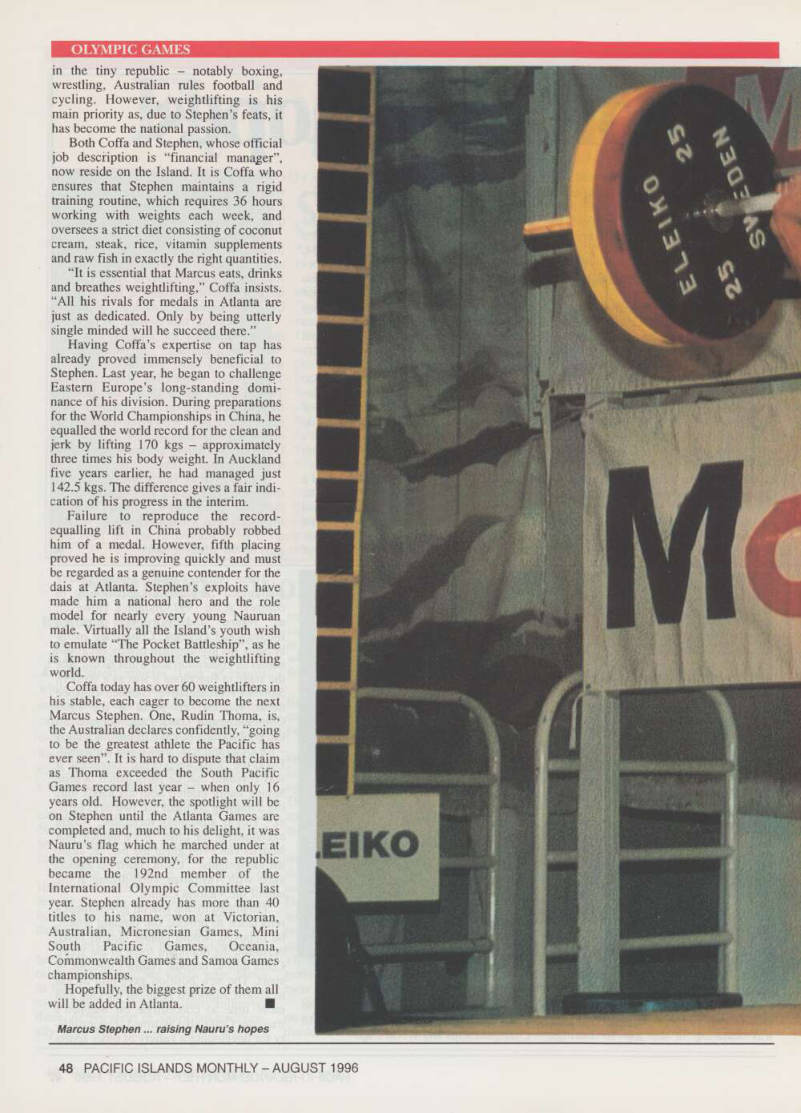
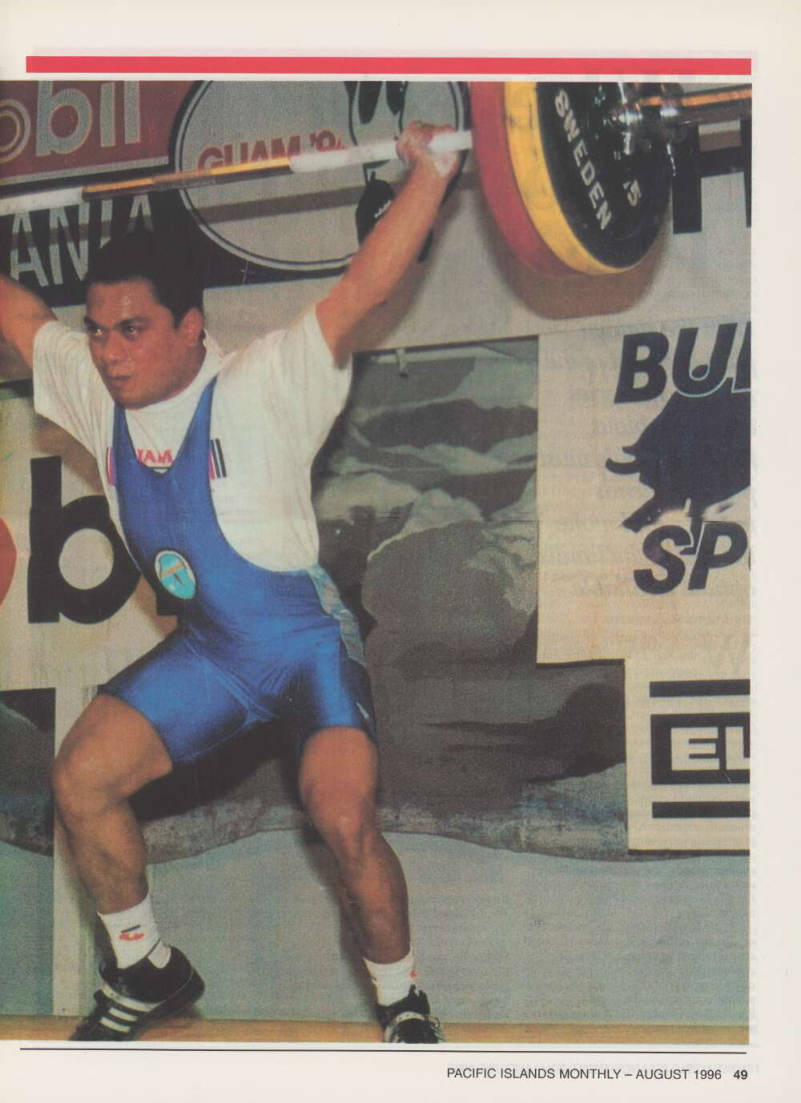
Marcus Stephen...raising Nauru’s hopes